



News:
Brokerage
Posted: June 23, 2026
SoHo emerges as America’s most active trophy retail market as investors prioritize quality, Adirondack Capital Partners finds
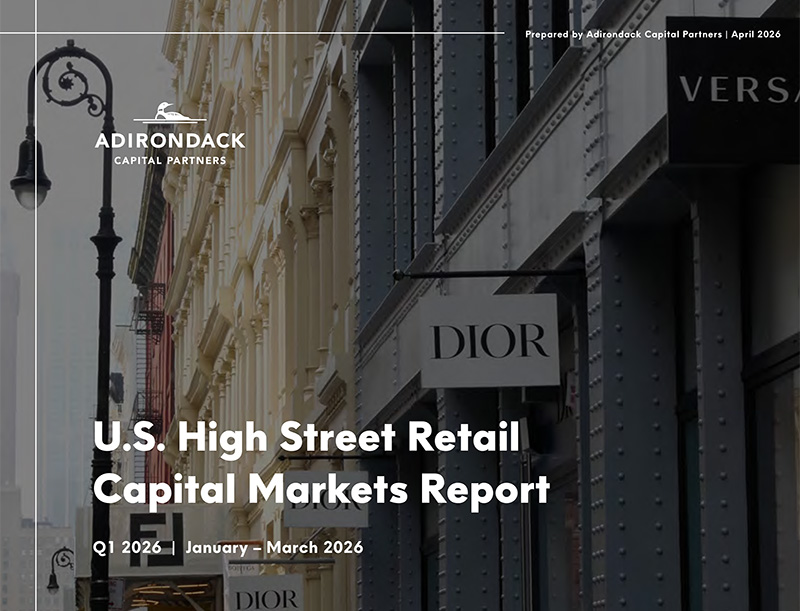
Manhattan, NY Investors are increasingly concentrating capital in the country’s most coveted retail corridors, with SoHo emerging as the nation’s most active trophy retail market, according to Adirondack Capital Partners’ (ACP) latest U.S. High Street Retail Capital Markets Report.
Drawing on transaction activity tracked during the firm’s most recent reporting period, ACP found that SoHo accounted for 43% of all trophy retail transactions nationwide, underscoring a broader shift toward quality and selectivity as buyers navigate an increasingly disciplined investment environment.
“The data points to a clear theme: capital remains available, but it’s increasingly concentrated in the country’s most desirable retail corridors,” said Michael Hunter Coghill, founder and managing partner of Adirondack Capital Partners. “Buyers are underwriting more carefully, but they continue to demonstrate tremendous conviction when it comes to premier assets occupied by enduring brands. Trophy retail has proven itself to be one of the most resilient and defensible sectors in commercial real estate. The market has entered a new phase defined by conviction rather than opportunism.”
ACP tracked 14 trophy retail transactions totaling more than $704 million in known volume across many of the country’s premier high street retail destinations, including SoHo and Madison Ave. in New York City, Williamsburg, Brooklyn, Palm Beach’s Worth Ave., Miami’s Design District and San Francisco’s Union Square. Of those transactions, six occurred in SoHo, representing more than $195 million in investment activity and accounting for 43% of all trophy retail trades nationwide.
The neighborhood’s investment momentum mirrors its leasing resurgence. According to REBNY, median asking rents along SoHo’s Broadway corridor climbed to $750 per s/f during the second half of 2025, a 24 percent increase from the first half of the year, as vacancy scarcity pushed rents to their highest levels in a decade.
Among the report’s key findings:
• Pricing resilience in trophy locations. Prime retail corridors continued to command premium valuations, with 120 Spring St. in SoHo trading for $8,043 per s/f, the highest price achieved nationally during the reporting period.
• More disciplined underwriting. Buyers remain active but are placing greater emphasis on tenant quality, lease durability, downside protection and market fundamentals.
• Continued conviction from private and international capital. Family offices, ultra-high-net-worth investors and overseas buyers remain active participants in the market.
• The rise of brand ownership. Nearly 30% of transactions tracked involved owner-users or affiliated brands acquiring their own locations, highlighting a growing preference among luxury retailers for permanence and control.
• Worth Ave.’s emergence as an institutional market. While representing just two transactions, Palm Beach accounted for approximately 35% of total transaction volume nationwide, underscoring the growing importance of South Florida among luxury retail investors.
“We continue to see investors prioritizing quality over quantity,” said Brittany Feinberg, partner at Adirondack Capital Partners. “Whether in SoHo, Palm Beach or other premier retail corridors, buyers are targeting assets with strong fundamentals and enduring appeal. Demand remains particularly robust among private and international capital with a long-term investment horizon.”
The report also highlights the growing influence of Japanese ultra-high-net-worth investors and family offices, whose patient approach and willingness to pursue off-market opportunities continue to shape the competitive landscape for trophy retail assets across the U.S.
ACP itself advised on two of the report’s benchmark transactions through discreet, off-market processes: the $18.5 million sale of 120 Spring St. in SoHo, which established the highest price per s/f achieved nationally during the reporting period, and the $43 million sale of 225 Worth Ave. in Palm Beach, which set a record for the highest price per s/fever paid for a Palm Beach retail asset exceeding 10,000 s/f.
The full U.S. High Street Retail Capital Markets Report is available at: https://adirondackcapitalpartners.com/q1report
MORE FROM Brokerage
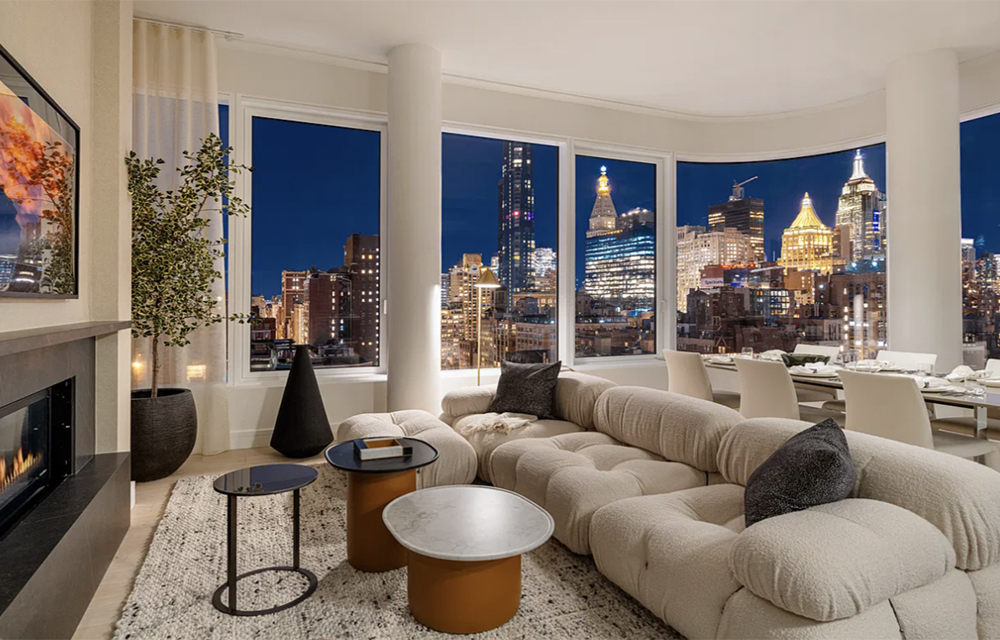
200E20TH sells out in Gramercy, penthouse A closes out sales at the CetraRuddy-designed condominium residences
Manhattan, NY 200E20TH, the CetraRuddy-designed architectural masterwork that brought a curved, contemporary sensibility to Gramercy’s Beaux-Arts streetscape, has




Quick Hits
 (2).gif)

Columns and Thought Leadership

New York’s streets are full again, and the retail numbers prove it - by Noam Aziz
Walk down any New York block this year and you can feel it. The sidewalks are crowded, the storefronts are lit, and the energy that defines this city is back at full volume.

Hunt commercial real estate question and answer: Fortune 500 wisdom - by David Hunt
Yes, there are lessons to be learned from the largest companies in America when comes to managing your real estate. But the decision to buy or lease real estate may not be one of

The art of investing in real estate - by Thomas Donovan
Real estate investing is as much an art as it is a skill. No one can time the market, or the factors that drive it, perfectly. Location, zoning, size, transportation, and neighborhood density give you a baseline for

Hunt CRE question and answer: Choosing a real estate agent - by David Hunt
First, we will only work with one agent exclusively. The primary reason is that we want that agent to legally represent our client’s interests. In New York State, a real estate agent has a fiduciary
.gif)