



News:
Brokerage
Posted: July 8, 2025
Tri-state capital migrates nationally amid regulation pressure - by Reese Weaver

New York tri-state multifamily investors are increasingly reallocating capital to less-regulated markets across the U.S. as rent control and legislative risk erode returns at home. With over 60% of New York City’s rental housing stock classified as rent-stabilized, the traditional value-add model — buying under-performing buildings, upgrading units, and raising rents — is now less viable. Investors face strict limits on rent increases, even after capital improvements, making it difficult to justify renovation costs.
The 2019 Housing Stability and Tenant Protection Act further curtailed landlord flexibility, limiting rent increases and vacancy bonuses. As a result, stabilized assets in New York City often trade at compressed cap rates with limited upside, while interest rates and operating costs have risen. Many institutional and mid-sized investors now view other United States markets as more attractive for capital deployment.
Nationwide, multifamily investment volume reached $28.8 billion in Q1 2025, up 33% year-over-year. New York tri-state firms contributed significantly to this growth, targeting markets in the Southeast, Midwest, Mountain West, and parts of the Mid-Atlantic — areas with no rent control and more favorable fundamentals.
With over $650 billion in multifamily debt maturing nationally by 2026, opportunities abound to recapitalize or acquire assets in growth markets where rents can adjust freely to reflect demand. The shift signals a long-term strategic pivot: New York tri-state investors are no longer just chasing yield — they’re avoiding regulation that caps upside and hinders reinvestment.
Reese Weaver is an associate in the national multifamily group of Besen Partners, Manhattan, N.Y.
Tags:
Brokerage
New York City
MORE FROM Brokerage
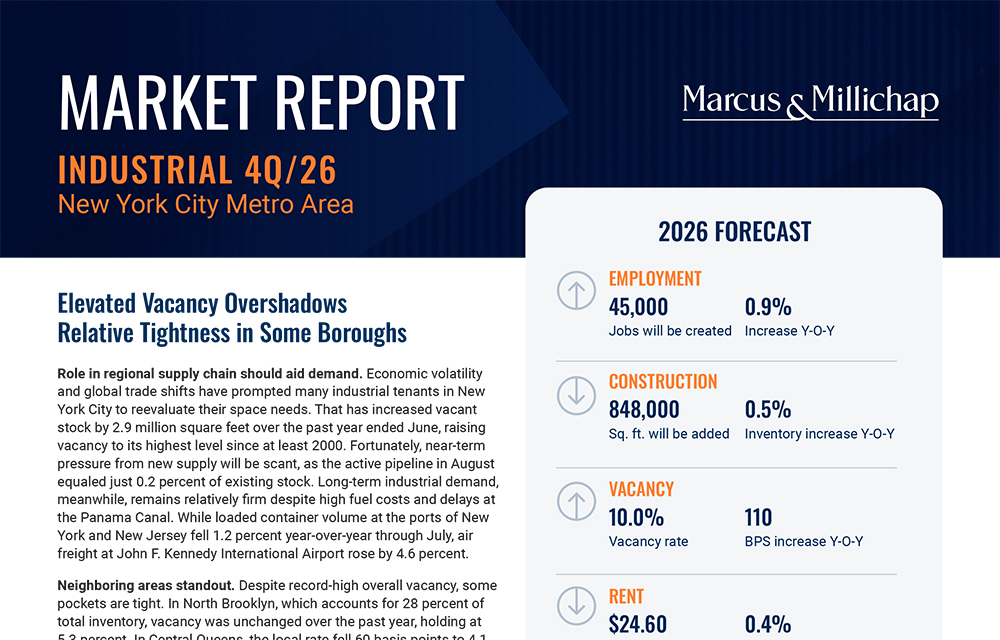
Marcus & Millichap releases fourth-quarter 2026 NYC industrial market report
Manhattan, NY Marcus & Millichap has published its fourth-quarter 2026 New York City Industrial Market Report. “New York City’s industrial market is showing a clear





Quick Hits
 (2).gif)

Columns and Thought Leadership

The art of investing in real estate - by Thomas Donovan
Real estate investing is as much an art as it is a skill. No one can time the market, or the factors that drive it, perfectly. Location, zoning, size, transportation, and neighborhood density give you a baseline for

New York’s streets are full again, and the retail numbers prove it - by Noam Aziz
Walk down any New York block this year and you can feel it. The sidewalks are crowded, the storefronts are lit, and the energy that defines this city is back at full volume.

Hunt CRE question and answer: Choosing a real estate agent - by David Hunt
First, we will only work with one agent exclusively. The primary reason is that we want that agent to legally represent our client’s interests. In New York State, a real estate agent has a fiduciary

Hunt commercial real estate question and answer: Fortune 500 wisdom - by David Hunt
Yes, there are lessons to be learned from the largest companies in America when comes to managing your real estate. But the decision to buy or lease real estate may not be one of
.gif)