



News:
Brokerage
Posted: April 17, 2018
Qualifying real property in a §1031 Exchange – Part 1 - by Pamela Michaels
Surprisingly, as real estate savvy as most investors are in the Northeast, some may not be aware of the requirement that both the relinquished property being sold–and the replacement property being purchased–must be “held for investment or productive use in a trade or business.” Note that after the 2017 Tax Act only real property interests can be exchanged as personal property no longer qualifies for Section 1031 tax deferral. So, what is the meaning of this phrase?
First, determining whether property is qualifying real property is a facts and circumstances test. Listed below are some of the factors that the IRS may consider to evaluate if a property was held for investment versus held for sale:
- The purpose for which the property was initially acquired;
- The purpose for which the property was subsequently held;
- The purpose for which the property was being held at the time of sale;
- The extent of advertising, promotion of other active efforts used in soliciting buyers for the sale of the property;
- The listing of property with brokers;
- The extent to which improvements, if any, were made to the property;
- The frequency, number and continuity of sales;
- The extent and nature of the transaction;
- The ordinary course of business of the taxpayer;
- How long the property has been owned.
Note that the opposite of holding property for investment is holding primarily for sale. Dealers, those who buy and “flip” and those that buy to fix up and quickly sell, generally hold primarily for sale purposes. Activities that an investor may not suspect could indicate an intent to hold for sale, which could taint the investor qualifying for 1031 tax deferral, can include listing the property for sale, negotiating contracts for sale, making substantial improvements to the property, rehabbing activities, and continuously buying and reselling property without investment activity during ownership.
On the contrary, investment activity includes leasing property, showing the property to prospective tenants, marketing the property for rent, collecting rents, maintaining property and reporting income and investment expenses on tax returns for one or ideally for more than one year.
Second, the holding period is not determinative in and of itself and there is no holding period set forth in the IRC that will guarantee that an investor has held for investment. As demonstrated in Allen v. U.S. 113 aff’d2. d 2014-2262 (2014), the intent of the taxpayer is more important than the length of the holding period. In Allen, the taxpayer owned the property for over 10 years but admitted that he originally acquired the property to develop it and resell it. He argued that, over the course of time, he changed his mind and decided not to develop the property, but continued to hold it “for investment” until he could sell it. However, the tax court found no evidence of when the taxpayer’s intent changed from holding for development to holding for long-term investment purposes. This outcome highlights the importance of taxpayers having enough documentation and objective facts to help support their intent to hold for investment in §1031 exchanges.
Although the intent with respect to a property can change over time, the intent during the period prior to the sale is critical. See, Tibbals v. United States, 362 F.2d 266, 273 (1966). The court determined in Allen that the taxpayer failed to show when, how, or why his intent changed.
Part 2 of this article will appear in the May 1st edition of the New York Real Estate Journal
Pamela Michaels, Esq., is sr. vice president with Asset Preservation, Inc., New York, N.Y.
Tags:
Brokerage
MORE FROM Brokerage
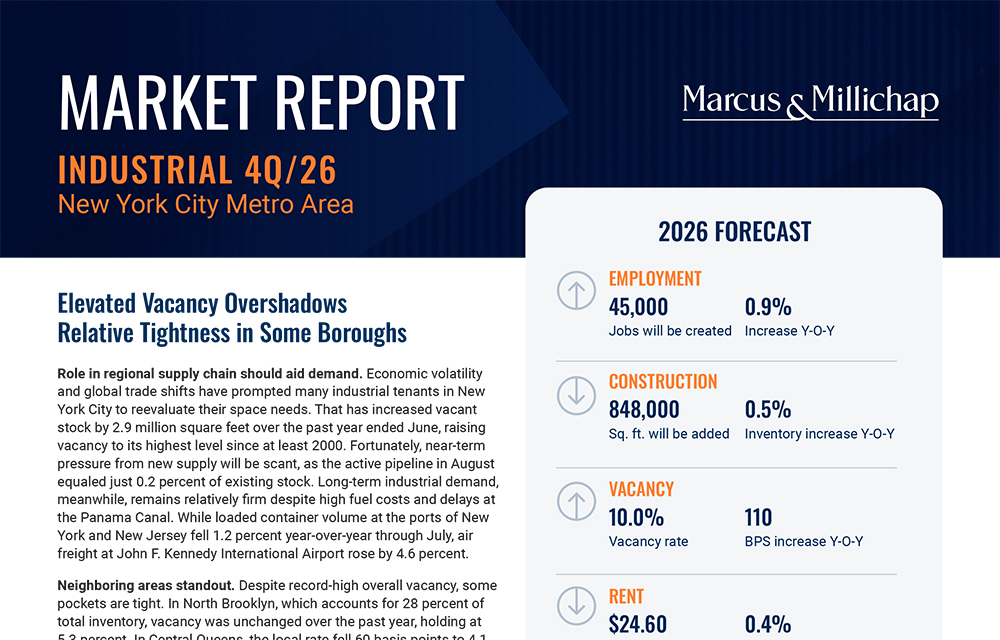
Marcus & Millichap releases fourth-quarter 2026 NYC industrial market report
Manhattan, NY Marcus & Millichap has published its fourth-quarter 2026 New York City Industrial Market Report. “New York City’s industrial market is showing a clear






 (2).gif)

Columns and Thought Leadership

Hunt CRE question and answer: Choosing a real estate agent - by David Hunt
First, we will only work with one agent exclusively. The primary reason is that we want that agent to legally represent our client’s interests. In New York State, a real estate agent has a fiduciary

New York’s streets are full again, and the retail numbers prove it - by Noam Aziz
Walk down any New York block this year and you can feel it. The sidewalks are crowded, the storefronts are lit, and the energy that defines this city is back at full volume.

The art of investing in real estate - by Thomas Donovan
Real estate investing is as much an art as it is a skill. No one can time the market, or the factors that drive it, perfectly. Location, zoning, size, transportation, and neighborhood density give you a baseline for

Hunt commercial real estate question and answer: Fortune 500 wisdom - by David Hunt
Yes, there are lessons to be learned from the largest companies in America when comes to managing your real estate. But the decision to buy or lease real estate may not be one of
.gif)