



News:
Brokerage
Posted: June 10, 2025
Pickard Chilton's T3 RiNo receives 2025 wood in architecture award from WoodWorks
Denver, CO According to Pickard Chilton, an award-winning architecture studio best known for its innovative and cutting-edge design of corporate headquarters and campuses, T3 RiNo, a six-story mass timber, Class-A, mixed-use office building at 3500 Blake Street, has won a 2025 Wood in Architecture award from WoodWorks – Wood Products Council. The award was presented at a reception alongside the 2025 AIA Conference on Architecture & Design in Boston on June 5.
WoodWorks, a non-profit known for supporting innovative wood design, helps developers and design teams use wood successfully in commercial and multi-family construction. It is also a leading provider of continuing education to design and building professionals across the U.S. The Wood in Architecture awards recognize excellence in mass timber, light-frame wood, and hybrid building design, celebrating design teams using wood in innovative ways to positively impact the environment, occupants, and their communities. Entries were reviewed by a jury of industry peers and judged on a number of criteria, including design excellence, innovative use of wood, sustainability and resilience, and market impact.
T3 RiNo was developed by the collaboration of Hines, McCaffery, and Ivanhoé Cambridge, the real estate group of CDPQ. The “T3” stands for Timber, Transit, and Technology, elements woven into the building with timber design, proximity to multiple transit options, and digital building systems focused on the expectations of today’s tenants.
“We are thrilled for T3 RiNo to be recognized with a 2025 Wood in Architecture award from WoodWorks. An overarching team goal was to maximize and express the exposed wood. As such, the building’s high-performance, transparent façade was designed to maximize exposure of the full timber structure from both the interior and exterior,” said Michael Hensley AIA, a principal at Pickard Chilton.
Built using Type IV-HT construction, the timber structural system gives T3 RiNo its character. A glulam post-and-beam frame supports concrete-topped cross-laminated timber (CLT) panels, engineered to reduce vibration and enhance acoustic performance. The timber grid provides efficient structural spans, optimizing wood fiber while adding flexibility for tenant layouts. Rigorous coordination between the optimized structure and MEP systems allows the wood expression to shine through. All timber utilized was sourced from supplier Nordic Structures and manufactured by Chantiers Chibougamau in Québec, Canada.
The building offers 239,000 s/f of office and 19,000 s/f of retail space designed to foster creativity, collaboration, and a healthy work-life balance. Pickard Chilton’s forward-thinking design features numerous open terraces and a variety of amenity spaces, including social areas and a modern fitness and bicycle facility.
The entirety of the building’s office space, more than 220,000 s/f, has been pre-leased by Xcel Energy Colorado, making it the largest office tenant in the RiNo submarket.. The floor-to-ceiling windows offer views of Denver’s natural landmarks, while the outdoor terraces break down the building’s mass to provide tenants with multiple private outdoor experiences. Pickard Chilton’s design combines natural light and sculpture, emphasizing occupants’ connection to nature through both form and materiality.
T3 RiNo has emerged as a standout in contemporary sustainable design. Its carbon-negative mass timber structure is 100% renewable, recyclable, and non-toxic. The building contains 188,000 cubic feet of mass timber, sequesters 4,155 metric tons of CO2, saving an additional 1,608 metric tons of CO2 and using 38% less embodied carbon than if constructed conventionally. Construction and manufacturing processes represent a greenhouse gas reduction equivalent to taking 1,218 cars off the road for one year. T3 RiNo is LEED-CS Gold, WELL Silver v2-Pilot Core Office, and Energy Star certified, with WELL Health-Safety certification pending.
Tags:
Brokerage
MORE FROM Brokerage
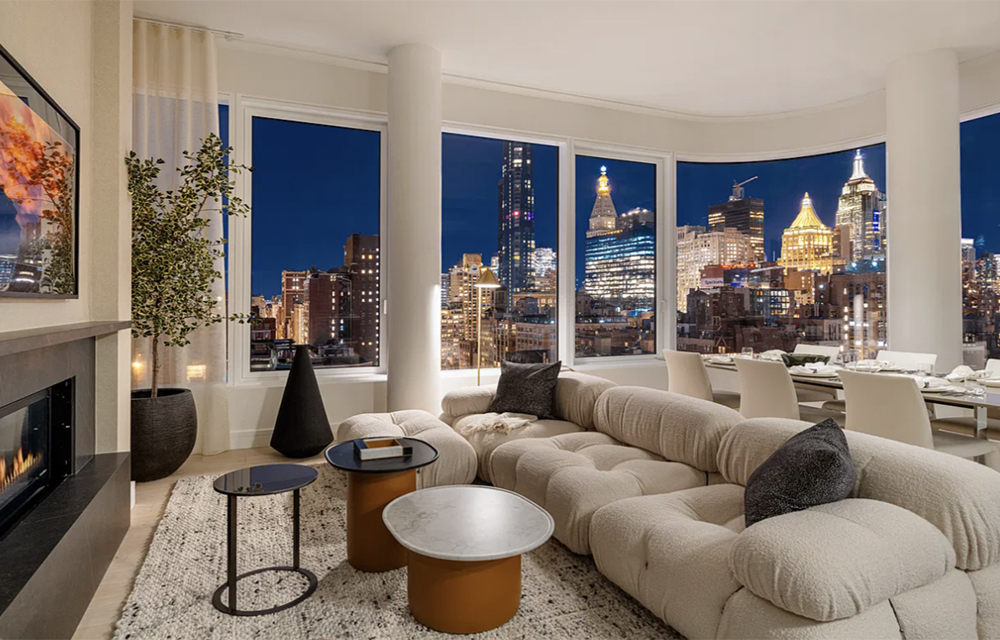
200E20TH sells out in Gramercy, penthouse A closes out sales at the CetraRuddy-designed condominium residences
Manhattan, NY 200E20TH, the CetraRuddy-designed architectural masterwork that brought a curved, contemporary sensibility to Gramercy’s Beaux-Arts streetscape, has



Quick Hits
 (2).gif)

Columns and Thought Leadership

New York’s streets are full again, and the retail numbers prove it - by Noam Aziz
Walk down any New York block this year and you can feel it. The sidewalks are crowded, the storefronts are lit, and the energy that defines this city is back at full volume.

The art of investing in real estate - by Thomas Donovan
Real estate investing is as much an art as it is a skill. No one can time the market, or the factors that drive it, perfectly. Location, zoning, size, transportation, and neighborhood density give you a baseline for

Hunt commercial real estate question and answer: Fortune 500 wisdom - by David Hunt
Yes, there are lessons to be learned from the largest companies in America when comes to managing your real estate. But the decision to buy or lease real estate may not be one of

Hunt CRE question and answer: Choosing a real estate agent - by David Hunt
First, we will only work with one agent exclusively. The primary reason is that we want that agent to legally represent our client’s interests. In New York State, a real estate agent has a fiduciary
.gif)