



News:
Brokerage
Posted: April 3, 2018
It is never too early to prepare for a 1031 Exchange - by David Feeser
It is never too early to prepare for a 1031 exchange. There are many options that should be considered when planning for an exchange. Advance planning can help the process go smoother and provide better results for the exchanger. The financial, legal and accounting aspects of the transaction should be considered prior to the sale of the relinquished property. The involvement of the exchanger’s financial, accounting and legal professionals is highly recommended to establish such a plan to achieve the goals of the exchanger. Furthermore, the exchanger will need to engage the services of a qualified intermediary to prepare the 1031 documentation in compliance with the tax code.
To maximize the tax deferral, the exchanger must (a) buy a replacement property that is the same price or greater than the relinquished property (net of direct selling expenses) and (b) use all the cash proceeds from the sale of the relinquished property towards the purchase of the replacement property. Any trade down in value, whether cash withdrawn or financing that is not replaced, will likely trigger some tax ramifications as a partial, but still valid, exchange.
Besides the obvious monetary benefits of deferring the capital gains tax, many times asset quality, market conditions and quality of life factors can drive the exchange. Some exchangers desire to have less intensive management and seek to consolidate properties into a larger property, or even reinvest in a net lease property shifting the burdens of ownership to the tenants. Other times, exchangers seek to exit or diversify out of a market or location that may be limited in upside potential or ripe for a downturn. The exchange could also be motivated by estate planning or meeting a retirement expectation. There are many scenarios that an exchanger can bring to the table that can be addressed through the 1031 exchange process to meet their goals.
Exchangers must evaluate the benefits of an exchange versus a traditional taxable sale. In order to justify the tax benefits, the exchanger must have a grasp on the potential tax implications of the transaction. Ultimately, the primary driver is whether there is enough taxable gain being deferred to justify structuring an exchange? The financial information necessary to assess the benefits includes adjusted basis, capital gains, tax exposure, equity, and debt. A 1031 exchange requires the use of the equity, as well as a requirement to take out an equal amount of debt as was paid off on the relinquished property (or replacing that amount with new cash), to re-invest in the replacement property. The deferral of tax provides the exchanger the ability to purchase replacement property with funds that would have otherwise been paid as capital gains tax on a sale of the property. Furthermore, the exchanger can potentially leverage such funds to substantially increase their purchasing power and wealth building potential. The results of these calculations will provide the exchanger with the insight necessary as to the merits of a 1031 exchange.
The ownership structure of the property to be relinquished is a critical factor in the exchange process. The basic rule is that the taxpayer selling the relinquished property must, with limited exceptions, be the taxpayer acquiring the replacement property. A simple way to view this requirement is that the tax identification number should be the same for both sides of the exchange transaction. Some of the commonly used exceptions to this rule include the use of disregarded entities, such as single member LLCs or revocable trusts. The ownership structure should be fully vetted with the exchanger’s tax advisor prior to the exchange process.
The replacement property options may not be completely obvious to the exchanger and the involvement of a realtor with 1031 experience and a qualified intermediary can be invaluable to meeting the desired goals. The replacement property, like the relinquished property, must be a property used in a trade or business, or held for investment intent, to qualify for a 1031 exchange. The types of replacement property that most exchangers will think of first will usually include multi-family, retail, raw land and commercial property types. The qualified replacement property options they may not be aware of include tenancies in common (TIC), Delaware Statutory Trusts (DST), or triple net lease properties. A common trait of these non-traditional options is that they offer an elimination of management responsibilities and an income stream that can be used for a stress reduced retirement and is easily divided for heirs as an estate planning option. Acquiring a typical triple net lease property usually starts in the $1 million range and goes up from there, whereas TICs and DSTs provide flexibility as to the amount necessary for investment which can be as little as $100,000.
In conclusion, by planning ahead the exchanger can potentially explore numerous options that will maximize the benefits of a 1031 exchange that satisfy their goal. It can be important to have financial and legal advisors involved in the early stages to provide the information necessary for the exchanger to make informed decisions on the 1031 exchange options. In addition, a savvy realtor along with a supportive qualified intermediary can be instrumental in structuring a successful 1031 exchange.
David Feeser, Esq., is exchange director at Legal 1031 Exchange Services, Inc., New York, NY.
Tags:
Brokerage
MORE FROM Brokerage
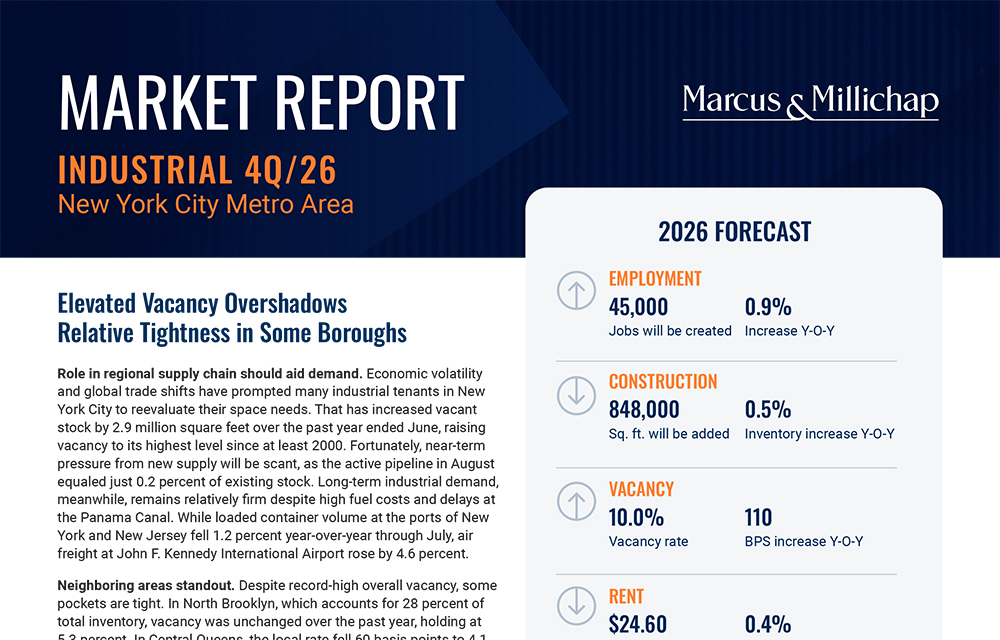
Marcus & Millichap releases fourth-quarter 2026 NYC industrial market report
Manhattan, NY Marcus & Millichap has published its fourth-quarter 2026 New York City Industrial Market Report. “New York City’s industrial market is showing a clear





Quick Hits
 (2).gif)

Columns and Thought Leadership

Hunt commercial real estate question and answer: Fortune 500 wisdom - by David Hunt
Yes, there are lessons to be learned from the largest companies in America when comes to managing your real estate. But the decision to buy or lease real estate may not be one of

Hunt CRE question and answer: Choosing a real estate agent - by David Hunt
First, we will only work with one agent exclusively. The primary reason is that we want that agent to legally represent our client’s interests. In New York State, a real estate agent has a fiduciary

New York’s streets are full again, and the retail numbers prove it - by Noam Aziz
Walk down any New York block this year and you can feel it. The sidewalks are crowded, the storefronts are lit, and the energy that defines this city is back at full volume.

The art of investing in real estate - by Thomas Donovan
Real estate investing is as much an art as it is a skill. No one can time the market, or the factors that drive it, perfectly. Location, zoning, size, transportation, and neighborhood density give you a baseline for
.gif)