



News:
Brokerage
Posted: August 26, 2025
Why Long Island City’s “One LIC” rezoning could hurt property values - by Cole Kinney Leonhardt

The recent “One LIC” rezoning proposal — a sweeping land-use change aimed at boosting housing production in Long Island City — has sparked growing concern among property owners, as all upzoned sites will be subject to Mandatory Inclusionary Housing (MIH). While the initiative is framed as a tool for affordability and growth, its implementation could depress property values for many private owners caught in the rezoning footprint.
The Core Issue: MIH’s Burden on Value
Under MIH, developers must set aside a portion (typically 20–30%) of residential units as permanently affordable, often at below-market rents. While this policy aims to expand housing access, it also significantly reduces the revenue potential of a development — a critical factor in how land is valued.
For small and mid-sized property owners who might have sold to a developer, this affordability mandate can shrink what buyers are willing to pay, especially when combined with heightened interest rates and rising construction costs.
Just as importantly, MIH prevents developers from building high-end, luxury condo projects — a product type that often justifies premium land prices in upzoned areas like Long Island City. Without the ability to pursue luxury condo strategies, developers lose a key path to maximizing return on investment, making many MIH-designated sites far less attractive.
Loss of Market Flexibility
Unlike voluntary inclusionary zoning, MIH is mandatory and binding — there’s no opt-out. This rigidity means that even if the economics don’t work, developers still must comply. As a result, many owners of newly upzoned sites find themselves with “paper density” (more allowable height or FAR), but lower real-world value because the mandated affordability erodes profit margins.
Uneven Impact Across LIC
The proposed rezoning affects a broad swath of Long Island City, but the impact won’t be uniform. Commercial or industrial-zoned sites may benefit from more zoning flexibility, opening the door to residential development where it was previously restricted. However, existing residentially zoned sites — particularly those that could have been marketed for luxury condo development — will see no added flexibility under the new framework.
Instead, these sites will now be subject to MIH, forcing developers to include affordable units and making luxury condo development financially unfeasible. As a result, owners of these properties may find themselves locked into lower land valuations, with the only viable buyers being those pursuing MIH rental projects with thinner margins. In many cases, what appears to be an upzoning may actually erode value by removing optionality and narrowing the buyer pool.
The Takeaway
While well-intentioned, the “One LIC” rezoning plan risks unintended consequences: by applying MIH mandates broadly, it may devalue private property, reduce site liquidity, and chill interest from potential buyers and developers. Owners should stay informed, speak with planners, and consider advocacy — because not all “upzoning” leads to upside.
Cole Kinney Leonhardt, is an investment sales associate with Brax Realty, Manhattan, N.Y.
Tags:
Brokerage
MORE FROM Brokerage
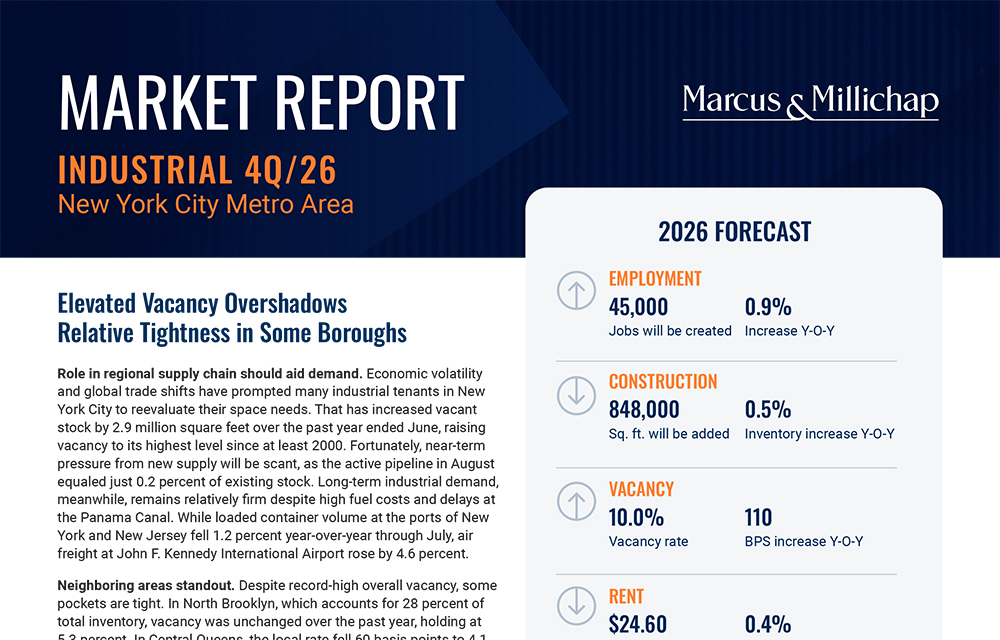
Marcus & Millichap releases fourth-quarter 2026 NYC industrial market report
Manhattan, NY Marcus & Millichap has published its fourth-quarter 2026 New York City Industrial Market Report. “New York City’s industrial market is showing a clear





Quick Hits

Columns and Thought Leadership

New York’s streets are full again, and the retail numbers prove it - by Noam Aziz
Walk down any New York block this year and you can feel it. The sidewalks are crowded, the storefronts are lit, and the energy that defines this city is back at full volume.

Hunt CRE question and answer: Choosing a real estate agent - by David Hunt
First, we will only work with one agent exclusively. The primary reason is that we want that agent to legally represent our client’s interests. In New York State, a real estate agent has a fiduciary

The art of investing in real estate - by Thomas Donovan
Real estate investing is as much an art as it is a skill. No one can time the market, or the factors that drive it, perfectly. Location, zoning, size, transportation, and neighborhood density give you a baseline for

Hunt commercial real estate question and answer: Fortune 500 wisdom - by David Hunt
Yes, there are lessons to be learned from the largest companies in America when comes to managing your real estate. But the decision to buy or lease real estate may not be one of
.gif)