



News:
Brokerage
Posted: December 17, 2019
REBNY releases 2019 Manhattan Retail Report
Manhattan, NY The Real Estate Board of New York’s (REBNY) has released its fall 2019 Manhattan Retail Report.The report found that average asking rents per s/f fell in many of the borough’s retail corridors in a continuation of a multi-year market correction. Out of the 17 major corridors analyzed by REBNY, 11 experienced year-over-year decreases in asking rent per s/f.
The area’s retail market continues to adjust to changing market trends. High asking rents continue to drop, resulting in an uptick in year-over-year leasing activity.
REBNY’s Manhattan Retail Report Advisory Group advised that retailers are becoming increasingly innovative in their utilization of brick-and-mortar spaces. As traditional storefront retail leases dip, retailers are emphasizing unique, in-person experiences such as pop-ups and promotional spaces to complement online and marketing efforts. The report also found that retailers are creating daytime co-working spaces and bookstore cafés to create modern storefronts to satisfy new consumer demand.
“Our report found that declining rents present opportunities for a growing number of pop-up and experiential storefronts. Prospective long-term tenants remain selective, yet activity continues to be strong in today’s market,” said James Whelan, REBNY president.
The retail market outlook remains positive with new operators entering the market with heightened interest in retail spaces. New experiential concepts will continue to buoy the market moving forward.
Highlights from the report:
In SoHo on Broadway (between Houston and Broome Sts.), average asking rents declined 12% year-over-year to $491 per s/f. The area is witnessing increased pop-up activity and digitally native brands experimenting with retail space as rents adjust from the post-recession period, when rents nearly doubled to historic peaks. Complications in the area stem from restrictive zoning that limits food/beverage uses in the corridor as well as its composition of loft buildings with large retail spaces that are difficult to subdivide.
Asking rents on Columbus Ave.between 66th and 79th Sts. remained flat year-over-year at $298 per s/f. Columbus Ave. is a self-contained, tight market with low availability and it is viewed as a destination for branded retailers and smaller storefronts alike due to high residential foot traffic.
In lower Fifth Ave. between 42nd and 49th Sts., asking rents declined 9% year-over-year to $852 per s/f. REBNY attributes this drop to an increased amount of available spaces, with high-end apparel leaving the corridor in favor of emerging downtown strips. Upper Fifth Ave. between 49th and 59th Sts. also experienced a 5% year-over-year decline to $2,838 psf. Asking rents are expected to continue to decrease.
On West 34th St. between Fifth and Seventh Aves., average asking rents declined 8% year-over-year to $528 per s/f. By contrast, asking rents in Times Sq. on Broadway and Seventh Ave. (between 42nd and 47th Sts.) increased 2% year-over-year to $1,889. Herald Sq. represents a more challenging retail environment than Times Sq., though, despite recent closings, the outlook in Herald Sq. remains positive with new recent leases.
On East 86th St. between Lexington and 2nd Aves., average asking rents declined 11% to $327 per s/f due to a lack of available prime retail space. Asking rents had recently inflated artificially due to prominent leases from Old Navy and JP Morgan Chase, with the market now correcting itself.
Tags:
Brokerage
MORE FROM Brokerage
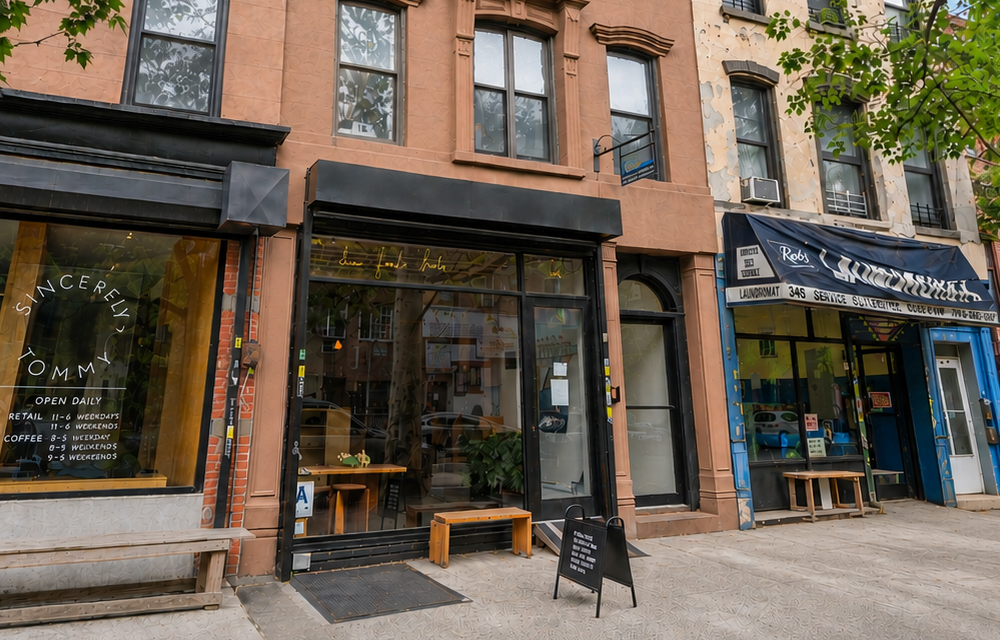
Bestreich, Reynolds, Davila, and Flaherty of Investment Property Realty Group close $1.97 million sale of 343A Tompkins Ave. in Bed-Stuy
Brooklyn, NY Investment Property Realty Group (IPRG) closed the sale of 343A Tompkins Ave., a mixed-use building located in the Bed-Stuy section of the borough, for $1.97 million.



Columns and Thought Leadership

Hunt commercial real estate question and answer: Fortune 500 wisdom - by David Hunt
Yes, there are lessons to be learned from the largest companies in America when comes to managing your real estate. But the decision to buy or lease real estate may not be one of

Hunt CRE question and answer: Choosing a real estate agent - by David Hunt
First, we will only work with one agent exclusively. The primary reason is that we want that agent to legally represent our client’s interests. In New York State, a real estate agent has a fiduciary

A guide to finding the right NYC property management company - by Sanjay Gandhi
Being a small to midsize landlord in NYC is an increasingly demanding endeavor. From navigating complex regulations, increased compliance demands to dealing with tenant issues and remediating violations. It is wise to enlist the assistance of a partner, a professional

New York’s streets are full again, and the retail numbers prove it - by Noam Aziz
Walk down any New York block this year and you can feel it. The sidewalks are crowded, the storefronts are lit, and the energy that defines this city is back at full volume.
.gif)