



News:
Brokerage
Posted: August 26, 2025
Lasting effects of eminent domain on commercial development - by Sebastian Jablonski

The state has the authority to seize all or part of privately owned commercial real estate for public use by the power of eminent domain. Although the state is constitutionally required to provide just compensation to the property owner, it frequently fails to account for the property’s future development potential and the lasting impact the taking may have on its prospective use.
A partial taking of a commercial real estate property can create a ripple effect, which could dramatically alter the usability of the remaining land. The remainder may fall out of compliance with local zoning codes, including setbacks, parking minimums, and lot size requirements. When the state’s taking causes such violations, the property owner may be forced to seek variances, either to bring the remaining property back into compliance or to pursue future development plans.
For example, if the state takes a narrow strip of land located alongside the frontage of the property to widen a road, the remaining parcel may no longer comply with local codes. This seemingly minor taking can significantly hinder future development or expansion unless the property owner is able to bring the property back into compliance.
If your property is at risk of being taken by the state, it is essential to consult with an attorney to fully understand the potential consequences. Even a minor taking can have major implications for future development. Understanding the full impact is crucial to ensuring that you, as the property owner, are properly compensated by the state and that the remaining property is still usable and can still be developed in the future.
Sebastian Jablonski is an associate at Forchelli Deegan Terrana LLP, Uniondale, N.Y.
Tags:
Brokerage
Long Island
MORE FROM Brokerage
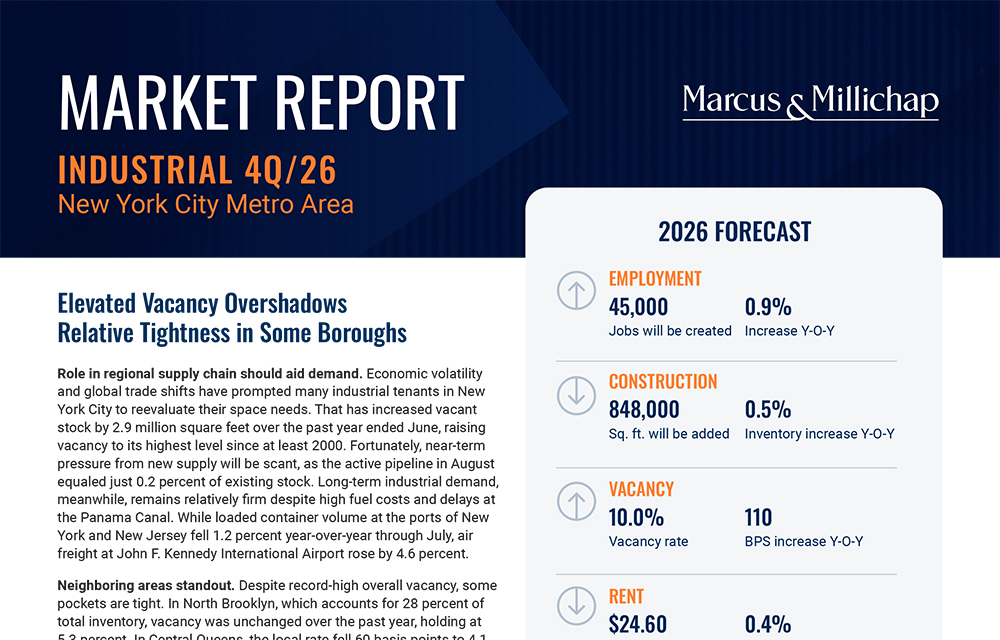
Marcus & Millichap releases fourth-quarter 2026 NYC industrial market report
Manhattan, NY Marcus & Millichap has published its fourth-quarter 2026 New York City Industrial Market Report. “New York City’s industrial market is showing a clear



Quick Hits

Columns and Thought Leadership

Hunt commercial real estate question and answer: Fortune 500 wisdom - by David Hunt
Yes, there are lessons to be learned from the largest companies in America when comes to managing your real estate. But the decision to buy or lease real estate may not be one of

Hunt CRE question and answer: Choosing a real estate agent - by David Hunt
First, we will only work with one agent exclusively. The primary reason is that we want that agent to legally represent our client’s interests. In New York State, a real estate agent has a fiduciary

The art of investing in real estate - by Thomas Donovan
Real estate investing is as much an art as it is a skill. No one can time the market, or the factors that drive it, perfectly. Location, zoning, size, transportation, and neighborhood density give you a baseline for

New York’s streets are full again, and the retail numbers prove it - by Noam Aziz
Walk down any New York block this year and you can feel it. The sidewalks are crowded, the storefronts are lit, and the energy that defines this city is back at full volume.
.gif)