



News:
Brokerage
Posted: May 28, 2026
Mesa West Capital originates $43.8 million loan for industrial park refinance in Martinsburg, WV.
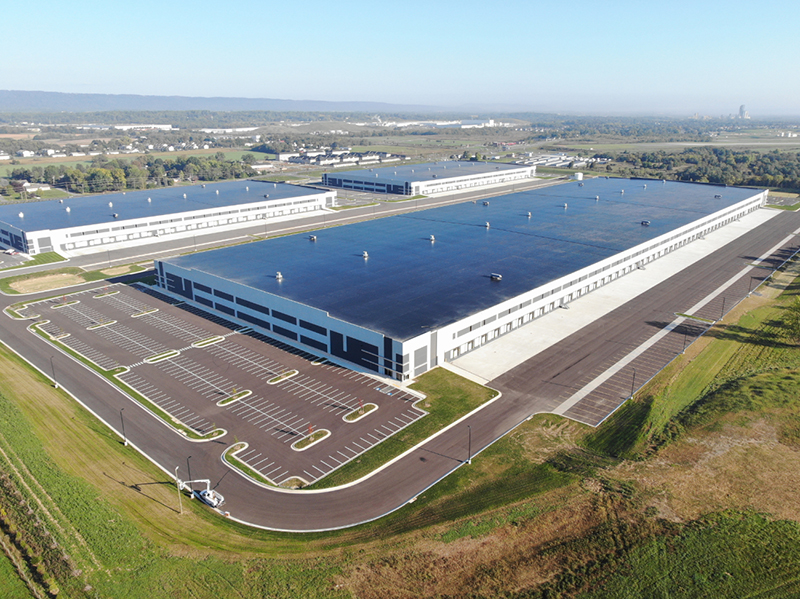
Martinsburg, WV Mesa West Capital has provided a joint venture between affiliates of Hines and MetLife Investment Management with a $43.8 million five-year, first mortgage loan to refinance two Class A industrial buildings totaling 730,800 s/f. Pamir Niaz, executive director at Mesa West Capital, led the New York–based origination team.
Delivered in early 2023, the buildings each total 365,400 s/f and are located at 4903 and 5115 Winchester Ave. on a 69.8-acre site. The cross-docked facilities feature 40-ft. clear heights, 90 dock doors, 136 trailer spaces and access to at least 4,000 amps of power. The two buildings, one fully leased to packaging manufacturer Treplar Inc, and the other vacant, represent the first phase of Tabler Station Logistics Park, a two-phase development totaling 1.6 million s/f of modern, bulk distribution space
The buildings are accessible to I-81, one of the East Coast’s most critical north–south logistics corridors and provides connectivity to more than 50 million consumers within a five-hour drive. The location offers efficient access to major Mid Atlantic and Northeast population centers, including Washington, D.C., Baltimore, Richmond, Pittsburgh, Philadelphia, and New York. The Port of Baltimore and Washington Dulles International Airport are both within a 90 minute drive, supporting regional and global distribution capabilities.
“The properties benefit from desirable Class A specifications and quality ownership and are well positioned within a key growth corridor along I-81,” said Niaz. “The market continues to benefit from increasing tenant demand flowing westward as industrial users expand beyond Northern Virginia, where supply has been constrained by data center development.”
The financing was arranged by John Alascio, TJ Sullivan and Aaron Graves out of Cushman & Wakefield’s New York and Philadelphia offices.
MORE FROM Brokerage

Marcus & Millichap releases fourth-quarter 2026 NYC industrial market report
Manhattan, NY Marcus & Millichap has published its fourth-quarter 2026 New York City Industrial Market Report. “New York City’s industrial market is showing a clear




Quick Hits
 (2).gif)

Columns and Thought Leadership

Hunt commercial real estate question and answer: Fortune 500 wisdom - by David Hunt
Yes, there are lessons to be learned from the largest companies in America when comes to managing your real estate. But the decision to buy or lease real estate may not be one of

Hunt CRE question and answer: Choosing a real estate agent - by David Hunt
First, we will only work with one agent exclusively. The primary reason is that we want that agent to legally represent our client’s interests. In New York State, a real estate agent has a fiduciary

The art of investing in real estate - by Thomas Donovan
Real estate investing is as much an art as it is a skill. No one can time the market, or the factors that drive it, perfectly. Location, zoning, size, transportation, and neighborhood density give you a baseline for

New York’s streets are full again, and the retail numbers prove it - by Noam Aziz
Walk down any New York block this year and you can feel it. The sidewalks are crowded, the storefronts are lit, and the energy that defines this city is back at full volume.
.gif)