



News:
Brokerage
Posted: September 1, 2016
Fitzsimons of Cushman & Wakefield reps Novatus Energy and Lenchner in-house reps William Kaufman Organization in 3,353 s/f lease at 767 Third Avenue
New York, NY In a move that continues the success of the William Kaufman Organization’s (WKO) pre-built leasing program, energy company Novatus Energy LLC, a portfolio company of the Infrastructure Investment Fund (IIF), has signed a five-year leasing transaction at 767 Third Ave. in Midtown East.
The lease encompasses 3,353 s/f of high-end, pre-built space on a portion of the 17th floor at the 40-story, 296,000 s/f building, which is located between East 47th and East 48th Sts.
John Fitzsimons of Cushman & Wakefield represented Novatus Energy, while Michael Lenchner, vice president & director of leasing of Sage Realty Corporation, the leasing and management division of WKO, represented ownership in-house. Asking rents at the property range from $66 to $81 per rentable s/f.
The new lease for Novatus Energy also follows the launch of WKO’s short-form leasing program, a new initiative aimed at expediting and streamlining the office leasing process for small- to mid-sized tenants. Over the last few weeks, Sage has completed more than 10,000 rentable s/f of new transactions through this new program, including: Libra (2,582 rentable s/f), Athena Communication (1,648 rentable s/f), Straus Asset (200 rentable s/f), Goldman Capital (1,500 rentable s/f) and Legend Advanced Funding (3,586 rentable s/f).
“Our building at 767 Third Ave. has been extremely well received in the marketplace as evidenced by our successful leasing campaign,” Lenchner said, noting that only one 3,702 s/f pre-built unit remains available on the 17th floor. “We look forward to more exciting leasing announcements in the coming months.”
In addition, WKO has officially completed its brand-new, $3.1 million amenity center and outdoor sundeck. The new amenity area includes a sundeck with lush landscaping and movable tables and chairs, as well as a new, original amenity for a Manhattan commercial office building – a dropdown movie screen. Inside, a state-of-the-art tenant lounge is available for daily use by all tenants of the building, featuring a communal meeting space, large boardroom, flat-screen TVs, couches and a kitchenette/pantry.
Earlier in the year, building ownership has completed an elevator modernization, upgrades to the lobby, common corridors and rest rooms, as well as the refinishing of the building’s oak façade and tables and benches in the plaza area, which is known for its iconic three-story high chess board.
Constructed in 1981, the sinuous tower at 767 Third Ave. is long-regarded as a premier property in the Midtown East marketplace. Built with a unique mix of oak and brick, the building features one-of-a-kind elements and public amenities, including an open plaza area with wooden benches and tables, a 1929-era Ford truck and a three-story high chess board.
Tags:
Brokerage
MORE FROM Brokerage
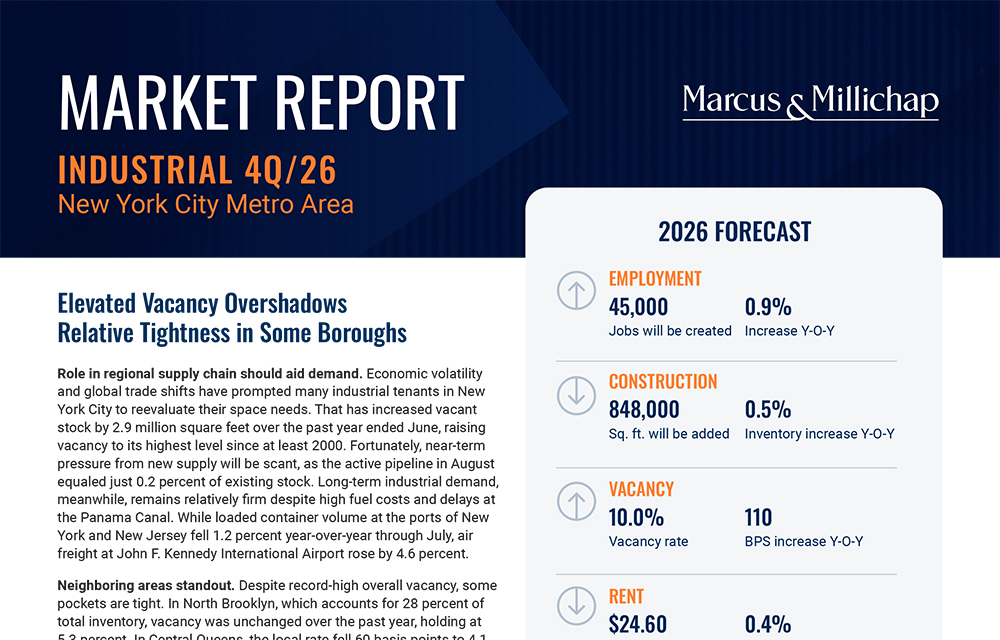
Marcus & Millichap releases fourth-quarter 2026 NYC industrial market report
Manhattan, NY Marcus & Millichap has published its fourth-quarter 2026 New York City Industrial Market Report. “New York City’s industrial market is showing a clear





Quick Hits
 (2).gif)

Columns and Thought Leadership

Hunt CRE question and answer: Choosing a real estate agent - by David Hunt
First, we will only work with one agent exclusively. The primary reason is that we want that agent to legally represent our client’s interests. In New York State, a real estate agent has a fiduciary

The art of investing in real estate - by Thomas Donovan
Real estate investing is as much an art as it is a skill. No one can time the market, or the factors that drive it, perfectly. Location, zoning, size, transportation, and neighborhood density give you a baseline for

New York’s streets are full again, and the retail numbers prove it - by Noam Aziz
Walk down any New York block this year and you can feel it. The sidewalks are crowded, the storefronts are lit, and the energy that defines this city is back at full volume.

Hunt commercial real estate question and answer: Fortune 500 wisdom - by David Hunt
Yes, there are lessons to be learned from the largest companies in America when comes to managing your real estate. But the decision to buy or lease real estate may not be one of
.gif)