



News:
Brokerage
Posted: October 4, 2016
Executive of the Month: Question and answer session with Jane Lyons, managing partner of Rhodes Associates
 Jane Lyons, Rhodes Associates
New York, NY Jane Lyons is a managing partner of Rhodes Associates. During her more than 25-year career in executive search and organizational consulting, Lyons has completed more than 700 search and consulting assignments, specializing in the real estate industry, globally. Lyons has assisted many of the world’s leading real estate companies including banking, commercial lending, investment, and private and public owner/developers in recruiting their most successful executives. Earlier in her career, she worked in marketing and sales for the Wharton Business School and CBS, Inc. She serves as the Americas regional leader for IRC Global Executive Search Partners and previously served as the co-president for Commercial Real Estate Women New York in 2015. Lyons is a member of the Urban Land Institute, Pension Real Estate Association, and Mortgage Bankers Association.
Rhodes Associates has a singular mission – the success of their clients and maximizing return on investment in human capital. Founded in 1969, they specialize in representing firms in most major sectors and disciplines within the global real estate industry. Throughout their 40+ years of experience in executive search, organizational and strategic consulting, they have consistently demonstrated skill at building high performance teams for some of the world’s leading real estate companies. Together, Rhodes’ partners have more than 100 years of real estate and executive search experience and are involved in all aspects of the search/consulting process. The firm’s client-centered focus and attention to return on investment, leads to industry leading assignment completion and retention rates.
Lyons recently sat down with the New York Real Estate Journal for a question and answer session.
 Jane Lyons and Steven Littman of Rhodes Associates during a visit to Istanbul
Q. In your role as a managing partner at Rhodes Associates, one of the world’s leading search/consulting firms specializing in the real estate industry, what do you see as the macro issue impacting today’s industry?
A. There is no doubt that the number one issue is tight credit and projects that should be happening are paralyzed due to this. Case in point, the CMBS market is so tight that origination is down 40%. New sources of capital have to be utilized but in many cases, would-be borrowers cannot accept the increased cost of these alternative debt sources.
Q. Where are the banks in all of this?
A. The banks are exceptionally cautious. They believe there is great risk in placing bundled loans into securitized packages. And the regulations, such as Dodd-Frank, are having a chilling effect. In all too many cases, the loan officers are strung up by compliance departments and a slew of new lending restrictions.
Q. So the overall impact is....?
A. Too much of the market is in suspended animation. If you are a would-be borrower seeking construction financing, you are potentially frozen in place because you cannot get the money you need. The same also applies to financing for new acquisitions. Your plans may be on hold as the debt required to finance the deal is not available at an appropriate cost. All across the board, there is a great deal of difficulty in deal making. The market is not dead, but everything is harder to accomplish in a tight money environment – and profits are squeezed because of the increased interest rates.
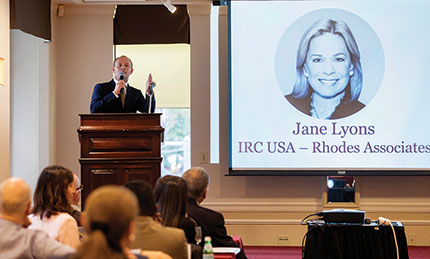 Taken at the IRC Global Executive Search Partners Annual Global Conference last year. President, Patrick Westerburger introducing Jane Lyons, managing partner of Rhodes Associates, as the new Americas regional head of IRC Global Executive Search Partners.
Q. Can talented candidates who have the skills and experience to successfully deal with the above market conditions be identified through search, therefore allowing the investor/developers to complete their financing?
A. Absolutely. But it requires a major shift in thinking, in strategy, and in mindset. For example, it is no longer good enough to find “good” people for senior positions. You have to search harder and evaluate experience and credibility more carefully and selectively to find true deal makers. You want professionals with proven track records for getting deals done in all market cycles.
Q. Won’t they carry big price tags in terms of compensation packages?
A. Absolutely. That is precisely part of the mindset some companies will have to change. They will likely have to bid higher for the best and the brightest – but those candidates will create great long-term value for the firms they are with.
Q. But they also have to have caps on how much they will pay, right?
A. Not in the traditional sense. Increasingly, the employment market, rather than a company’s internal compensation structure, has to control the parameters in setting pay scales. Of course, we help them with this. If they need a senior finance professional, we will tell our client what the market is paying for that caliber of professional. The client is either going to provide the competitive compensation or they will not be able to attract the truly superior talent that they are in need of today. The bottom line is that the rules of the playbook have been rewritten and companies must adapt to this. Not by keeping up with the curve, but getting ahead of it.
Q. When you look out over the coming years, what worries you most about the real estate industry?
A. Constant instability in the marketplace, due mostly to difficulties in the capital markets. Rising interest rates and lowering cap rates are causing investor/developers to take higher degrees of risk as they seek to maintain or improve their return on investment. Not many investors or capital sources will/can adjust by focusing on longer term investments with core returns.
Q. Then what are you most optimistic about?
A. The commercial real estate market is not going away. It is resilient and will always rise. The US is one of the most attractive marketplaces in the world to invest in and the flow of internal and external debt and equity capital will always seek to invest here.
Tags:
Brokerage
MORE FROM Brokerage

United Properties Corp. expands Wisconsin and Illinois retail presence adding 200,000 s/f
West Allis, WI United Properties Corp. completed two retail acquisitions totaling $27.4 million across Illinois and Wisconsin, adding 205,000 s/f of shopping center space to its portfolio






Quick Hits
 (2).gif)

Columns and Thought Leadership

Hunt commercial real estate question and answer: Fortune 500 wisdom - by David Hunt
Yes, there are lessons to be learned from the largest companies in America when comes to managing your real estate. But the decision to buy or lease real estate may not be one of

Positive forecast for New York’s pro-housing push? - by Philip Butler
New York’s housing crisis remains a hot button topic despite growing consensus that varied and affordable housing is desperately needed statewide. Governor Hochul has recently introduced several initiatives to overcome N.Y.’s anti-housing

A guide to finding the right NYC property management company - by Sanjay Gandhi
Being a small to midsize landlord in NYC is an increasingly demanding endeavor. From navigating complex regulations, increased compliance demands to dealing with tenant issues and remediating violations. It is wise to enlist the assistance of a partner, a professional

New York’s streets are full again, and the retail numbers prove it - by Noam Aziz
Walk down any New York block this year and you can feel it. The sidewalks are crowded, the storefronts are lit, and the energy that defines this city is back at full volume.
.gif)