



News:
Brokerage
Posted: November 22, 2022
BTEA honors five transformative projects & industry leaders
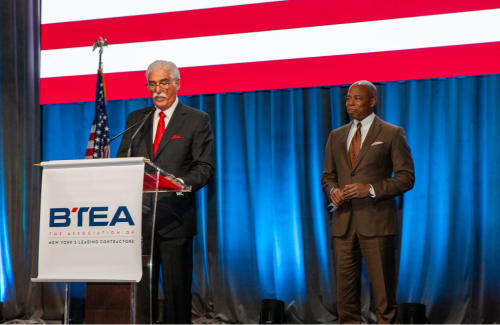
Transformative Project Awards. Photo Credit: Greg Morris/BTEA
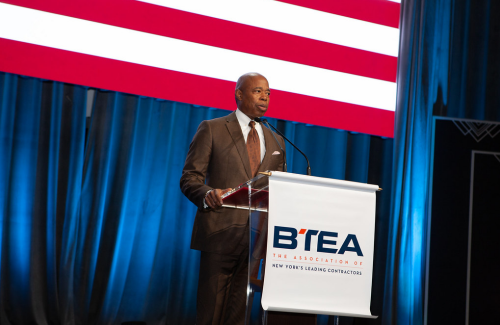
Project Awards. Photo Credit: Greg Morris/BTEA
Manhattan, NY The Building Trades Employers Association (BTEA) recently held its 2022 BTEA Transformative Project Awards, honoring union contractors responsible for five transformative projects that will be remembered for playing a pivotal role in New York City’s revitalization for generations. The BTEA also named three transformative industry leaders for 2022.
Addressing over 400 fellow BTEA union contractors at the Ziegfeld Ballroom, Louis Coletti, president and CEO, said: “This evening, we celebrate the world-class projects and transformative leaders who are not only revitalizing the city but also reimagining it by contributing to New York’s vibrancy, sustainability and livability for all.”
He was joined at the podium by Mayor Eric Adams and Kathryn Garcia, director of State Operations & Infrastructure for Governor Kathy Hochul. Both leaders praised the BTEA and its members for leading the way in building critical new projects for New Yorkers and the region.
Five transformative projects honored were:
- The New Terminal B at LaGuardia Airport, one of the largest P3 projects in U.S. aviation history. Completed in 2022, the $4 billion construction, 1.3 million s/f terminal includes expansive arrival and departure halls connected to two concourses, 35 gates, along with a 3,100-space parking garage.
- Jacob K. Javitz Center Expansion, a $1.5 billion expansion adding nearly 1.2 million s/f of event space to the renowned convention center. The facility adds 200,000 s/f of meeting rooms, along with a one-acre rooftop farm and other unique features.
- MTA 42nd Street Integrated Expansion Project, integrating all the planned work along the 42nd St. corridor at Grand Central, Bryant Park and Times Square Stations. The project will improve the city’s busiest subway station in Times Square to service 640,000 weekly subway riders, cutting costs and speed rail schedules.
- Moynihan Train Hall, which redeveloped the historic James A. Farley Post Office Building into a new 1.3 million s/f train hall for Long Island Railroad and Amtrak passengers. While providing new access to most of nearby Penn Station’s platforms, Moynihan Train Hall will include 850,000 s/f of new commercial, retail and dining space.
- One Vanderbilt, a 77-story skyscraper at the corner of 42nd St. and Vanderbilt Ave. At the building’s crown, SUMMIT One Vanderbilt is the city’s newest and most immersive observatory experience with 360-degree views of the city and beyond. SUMMIT provides vistas, curated multi-sensory experiences and cutting-edge technology.
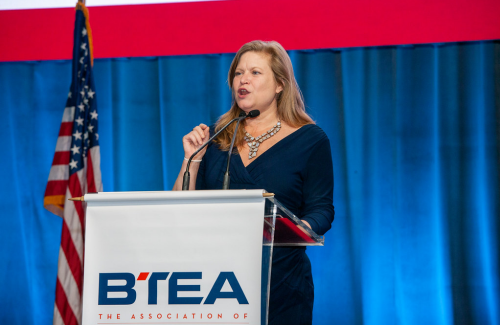
Kathryn Garcia on stage at the BTEA Transformative Project
Awards. Photo Credit: Greg Morris/BTEA
In addition, the BTEA honored three individuals for transformative leadership in labor and minority and women-owned businesses (MWBEs):
- Christopher Erikson, business manager of Local Union No. 3, IBEW, a labor leader devoted to uplifting the unionized electrical workforce. Erikson has successfully negotiated over 150 collective bargaining agreements, resulting in improved pensions and benefits for thousands of Local 3 members.
- Christine Boccia, co-chair of BTEA New York’s MWBE Committee and president of JD Traditional Industries. Boccia has rapidly grown a woman-owned construction firm while successfully advocating for MWBE legislative changes.
- Mike Hellstrom, Jr., vice president and eastern regional manager of the Laborers’ International Union of North America (LIUNA). Hellstrom has been a member of LIUNA since 1984 and is an advocate for over 45,000 unionized workers.
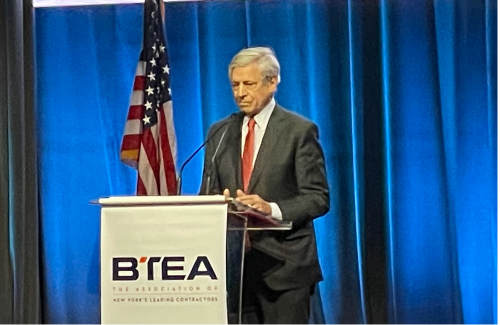
and New Jersey on stage at the BTEA Transformative
Project Awards. Photo Credit: Greg Morris/BTEA
“New York City is undergoing an unprecedented comeback from the pandemic. Despite economic challenges, the city continues its transformative new era of recovery,” said Coletti. “Although the pandemic brought the industry – and our city’s economy – to a screeching halt, construction spending is expected to reach an all-time high this year.”
The real estate and construction industry comprise 20 percent of New York City’s GDP while providing 10 percent of jobs and five percent of wages, “fueling a pathway to the middle class as one of New York’s top five paying job sectors,” said Coletti.
Coletti added, “The 2022 BTEA Transformative Projects are testaments to our city rebuilding better while we honor our resilient workforce and recognize the transformative leaders paving the way to our brighter future.”
The BTEA comprises 26 Construction Contractor Associations, with over 1,200 Construction Manager, General and Specialty Trade Subcontractor Companies
Tags:
Brokerage
MORE FROM Brokerage

Bestreich, Reynolds, Davila, and Flaherty of Investment Property Realty Group close $1.97 million sale of 343A Tompkins Ave. in Bed-Stuy
Brooklyn, NY Investment Property Realty Group (IPRG) closed the sale of 343A Tompkins Ave., a mixed-use building located in the Bed-Stuy section of the borough, for $1.97 million.




Quick Hits
 (2).gif)

Columns and Thought Leadership

A guide to finding the right NYC property management company - by Sanjay Gandhi
Being a small to midsize landlord in NYC is an increasingly demanding endeavor. From navigating complex regulations, increased compliance demands to dealing with tenant issues and remediating violations. It is wise to enlist the assistance of a partner, a professional

New York’s streets are full again, and the retail numbers prove it - by Noam Aziz
Walk down any New York block this year and you can feel it. The sidewalks are crowded, the storefronts are lit, and the energy that defines this city is back at full volume.

Hunt CRE question and answer: Choosing a real estate agent - by David Hunt
First, we will only work with one agent exclusively. The primary reason is that we want that agent to legally represent our client’s interests. In New York State, a real estate agent has a fiduciary

Hunt commercial real estate question and answer: Fortune 500 wisdom - by David Hunt
Yes, there are lessons to be learned from the largest companies in America when comes to managing your real estate. But the decision to buy or lease real estate may not be one of
.gif)