



News:
Brokerage
Posted: January 14, 2025
An unassuming blue book reveals an historic manuscript worth millions
Four days after the Presidential inauguration, one of the most important documents responsible for United States freedom will be auctioned at Christie’s Auction House. Discovered by a collector who purchased an incomplete set of 18th-century Laws of New York at a library sale, the plain book, worth approximately $100 and rebound in unattractive blue Buckram fabric from the 1950s, was unremarkable at first glance. Unbeknownst to the buyer at the time of purchase, the volume later turned out to contain the actual handwritten manuscript of the Declaration of Independence penned by Samuel Jones. Jones is credited with securing New York's ratification of the United States Constitution by breaking the impasse over the inclusion of a bill of rights.
The manuscript, with numerous marginal notations in Jones' hand, was likely brought to the Constitutional Convention in Poughkeepsie, New York by Jones. The volume, bound previously and then rebound about 70 years ago, indicates ‘Printed by John Holt, Printer to the State, 1782.’ The watermarks of the paper date to 1787 and correspond with the time of the New York Constitutional Convention. Jones penned the Declaration as it appears within the text of what stands as the earliest complete manuscript of the 1777 New York State Constitution—the only state constitution to quote the Declaration’s text in full. The detailed authentication process was conducted by Peter Klarnet at Christie’s with additional analysis by John P. Kaminski, a renowned Constitutional scholar and director of the Study of the American Constitution at the University of Wisconsin.
At the New York convention in Poughkeepsie where they were considering ratifying the Constitution, Jones broke the impasse about whether a bill of rights should be added. It was Jones who proposed removing the words "on condition that" a listing of rights would be added and proposed to insert the words “in full confidence that" a listing of rights would be added; Jones won that battle by two votes, which assured both the success of the Constitution as well as the later addition of the Bill of Rights.
“This document played a key role in shaping the nation’s founding principles and is the only privately held 18th-century manuscript of the Declaration of Independence according to the census maintained by Harvard University’s Declaration Resource Project. It is a unique artifact tied directly to the establishment of the Bill of Rights and the U.S. Constitution, and this auction marks the first time a manuscript of the Declaration by such a significant figure has ever been available. Its historical importance and scarcity make it a once-in-a-lifetime opportunity for collectors and institutions alike,” said Peter Klarnet. It is expected to sell for $2,000,000 - $3,000,000.
The Declaration of Independence holds a unique place in the New York Constitution, serving as a preamble to the 1777 document. While some other state constitutions mention the enactment of the Declaration of Independence in their preambles, New York boldly enshrined the entire document in text, linking its new government directly to the ideals of independence and natural rights. The discovery of this manuscript emphasizes the Declaration’s role not only as the foundational document establishing a new nation but also as the standard against which all governments "deriving their just powers from the consent of the governed" would be measured.
The “Jones Declaration of Independence” will be auctioned at Christie’s New York, 20 Rockefeller Plaza in New York, on January 24th as the pinnacle of the Important Americana auction, the annual sale of works of art, furniture, silver, folk art, Chinese Export works, and documents that trace American history.
Tags:
Brokerage
MORE FROM Brokerage
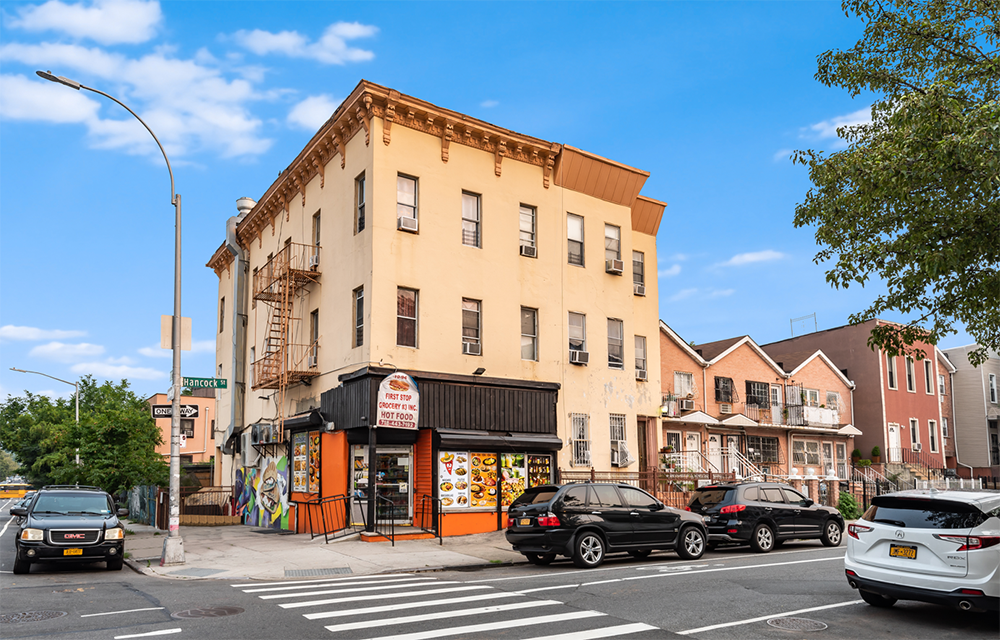
Investment Property Realty Group closes $1.75 million sale of 1094 Hancock Street in Brooklyn
Brooklyn, NY Investment Property Realty Group (IPRG), a New York-based commercial investment firm, has closed the sale of 1094 Hancock St., a mixed-use building in the Bushwick section, for $1.75 million.




 (2).gif)

Columns and Thought Leadership

A guide to finding the right NYC property management company - by Sanjay Gandhi
Being a small to midsize landlord in NYC is an increasingly demanding endeavor. From navigating complex regulations, increased compliance demands to dealing with tenant issues and remediating violations. It is wise to enlist the assistance of a partner, a professional

New York’s streets are full again, and the retail numbers prove it - by Noam Aziz
Walk down any New York block this year and you can feel it. The sidewalks are crowded, the storefronts are lit, and the energy that defines this city is back at full volume.

Hunt commercial real estate question and answer: Fortune 500 wisdom - by David Hunt
Yes, there are lessons to be learned from the largest companies in America when comes to managing your real estate. But the decision to buy or lease real estate may not be one of

Hunt CRE question and answer: Choosing a real estate agent - by David Hunt
First, we will only work with one agent exclusively. The primary reason is that we want that agent to legally represent our client’s interests. In New York State, a real estate agent has a fiduciary
.gif)