



News:
Brokerage
Posted: July 27, 2015
Vegh of Westwood Realty arranged two sales totaling $37.3million; Includes a five-building package for $25.8 million
Steven Vegh of Westwood Realty Associates has brokered two sales totaling $37.3 million.
In the first deal, a Brooklyn-based investor closed on a five-building package of mixed-use buildings for $25.8 million. The buildings, 220 - 226 W.116th St. and 449 W.125th St. consist of 52 residential units and seven retail spaces.
The seller, Adam Verner's Springhouse Partners, purchased the buildings for $15.4 million in July 2014. Treetop Development, who sold it to Verner, had purchased these buildings a short time before that for $9 million. During the year of ownership, Springhouse has completed many upgrades to the building common areas, renovated units and repositioned some of the retail, including the newly leased space to Petopia.
This is an indication of the continuous soaring property values in the city's rapidly gentrifying neighborhoods, such as Morningside Heights and West Harlem. The purchasers who are long-term holders are invested in the area around Columbia University's new development of 6.8 million s/f of new teaching, research and administration space and are looking to hold these assets long term.
Vegh was the sole broker in the off-market deal. Vegh, who is currently in contract on 75 buildings in Upper Manhattan alone currently, said, "This just further proves the strong market in Harlem today. Streets such as 116th and 125th St. are irreplaceable and are just getting stronger by the day especially with retail."
Black Spruce, a Manhattan-based management company led by Josh Gotlib has purchased another deal for $11.5 million to add to their recent buying spree. The properties consist of 51 Project Based Section 8 units spread throughout 17 three-family homes on 2320-2336 West 11th, 2302-2324 West 12th and 2315-2321 West 13th Sts. in the Gravesend area of Brooklyn. The properties were owned by E & M who bought these buildings for $4.5 million in 2006. Black Spruce has made some headlines with all their recent purchases such as the $58 million Bronx portfolio from Normandy. "Josh will do very well with these properties as a long term safe investment that will only keep growing with future value in both the rents and location," said Vegh, who was the sole broker in the off-market deal.
Tags:
Brokerage
MORE FROM Brokerage
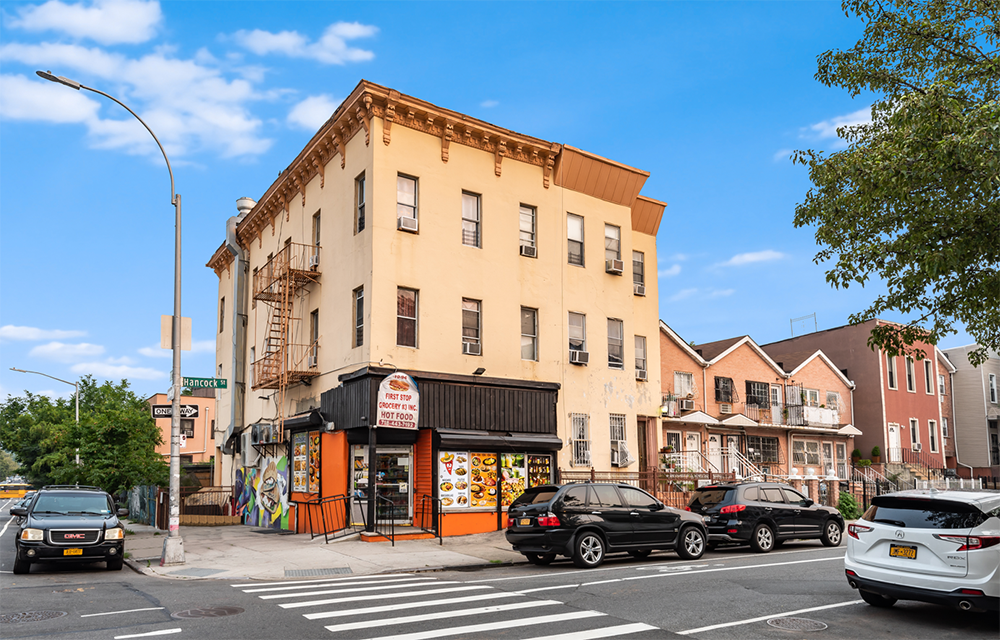
Investment Property Realty Group closes $1.75 million sale of 1094 Hancock Street in Brooklyn
Brooklyn, NY Investment Property Realty Group (IPRG), a New York-based commercial investment firm, has closed the sale of 1094 Hancock St., a mixed-use building in the Bushwick section, for $1.75 million.


Quick Hits

Columns and Thought Leadership

Hunt CRE question and answer: Choosing a real estate agent - by David Hunt
First, we will only work with one agent exclusively. The primary reason is that we want that agent to legally represent our client’s interests. In New York State, a real estate agent has a fiduciary

A guide to finding the right NYC property management company - by Sanjay Gandhi
Being a small to midsize landlord in NYC is an increasingly demanding endeavor. From navigating complex regulations, increased compliance demands to dealing with tenant issues and remediating violations. It is wise to enlist the assistance of a partner, a professional

New York’s streets are full again, and the retail numbers prove it - by Noam Aziz
Walk down any New York block this year and you can feel it. The sidewalks are crowded, the storefronts are lit, and the energy that defines this city is back at full volume.

Hunt commercial real estate question and answer: Fortune 500 wisdom - by David Hunt
Yes, there are lessons to be learned from the largest companies in America when comes to managing your real estate. But the decision to buy or lease real estate may not be one of
.gif)