



News:
Brokerage
Posted: July 25, 2011
Steve Spinola - Albany legislative report 2011: Achievements in real estate industry
The N.Y. real estate industry had a number of important accomplishments in the NYS legislative session that ended on June 24.
For the first time in 15 years, NYS adopted a budget that reduced spending below the level of the previous year. The $132.5 billion budget was adopted on time and reduced overall spending by more than 2%. More importantly, it eliminated a $10 billion deficit without raising taxes, without new borrowing, and without budget gimmicks. In addition, the adopted budget agreement puts us on a path toward fiscal responsibility by cutting next year's projected budget deficit from $15 billion to $2 billion.
Governor Andrew Cuomo, senate majority leader Dean Skelos and assembly speaker Sheldon Silver should be commended for making difficult budget decisions that were necessary to improve our state's prospects for renewed growth and economic prosperity for all New Yorkers.
Another important legislative accomplishment is the two percent real property tax cap that would control the growth of taxes for businesses and homeowners. This tax cap, however, does not apply to N.Y.C.
N.Y.C. will benefit from the renewal of two major economic development programs: the Industrial and Commercial Abatement Program (ICAP) and the 421a Partial Tax Exemption Program. These programs will encourage capital investment in new commercial and industrial development and new housing, and will offset the heavy tax burden our real property tax system places on these properties.
The legislature passed a renewal of the 50% reduction in the transfer tax for the conveyance of a property to a REIT. A reduction in transfer taxes levied on REITS has facilitated their formation. This has led to an emergence of REITS in N.Y. and a surge in overall transfer tax revenue. This bill has passed both houses and we expect the governor to sign this extension into law.
After many unsuccessful attempts, the legislature passed a bill for the siting of power plants. This legislation would allow for the development of new, more energy efficient power plants to meet the energy needs of our growing city. We will urge the governor to sign it into law.
The renewal of rent stabilization laws preserved a property owner's ability to deregulate apartments above a fixed threshold and avoided the proposals of the tenant advocates. The cumulative effect of their changes would have resulted in a virtual elimination of the deregulation of rent stabilized apartments. Rent stabilization was extended to June 15, 2015.
The rent threshold for vacancy decontrol was increased to $2,500 from $2,000; the income threshold for deregulating a unit above the rent threshold was increased to $200,000 from $175,000; the allowable monthly rent increase for an individual apartment improvement was changed to 1/60th from 1/40th of the cost of the improvement for buildings with more than 35 units; and owners are allowed only one vacancy increase per calendar year.
However, noteworthy are the tenant advocate provisions that were kept out of the extension of rent stabilization. There is no indexing of the rent or income threshold; there is no change to the vacancy allowance percentage; there is no limit imposed on the number of apartments an owner may reclaim for his personal or family use; there is no change to the MCI provisions; and there are no restrictions on the readjustment of the preferential rent at vacancy or lease renewal to the legal rent.
The real estate industry is disappointed that our leaders in Albany did not pass a proposal that would have permitted the owners of 80/20 buildings the option to cap their real estate taxes at 20% of their building's gross income if they kept their low income units affordable for another 30 years. This would have preserved as many as 5,000 affordable units.
Similarly, we thought the legislature missed an opportunity to address the chaos in the rental housing market resulting from the Court of Appeals decision in the Roberts/Tishman Speyer J-51 case. This court decision two years ago maintained that apartments receiving J-51 benefits could not be deregulated. It overruled the directive from the State Housing agency (DHCR) that, consistently for more than a decade, advised building owners that these units could be deregulated. The proposed J-51 legislation would return these units to rent stabilization; would establish a mechanism for determining rent and overcharges; and would bring order and clarity to the owners and occupants of the 40,000 units affected by the Court of Appeals decision.
The real estate industry had many important accomplishments in Albany in 2011. When the legislature returns later in the year, as is being reported, we will pursue passage of the J-51 legislation, strongly advocate for the 421a cap provision, and the restoration of 421a benefits to high density zoning districts (FAR15).
Steven Spinola is the president of REBNY, New York, N.Y.
Tags:
Brokerage
MORE FROM Brokerage
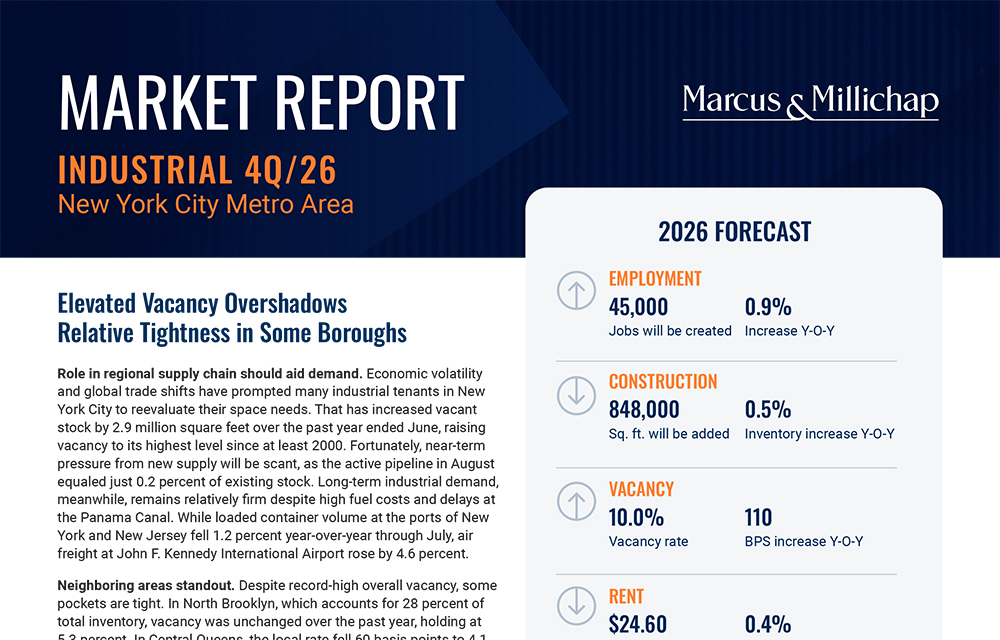
Marcus & Millichap releases fourth-quarter 2026 NYC industrial market report
Manhattan, NY Marcus & Millichap has published its fourth-quarter 2026 New York City Industrial Market Report. “New York City’s industrial market is showing a clear






Columns and Thought Leadership

Hunt CRE question and answer: Choosing a real estate agent - by David Hunt
First, we will only work with one agent exclusively. The primary reason is that we want that agent to legally represent our client’s interests. In New York State, a real estate agent has a fiduciary

The art of investing in real estate - by Thomas Donovan
Real estate investing is as much an art as it is a skill. No one can time the market, or the factors that drive it, perfectly. Location, zoning, size, transportation, and neighborhood density give you a baseline for

Hunt commercial real estate question and answer: Fortune 500 wisdom - by David Hunt
Yes, there are lessons to be learned from the largest companies in America when comes to managing your real estate. But the decision to buy or lease real estate may not be one of

New York’s streets are full again, and the retail numbers prove it - by Noam Aziz
Walk down any New York block this year and you can feel it. The sidewalks are crowded, the storefronts are lit, and the energy that defines this city is back at full volume.
.gif)