



News:
Brokerage
Posted: December 6, 2016
Shelby of Meridian negotiates $29 million retail property refinance
 Carol Shelby, Meridian Capital
Bronx, NY Meridian Capital Group arranged $29 million in financing for the refinance of a retail property.
The 10-year loan, provided by a balance sheet lender, features a fixed rate of 3.50%. This transaction was negotiated by Meridian managing director, Carol Shelby.
The property, located on East Fordham Rd., is a two-story, 42,000 s/f retail property and houses tenants Old Navy, McDonald’s and Gamestop. The building is situated in one of the borough’s largest shopping districts with over 300 shops and restaurants. Fordham Rd. also serves as a major transportation hub that is easily accessible by car and public transportation. The property is within walking distance from the newly renovated Fordham Plaza, as well as Fordham University’s Rose Hill campus with nearly 7,000 students, adding foot traffic. The property is a five block walk from the Fordham Metro North Railroad station and the B and D subway lines at Fordham Rd.
“The sponsor has owned the property for over 40 years and has maintained a strong occupancy with a number of national tenants,” said Shelby. “A new lease was recently signed with Old Navy and Meridian negotiated favorable terms in a short period of time, which made it possible to close the loan before Old Navy opened,” she added.
Founded in 1991, Meridian Capital Group is America’s most active debt broker and one of the nation’s leading commercial real estate finance advisory firms. In 2015, Meridian closed over 3,900 loans totaling more than $35 billion in transaction volume with 210 unique lenders, equating to $135 million per business day. Since inception, the company has closed more than $260 billion in financing with the full complement of capital providers, encompassing local, regional and national banks, CMBS lenders, agency lenders, mortgage REITs, life insurance companies, credit unions and private equity funds. Meridian arranges financing for many of the world’s leading real estate investors and developers and the company’s expansive platform has specialized practices for a broad array of property types including office, retail, multifamily, hotel, mixed-use, industrial, healthcare, student housing and self-storage properties.
Tags:
Brokerage
MORE FROM Brokerage
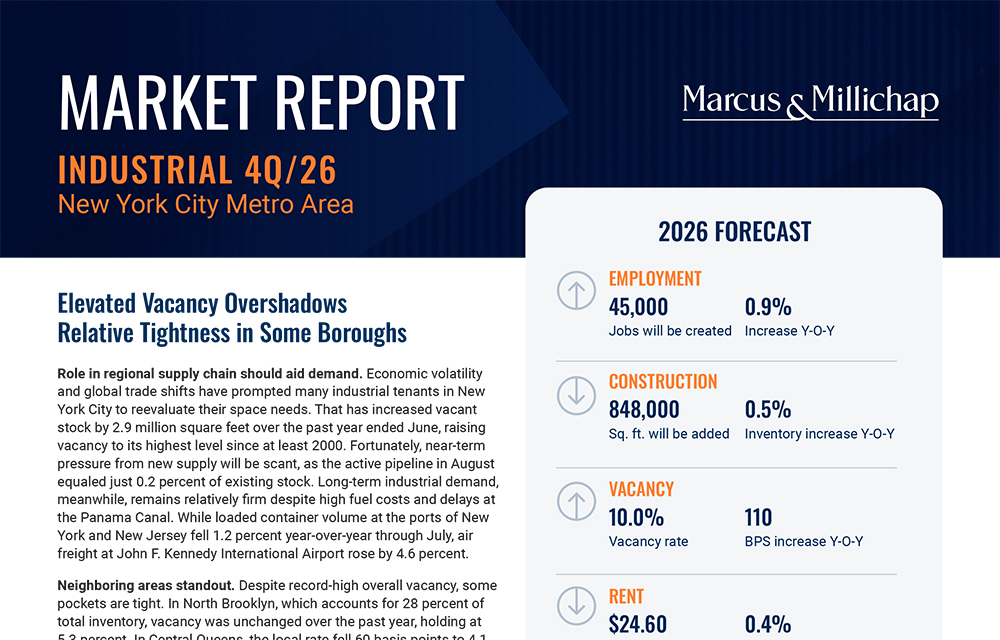
Marcus & Millichap releases fourth-quarter 2026 NYC industrial market report
Manhattan, NY Marcus & Millichap has published its fourth-quarter 2026 New York City Industrial Market Report. “New York City’s industrial market is showing a clear





Quick Hits
 (2).gif)

Columns and Thought Leadership

Hunt commercial real estate question and answer: Fortune 500 wisdom - by David Hunt
Yes, there are lessons to be learned from the largest companies in America when comes to managing your real estate. But the decision to buy or lease real estate may not be one of

New York’s streets are full again, and the retail numbers prove it - by Noam Aziz
Walk down any New York block this year and you can feel it. The sidewalks are crowded, the storefronts are lit, and the energy that defines this city is back at full volume.

The art of investing in real estate - by Thomas Donovan
Real estate investing is as much an art as it is a skill. No one can time the market, or the factors that drive it, perfectly. Location, zoning, size, transportation, and neighborhood density give you a baseline for

Hunt CRE question and answer: Choosing a real estate agent - by David Hunt
First, we will only work with one agent exclusively. The primary reason is that we want that agent to legally represent our client’s interests. In New York State, a real estate agent has a fiduciary
.gif)