



News:
Brokerage
Posted: October 28, 2013
Optimism at Anchin's Eighth Annual State of the Construction Industry event; Anderson of NY Bldg. Congress kicked off panel discussion
The mood at Anchin's Eighth Annual State of the Construction Industry event was upbeat, with a bright outlook for the future. The residential and commercial sectors are booming, construction staffing is back to 2008 levels, and industry experts are looking forward to a busy 2014.
This positive view of the future of construction in New York City was tempered by a note of caution. Philip Ross, practice leader of Anchin's Construction and Architecture and Engineering Industry Groups, summarized industry leaders' main concerns, which include rising insurance and workers' compensation costs, extremely competitive bidding on projects, inflationary pressures, the increasing use of nonunion alternatives and uncertainty about whether the next mayor will continue mayor Bloomberg's policies.
Richard Anderson, president of the New York Building Congress, kicked off the event by engaging the panel in a lively discussion covering a wide range of pertinent issues. Mary-Jean Eastman, FAIA, MRAIC, IIDA, principal & founding partner, Perkins Eastman; Charles Murphy, senior vice president, Turner Construction Company; Mitchel Simpler, partner, Jaros, Baum & Bolles and national director, ACEC New York; and Carter H. Strickland, Jr., commissioner, NYC Department of Environmental Protection all shared their views on the New York construction market in 2014 and beyond.
All of the panelists commented on New York's role as a global leader. They noted that construction is thriving in this region and throughout most of the United States as well as in South America, the Middle East and the Far East. Residential and commercial projects are fueling growth in each of these areas.
When asked about their particular concerns going forward, they had various perspectives: Ms. Eastman was troubled about the inflationary pressure on the residential housing market and wondered whether it would be sustainable. Noting that the employment landscape is changing in the industry, Mr. Murphy stressed the importance of succession and career planning. In addition to the inflationary pressures in the marketplace, Mr. Simpler was also concerned about the difficulty in finding appropriate staff at affordable costs. The new administration's commitment to rebuilding the city's infrastructure was Mr. Strickland's primary worry.
Questioned about lessons learned from Hurricane Sandy, the group agreed that the City's infrastructure, which is one the oldest in the nation, needs to be modernized and upgraded. People need to be more aware of the value of infrastructure to the success of the city. Capital improvements need to continue so the area can tolerate future storms.
The panel also touched on issues that need to be considered by the New York State legislature, including amending the Scaffold Law. The costs associated with that law, including an anticipated rise in insurance rates, contribute to New York having the highest construction costs in the country.
Reflecting on the outlook for integrated project delivery (IPD) in New York, the panelists agreed that the outlook is guarded, at least in the short term. Although IPDs are widely used in Texas and on the West Coast, New York is unfamiliar with how they operate and the learning curve is steep.
The event, co-sponsored by the New York Building Congress, ACEC-NY and AIA-NY drew an overflow crowd. At the conclusion of the panel discussion, Anchin presented donations to each of the sponsoring entities. Richard T. Anderson, accepting on behalf of the New York Building Foundation noted the importance of the lessons learned from Hurricane Sandy. Sissy Nikolaou, Chair of ACEC New York's Scholarship Committee, commented that ACEC is working towards their goal of awarding $50,000 in scholarships to third-year engineering students. Tomas J. Rossant, AIA, AIANY's Vice President for Public Outreach and future Chair, accepted on behalf of The Center for Architecture and remarked about how the city's global competitiveness was enhanced by its building environment.
Anchin's event concluded with continued networking amongst industry leaders and a true feeling of hope for the future of NY construction and development.
Photo 1: Shown (from left) are: Sissy Nikolaou of Mueser Rutledge Consulting Engineers/ACEC-NY scholarship committee chair; Tomas Rossant of Ennead Architects/AIA-NY board member & 2015 chairman; Phillip Ross of Anchin, Block & Anchin LLP; and Richard Anderson of the New York Building Congress
Photo 2: Richard T. Anderson of The New York Building Congress; Mary-Jean Eastman of Perkins Eastman Architects; Carter Strickland, Jr. of the NYC Department of Environmental Protection; Mitchel Simpler of Jaros, Baum & Bolles/National Director of ACEC; Charles Murphy of Turner Construction Company.
Tags:
Brokerage
MORE FROM Brokerage
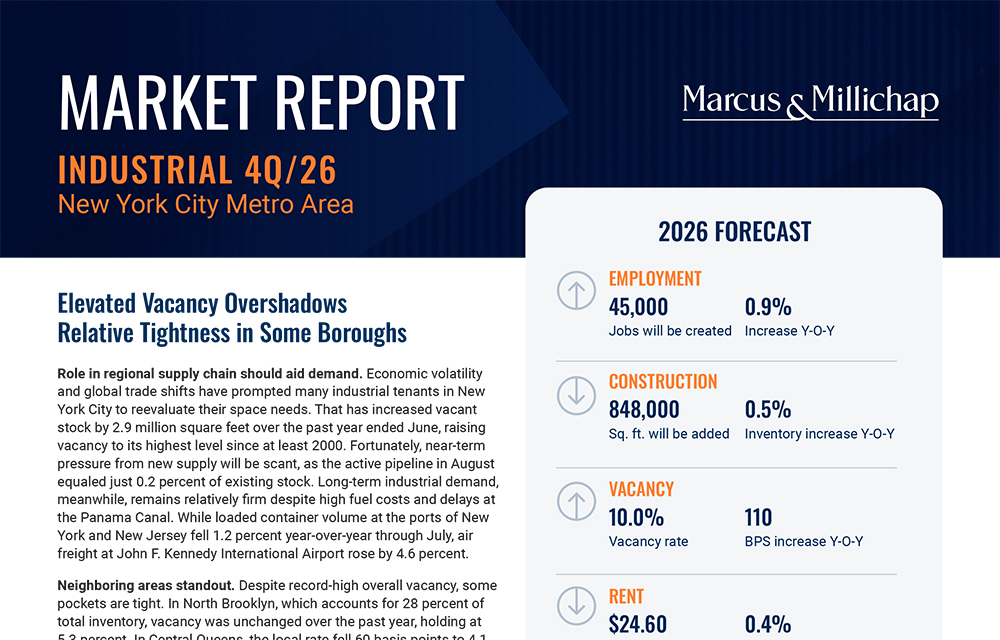
Marcus & Millichap releases fourth-quarter 2026 NYC industrial market report
Manhattan, NY Marcus & Millichap has published its fourth-quarter 2026 New York City Industrial Market Report. “New York City’s industrial market is showing a clear



Quick Hits

Columns and Thought Leadership

The art of investing in real estate - by Thomas Donovan
Real estate investing is as much an art as it is a skill. No one can time the market, or the factors that drive it, perfectly. Location, zoning, size, transportation, and neighborhood density give you a baseline for

Hunt CRE question and answer: Choosing a real estate agent - by David Hunt
First, we will only work with one agent exclusively. The primary reason is that we want that agent to legally represent our client’s interests. In New York State, a real estate agent has a fiduciary

Hunt commercial real estate question and answer: Fortune 500 wisdom - by David Hunt
Yes, there are lessons to be learned from the largest companies in America when comes to managing your real estate. But the decision to buy or lease real estate may not be one of

New York’s streets are full again, and the retail numbers prove it - by Noam Aziz
Walk down any New York block this year and you can feel it. The sidewalks are crowded, the storefronts are lit, and the energy that defines this city is back at full volume.
.gif)