



News:
Brokerage
Posted: May 26, 2015
Yankelovich of GFI Realty Services completes $6.4 million sale; Four-story walk-up - 632 Ocean Parkway
GFI Realty Services, Inc. arranged the sale of 632 Ocean Parkway. The $6.4 million transaction set a high mark for the Kensington section of the borough, with its price per s/f of $296. The four-story walk-up consists of 31 residential units. The property also has 28,000 s/f of available air rights.
GFI Realty Services arranged the sale, with senior director of investment sales Erik Yankelovich representing both the buyer and the seller.
"The family firm that sold the property has come under a new generation of management in recent years, and they are interested in redirecting their real estate capital to a less management-intensive asset class," said Yankelovich. "GFI was given a carve-out for an investor we thought would be ideal, and he ultimately proved to offer the seller the best terms."
The multifamily building is located near the B, F and Q trains, and in proximity to several local retail corridors.
"The buyer was looking to add to his area portfolio, and capitalized on the opportunity to acquire this pre-war building," said Yankelovich. "A hands-on operator, he intends to make various improvements to the property and to maintain it as a rental building for the long term."
The residential Brooklyn neighborhood of Kensington is located in between Borough Park and East Flatbush, within walking distance of Prospect Park. The thriving area is home to several schools, trains and bus lines.
This deal comes on the heels of several record-setting transactions arranged by Yankelovich and GFI in neighboring areas. Notably, Yankelovich brokered the separate sales of 147 Ocean Avenue and 115 Ocean Avenue in Prospect Lefferts Gardens, which successively set neighborhood records in terms of price per unit and rent roll multiple.
Extremely active in southern Brooklyn, GFI recently arranged a $60-million, four-building portfolio transaction in Bay Ridge and Midwood, which sold for a per-unit price that eclipsed previous neighborhood transactions. They also brokered the sale of 15-21 Crooke Avenue, a Prospect Park South building which traded for $14.25 million.
Tags:
Brokerage
MORE FROM Brokerage
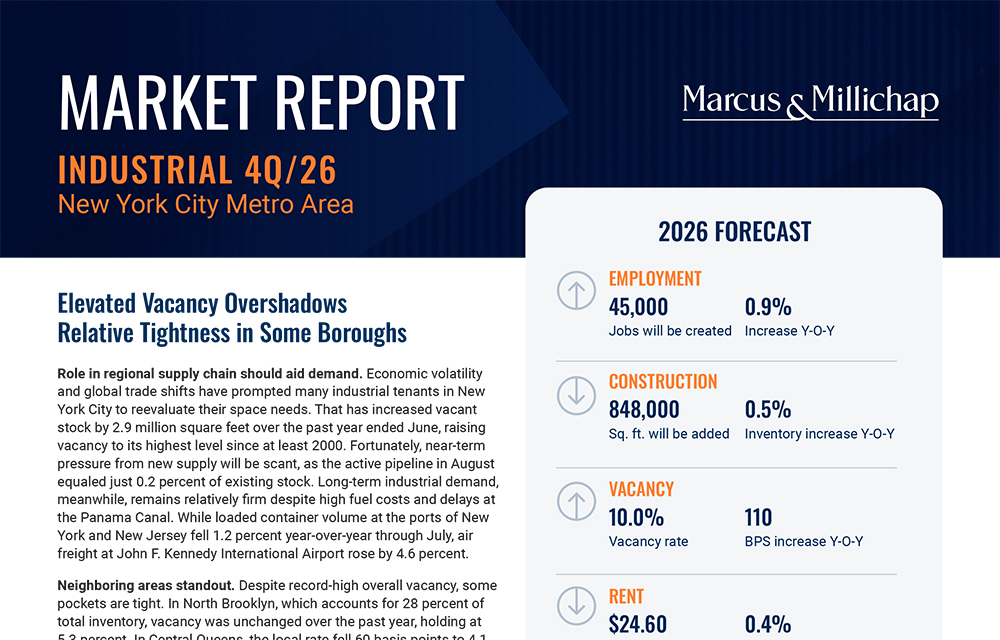
Marcus & Millichap releases fourth-quarter 2026 NYC industrial market report
Manhattan, NY Marcus & Millichap has published its fourth-quarter 2026 New York City Industrial Market Report. “New York City’s industrial market is showing a clear




Quick Hits
 (2).gif)

Columns and Thought Leadership

The art of investing in real estate - by Thomas Donovan
Real estate investing is as much an art as it is a skill. No one can time the market, or the factors that drive it, perfectly. Location, zoning, size, transportation, and neighborhood density give you a baseline for

Hunt commercial real estate question and answer: Fortune 500 wisdom - by David Hunt
Yes, there are lessons to be learned from the largest companies in America when comes to managing your real estate. But the decision to buy or lease real estate may not be one of

New York’s streets are full again, and the retail numbers prove it - by Noam Aziz
Walk down any New York block this year and you can feel it. The sidewalks are crowded, the storefronts are lit, and the energy that defines this city is back at full volume.

Hunt CRE question and answer: Choosing a real estate agent - by David Hunt
First, we will only work with one agent exclusively. The primary reason is that we want that agent to legally represent our client’s interests. In New York State, a real estate agent has a fiduciary
.gif)