



News:
Brokerage
Posted: January 10, 2017
Tips on making your property taxes less taxing by Wakeman and Wassel
 Robert Wakeman, Cullen and Dykman LLP
 Thomas Wassel, Cullen and Dykman LLP
All business owners know that whether they own their property or lease it, property taxes make up a significant portion of their expenses. Many do not realize that there is a process by which they can try to reduce their property taxes and obtain substantial savings.
Most real property is subject to taxation in New York State. Generally, the taxes are set by the town or city where the property is located. If the property is located in an incorporated village, that village may separately set the taxes for the property. The amount of taxes paid is based on the “assessment” of the property set by local officials, who attempt to determine the Fair Market Value (FMV) of the property by various methods. For most commercial property, this involves determining the actual or expected income and expenses for the property and performing various technical analyses to determine what a reasonable investor would pay for the property based on the expected rate of return. If it is determined that the assessed FMV of the property is higher than what the property is actually worth, the property owner may be entitled to refunds or a reduced FMV (and lower taxes) in future years.
There are many reasons why the assessment may be too high. Assessments may be unchanged for many years, and may not reflect current market conditions. An assessor may use the sales price of property to set an assessment, but this can be incorrect if the sales price reflects other assets in addition to the land and building, such as the “good will” of the business. This is particularly a problem in assessing hotels and motels, where items such as furniture, fixtures and equipment are often assessed improperly. If a property is in poor condition or has suffered from one of the numerous recent storms, the assessment may not reflect this. There are many other possible reasons—now is the time to ensure that the assessment is set correctly!
The next set of filings in the Capital District area are generally due by May 28. A “tentative” assessment for every property will be made public on May 1. A property owner can file a “grievance” with the town or city assessor challenging this tentative assessment. Failure to properly file a grievance by the deadline will prevent assessment review this year. In filing a grievance, the property owner should submit evidence to help persuade the assessor to lower the assessment and can attend a hearing to state the case. There is no governmental charge to file a grievance. The assessor will make a decision on or before July 1, when a “final” assessment will be published. If the property owner isn’t happy with that final assessment, a court proceeding can be started. The deadline for such a “tax certiorari” proceeding is July 31. There is a filing fee imposed by the court of $210. Each year’s assessment in each jurisdiction is a separate cause of action, and requires a separate filing. A filing in 2017 is a challenge to the assessment which will be used in 2017-18—it doesn’t affect assessments from earlier years, and doesn’t preserve a challenge to later years.
Here’s some good news: the worst that can happen if you file a grievance or start a proceeding is that the assessment stays where it is. The assessment can only be reduced by a court—it can’t be increased.
You owe it to yourself to have your assessment reviewed. Your bottom line may thank you.
Robert Wakeman and Thomas Wassel are members of Cullen and Dykman LLP, Albany, N.Y.
Tags:
Brokerage
MORE FROM Brokerage
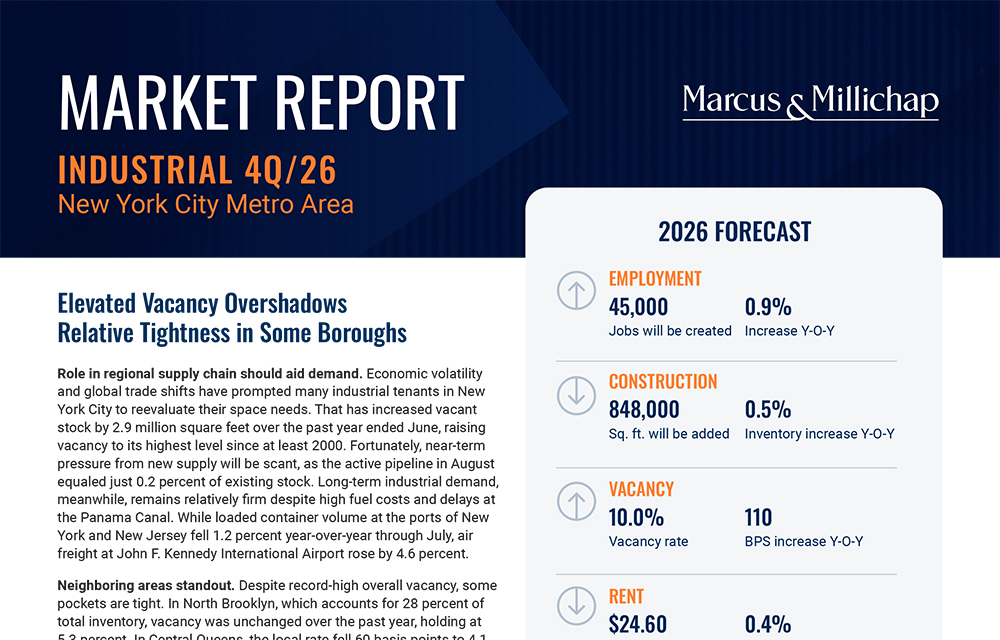
Marcus & Millichap releases fourth-quarter 2026 NYC industrial market report
Manhattan, NY Marcus & Millichap has published its fourth-quarter 2026 New York City Industrial Market Report. “New York City’s industrial market is showing a clear






Columns and Thought Leadership

The art of investing in real estate - by Thomas Donovan
Real estate investing is as much an art as it is a skill. No one can time the market, or the factors that drive it, perfectly. Location, zoning, size, transportation, and neighborhood density give you a baseline for

New York’s streets are full again, and the retail numbers prove it - by Noam Aziz
Walk down any New York block this year and you can feel it. The sidewalks are crowded, the storefronts are lit, and the energy that defines this city is back at full volume.

Hunt CRE question and answer: Choosing a real estate agent - by David Hunt
First, we will only work with one agent exclusively. The primary reason is that we want that agent to legally represent our client’s interests. In New York State, a real estate agent has a fiduciary

Hunt commercial real estate question and answer: Fortune 500 wisdom - by David Hunt
Yes, there are lessons to be learned from the largest companies in America when comes to managing your real estate. But the decision to buy or lease real estate may not be one of
.gif)