



News:
Construction Design & Engineering
Posted: October 13, 2026
The Façade is no longer just a finish. It’s a risk strategy. - by Bentley Zhao

Twelve-billion-dollar weather disasters have already hit the U.S. through the first half of 2026, causing at least $31.9 billion in damage, according to Climate Central1, the nonprofit that now maintains the disaster database NOAA discontinued. That follows 2025 research2 that closed with 23 such events and $115 billion in losses – the third-highest year on record. Disasters that struck once every 82 days in the 1980s now strike roughly every two weeks, according to Climate Central’s analysis. Whatever the debate over why, the reality for anyone who builds or owns real estate is the same: severe weather is a planning input now, alongside interest rates and construction costs.
I think about risk for a living. Managing it — across financing, construction, and market cycles — is what keeps me up at night, and it’s the discipline my father instilled in me building a business from nothing in a new country. What I’ve come to appreciate is that much of a building’s long-term risk is decided at the façade.
The Skin Isn’t Cosmetic Anymore
For most of my career, façade decisions were treated as design and budget questions: what does it look like, what does it cost. Performance was assumed. That assumption doesn’t hold anymore. A curtain wall – a non-load-bearing exterior system that attaches to a building’s structural frame – is engineered to manage wind, water, air infiltration, and thermal movement. It carries none of the floor or roof load, so its entire job is standing between your building and the weather. When it’s under-specified, you don’t find out at the ribbon cutting. You find out three years later, when water finds a joint nobody stress tested.
US Weatherseal, an independently owned firm that specializes in designing and installing curtain walls, windows, and storefronts, has completed façade work for several New Empire Group projects. It is not part of New Empire Group, but that ongoing working relationship reflects a shared premise: the façade is a performance system first, and everything else, including how it looks, gets built on top.
Strong Coordination is a Resilience Tool, Not Just an Efficiency One
New Empire Group has always believed in tight coordination across the development stack because it lets us manage risk instead of just reacting to it. I used to think of that mainly in terms of schedule and cost certainty. Increasingly, I think of it in terms of the weather. When ownership, construction management, design teams, and specialized façade contractors are aligned early and held to the same standard, infiltration testing happens at the system level, not just the spec sheet, and thermal movement is designed for the swings a region is actually seeing now. The connection details nobody sees once a building is buttoned up — the ones that decide whether a storm is a non-event or an insurance claim — get the scrutiny they deserve, because everyone at the table is accountable for how the pieces fit together.
The Economics Now Favor Getting This Right
There’s a version of this argument that sounds like owners are spending more for no reason. That’s not it. Every owner already pays for climate volatility, engineered for it or not, through insurance premiums, tenant turnover after a bad storm season, and business interruption when a façade fails. A better-engineered curtain wall isn’t an added cost so much as a choice about where that cost shows up: a modest premium at construction, or an open-ended liability for the life of the building. Once owners see it that way, it stops being a hard decision.
Building for the Climate We Actually Have
None of this means every building needs to be engineered like a bunker. It means matching the façade to the real risk profile of where a building sits and how long it needs to perform. A coastal high-rise and an urban infill project don’t face the same exposure, and shouldn’t carry the same spec. What they should share is a design process where façade performance is decided early, not value-engineered down after the fact.
The data isn’t pointing toward a return to the weather patterns most codes were written for. So the question for owners isn’t whether to take that seriously, it’s whether they’d rather design it now, at the drafting table, or discover the gaps in a storm. I know which side I’d rather be on, and it’s the same instinct that’s guided every decision I’ve made in this business: plan for the long term, control what you can, and don’t wait for the weather to force your hand.
Bentley Zhao is chairman and CEO of New Empire Group, Manhattan, N.Y.
1 https://www.climatecentral.org/climate-matters/mid-year-billion-dollar-disasters
2 https://www.climatecentral.org/climate-matters/2025-in-review
MORE FROM Construction Design & Engineering
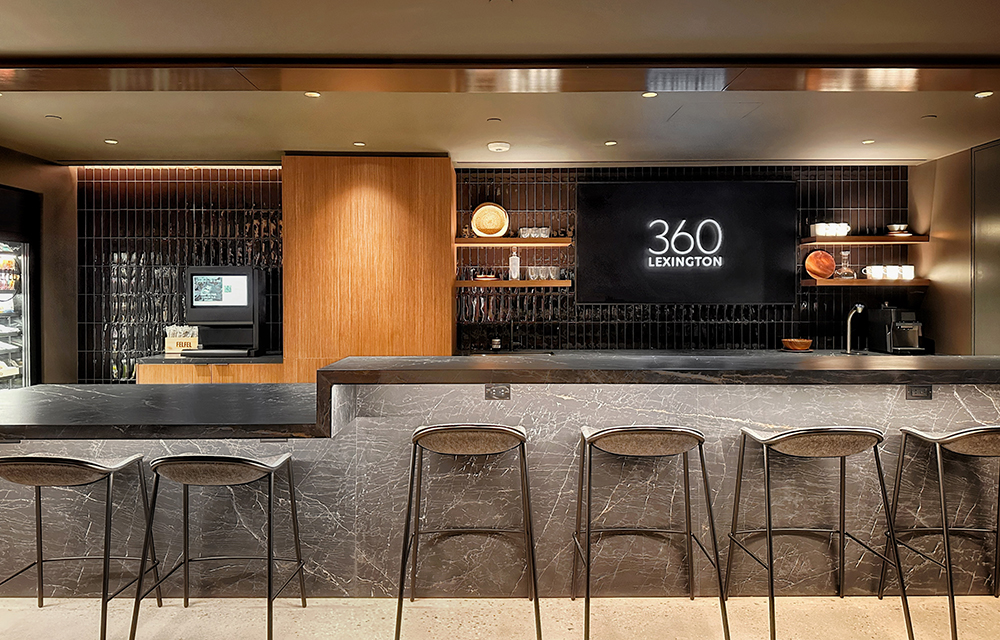
AmTrustRE and MdeAS Architects complete modernization of 360 Lexington Ave. in Midtown
Manhattan, NY AmTrustRE has completed a comprehensive modernization at 360 Lexington Ave. Led by New York-based architecture firm MdeAS Architects, the project reimagines the 268,000 s/f office building as a modern, hospitality-driven workplace designed to meet the evolving needs of tenants.

Columns and Thought Leadership

Premium experiences, proven returns: The New revenue playbook for sports venues - by Terry McIntyre
Investing in the Fan Experience as a Revenue Strategy The sports and entertainment venues that bet on premium experiences years ago are now seeing those investments pay off in packed seats, increased revenue, and industry recognition.
The Façade is no longer just a finish. It’s a risk strategy. - by Bentley Zhao
Twelve-billion-dollar weather disasters have already hit the U.S. through the first half of 2026, causing at least $31.9 billion in damage, according to Climate Central, the nonprofit that now maintains the disaster database NOAA discontinued.

We support green construction. Just not this kind - by Tammy Smith
Most people think of St. Patrick’s Day as a fun footnote on the calendar. In construction logistics, however, it’s a full-scale operational variable — especially if your work touches major metro areas with major parades and, let’s call it what it is, enthusiastic celebrants.
