



News:
Construction Design & Engineering
Posted: October 29, 2026
New designs offer first look at Beyer Blinder Belle and Shawmut-led transformation of historic First Battery Armory into Hebrew Union College’s future Upper West Side Campus
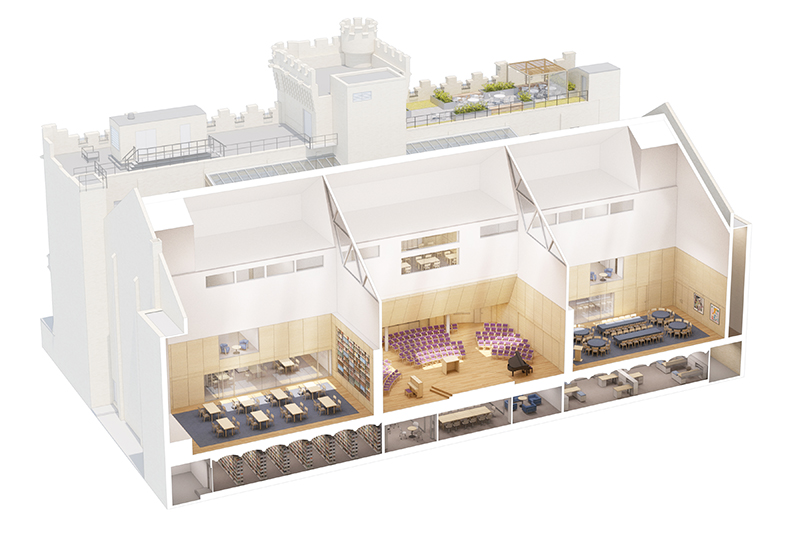
Manhattan, NY Hebrew Union College, in partnership with Shawmut Design and Construction and Beyer Blinder Belle Architects & Planners (BBB), unveiled new renderings of its future New York City campus at the landmark First Battery Armory building, located at 56 West 66th St. The renderings offer a first look at the transformation of the historic building into a dynamic new home for the College and a hub for Jewish learning, leadership, worship, and community life on the Upper West Side. Hebrew Union College plans to move into the new campus after the winter/spring term of 2027.
Designed by BBB, the new campus thoughtfully adapts the Armory to meet the evolving needs of Hebrew Union College’s students, faculty, and broader community, while honoring the building’s character and legacy. The project will create a educational environment equipped to support clergy formation and in-person and hybrid learning, while creating space for public programs, communal gatherings, and arts and cultural experiences. Shawmut is leading construction of the new campus.
“These renderings show the promise of what Hebrew Union College can be. They honor our history while boldly imagining our future,” said Hebrew Union College president Andrew Rehfeld, Ph.D. “Every space here is built with purpose, to create vibrant and welcoming hubs for learning, worship, and collaboration. These spaces will strengthen ties to the broader community while nurturing intellectual growth and spiritual formation.”

BBB’s design fosters collaboration and flexibility to meet the changing needs of religious education. The historic drill hall is transformed into three dramatic, triple-height spaces: a sanctuary, library reading room, and multipurpose event space, each of which — appropriately, for a space of sacred study — is illuminated by daylight from above. Additional spaces in the building include classrooms overlooking the former drill hall, along with faculty and staff offices in the masonry headhouse, all linked by a “connector zone” of sky-lit communicating stairs.
Representing a homecoming of sorts, the new campus brings the College back to the Upper West Side, where the Jewish Institute of Religion, which later merged with Hebrew Union College, was founded in 1922 on West 68th St.
Located between Central Park and Lincoln Center, the campus will place the College in one of the city’s most vibrant Jewish communities and near many of the city’s leading cultural and educational institutions.
MORE FROM Construction Design & Engineering

New designs offer first look at Beyer Blinder Belle and Shawmut-led transformation of historic First Battery Armory into Hebrew Union College’s future Upper West Side Campus
Manhattan, NY Hebrew Union College, in partnership with Shawmut Design and Construction and Beyer Blinder Belle Architects & Planners (BBB), unveiled new renderings of its future New York City campus at the landmark


Quick Hits


Columns and Thought Leadership

Premium experiences, proven returns: The New revenue playbook for sports venues - by Terry McIntyre
Investing in the Fan Experience as a Revenue Strategy The sports and entertainment venues that bet on premium experiences years ago are now seeing those investments pay off in packed seats, increased revenue, and industry recognition.

We support green construction. Just not this kind - by Tammy Smith
Most people think of St. Patrick’s Day as a fun footnote on the calendar. In construction logistics, however, it’s a full-scale operational variable — especially if your work touches major metro areas with major parades and, let’s call it what it is, enthusiastic celebrants.

The façade is no longer just a finish. It’s a risk strategy. - by Bentley Zhao
Twelve-billion-dollar weather disasters have already hit the U.S. through the first half of 2026, causing at least $31.9 billion in damage, according to Climate Central, the nonprofit that now maintains the disaster database NOAA discontinued.
