



News:
Brokerage
Posted: June 5, 2009
TechCity reveals new master plan for 260-acre mixed-use green development; Designed by Divney of Divney, Tung, Schwable, LLP
A new master plan for TechCity, a 260-acre site located mid-way between N.Y.C. and Albany, envisions a mixed-use eco-village that is a model for green development where people can live, work and play, a showcase for the future economic development of the Hudson Valley region.
The plan, designed by Michael Divney of Divney, Tung, Schwable, LLP, would transform this former 2.5 million s/f manufacturing property around a design that modernizes the property while preserving open space and natural areas. The new design includes a system of sidewalks, landscaped spaces, covered parking and the use of new urbanism principles in the layout of a mixed-use neighborhood, with a combination of office, industrial, retail, residential and recreational components. The project cost is currently undisclosed.
Alan Ginsberg, owner and chairman of TechCity, said, "We want to make TechCity into a national model for large-scale mixed-use green development. Our plans include the extensive use of solar and other alternative forms of renewable energy, and the attraction of companies that produce advanced green products and green collar jobs."
The master plan anticipates the creation of 2,200 construction jobs in the build out and fit up along with 3,860 permanent new green collar industrial, office, educational and retail jobs.
TechCity will be transformed into a 21st century sustainable development through the re-use of former industrial buildings, the installation of clean energy systems including solar panels and green roofs on the property's existing large-area, flat roofs.
TechCity, located in Ulster County is in a rural community surrounded by higher educational institutions with an abundant, qualified work force in the Hudson Valley at the foot of the Catskill Mountains. At the same time, this community is at the heart of a densely populated highway and rail corridor that spans from Montreal to Philadelphia and Baltimore, north to south; and from Cleveland to Boston, east to west.
At present, the town of Ulster is the lead agency for TechCity's State Environmental Quality Review (SEQR) process, a key initial step in the redevelopment process. Ginsberg said, "With the town government as our lead agency, we look forward to a full generic environmental review. The Town has also agreed to an expedited approval process for future build-outs, which makes TechCity a prime, shovel-ready site."
Today, TechCity comprises 27 low-rise buildings, many of which have no street frontage. The master plan calls for the selective demolition of obsolete buildings and the creation of a new set of internal roads designed to provide each remaining building with a new image, access to convenient centralized parking and a "front door" address to enhance a tenant's image and marketability. Overall, the building gross floor area will be approximately 2 million s/f of mixed-use development.
One major step is already complete. TechCity has shut down the site's outmoded, oil-burning central utility plant. The closed plant, which had annually emitted 100 tons of airborne pollutants when Ginsberg purchased TechCity, has been replaced by individual, very low emission, gas-fired rooftop units in occupied buildings.
In addition, TechCity has taken steps to reduce its consumption of electricity from the region's power grid, cutting its usage back from 9.1 million kilowatt hours (kWh) in 2006 to 5.8 million kWh in 2008 - a 36 percent reduction made possible by energy efficiencies.
Tags:
Brokerage
MORE FROM Brokerage
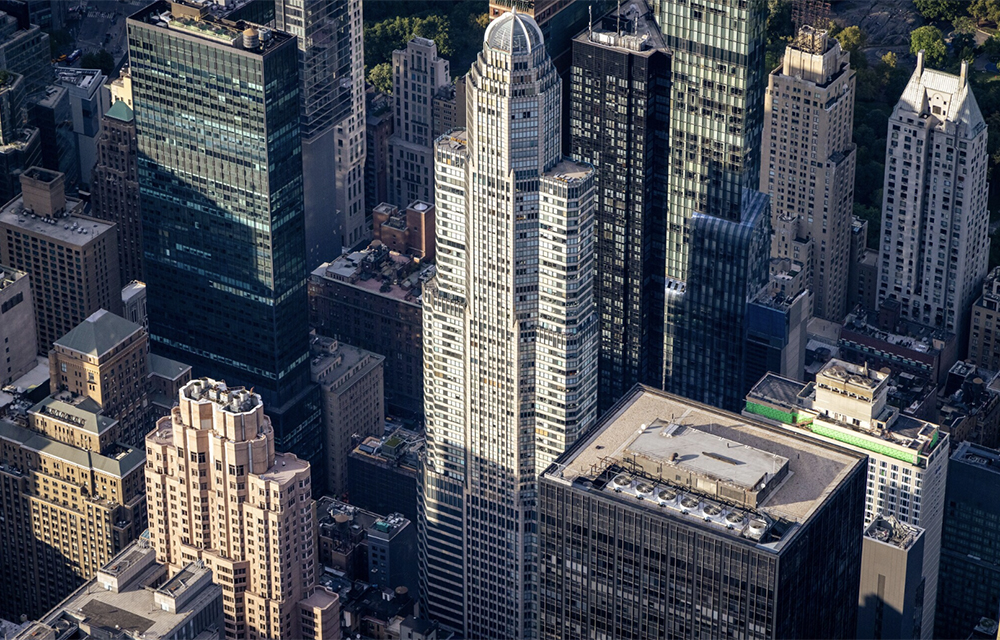
REALM, DelShah Capital and A.M. Properties acquire 377,000 s/f CitySpire office condominium
Manhattan, NY REALM, in partnership with DelShah Capital and A.M. Properties, acquired CitySpire, a 377,000 s/f office condominium comprising 24 floors within the 70-story tower at 156 W 56th St. in Midtown. Adjacent to Central Park with transit access and amenities, CitySpire is a Class A office asset located in one of the city’s most sought-after office corridors.




Quick Hits


Columns and Thought Leadership

Tri-state capital migrates nationally amid regulation pressure - by Reese Weaver
New York tri-state multifamily investors are increasingly reallocating capital to less-regulated markets across the U.S. as rent control and legislative risk erode returns at home. With over 60% of New York City’s rental housing stock classified as rent-stabilized, the traditional value-add model — buying under-performing buildings,

The death of the generic offering memorandum: What buyers expect in 2025 - by Kimberly Zar Bloorian
There was a time when an offering memorandum (OM) was pretty bare bones, some photos, a few bullet points on income, and a rent roll thrown in at the back. That used to get the job done. Not anymore. In 2025, buyers are sharper, faster, and more selective. They’re looking

A fresh start - by Shallini Mehra and Amit Doshi
For the past several years, the New York City multifamily housing market has been defined by disruption. The combined impact of the HSTPA rent laws and a sharply higher interest rate environment has fundamentally reduced

The anticipated effect of Basel III and ISO 20022 implementation on commercial real estate - by Michael Zysman
July 1, 2025 is the deadline for US banks to begin to adopt Basel III banking standards and July 14, 2025 is the deadline for U.S. banks to adopt ISO 20022 messaging standards. Both will have a significant effect on the banking and commercial real estate (CRE) finance sectors.