



News:
Brokerage
Posted: October 16, 2012
Should we be scared of a slowdown in the multifamily sector?
Has sluggish economic growth finally bogged down the rapid improvement of fundamentals for apartment properties across the nation? The national vacancy rate barely fell in the third quarter, inching downward from 4.7% to 4.6%, during a period that usually exhibits seasonal strength. This is the slowest rate of improvement since the recovery began in early 2010. For perspective, note that vacancies declined by an average of 35 basis points per quarter in 2010 and 2011; this year, vacancies fell by 30 basis points in the first quarter, 20 basis points in the second quarter, and 10 basis points in the third.
Net absorption, or the net change in occupied stock, slowed accordingly. Only 22,615 units were leased up in the third quarter, a clear trend downwards from the second quarter's figure of 31,014 and the first quarter's figure of 36,423. This is the lowest rate of absorption since the first quarter of 2010, and represents less than half the quarterly average rate of about 50,000 units that the sector enjoyed in 2010 and 2011.
Inventory growth continued at about the same pace as the second quarter, with 13,531 units coming online. This is still a relatively restrained pace for new construction, and demand for apartments still clearly outstrips supply growth, with absorption figures higher than construction, and vacancies declining. Still, there is cause for concern in the near-term that demand is abating for multifamily, just as a veritable avalanche of new projects begins to open their doors early next year.
Asking and effective rent growths were moderately healthy in the third quarter, coming in at 0.8% and 0.9%, respectively. This represents a slight decline versus second quarter's figures of 1.1% and 1.3%, but still represents a faster rate of rent growth than recent quarterly averages (between 0.5% to 0.6% in 2010 and 2011, for both asking and effective rents). With vacancies below 5% and the market getting relatively tight, landlords appear to have shifted their revenue-maximizing strategy from improving occupancy to raising rents.
Despite the slowdown in vacancy improvements and absorption, fundamentals still remain relatively robust, particularly given the context of high unemployment and tepid economic growth. We are on track to absorbing well over 100,000 units this year, and Reis expects further vacancy declines to the mid-4s by the end of 2012. The last time we saw vacancy levels in the low 4s was in mid-2001.
There are two risks in the near future: first, that demand for apartments will not be as robust. Home prices have shown a clear upward trend in recent months, with data from multiple sources all consistently reporting higher home prices and stronger figures for net home orders; it is notoriously difficult to trace a direct correlation between single-family home prices and demand for multifamily rentals, and linking individual decisions to either buy a single-family home or rent a multifamily apartment is challenging. Low mortgage rates have not prompted many households to buy homes, given expectations that home prices will remain flat. But that trend might finally be shifting: as home prices rise, households may feel a greater impetus to consider buying homes while mortgage rates remain low, and before prices rise "too much." This will tend to depress demand for apartment rentals.
The second risk for the apartment sector is the predictable spike in new construction, a big wave of which is expected to come online starting in 2013. Certain metros like Seattle, Washington, D.C. and Suburban Maryland appear to be at risk, given that their occupancies have only just recovered to 2006 levels. There are a lot of new projects coming online in Austin, but it can be argued that demand for apartments will remain strong, given that metro's large share of workers employed in the tech and energy sectors.
With demand potentially flagging and supply growth rapidly increasing, Reis expects national vacancies to improve only marginally over the next couple of years, with little chance of dipping below 4%. It is unlikely that apartment vacancies will decline to the 3s; the last time this happened was in the late '90s, but during that time GDP was growing well above 4% per year, a situation that certainly does not apply today. Landlord revenues will still be healthy, with effective rent growth expected to be around 3% over the next few years. However, it will be wise to temper the most optimistic forecasts for investment returns, even for this superstar property type.
Victor Calanog is the chief economist at Reis, Inc., New York, N.Y.
Tags:
Brokerage
MORE FROM Brokerage
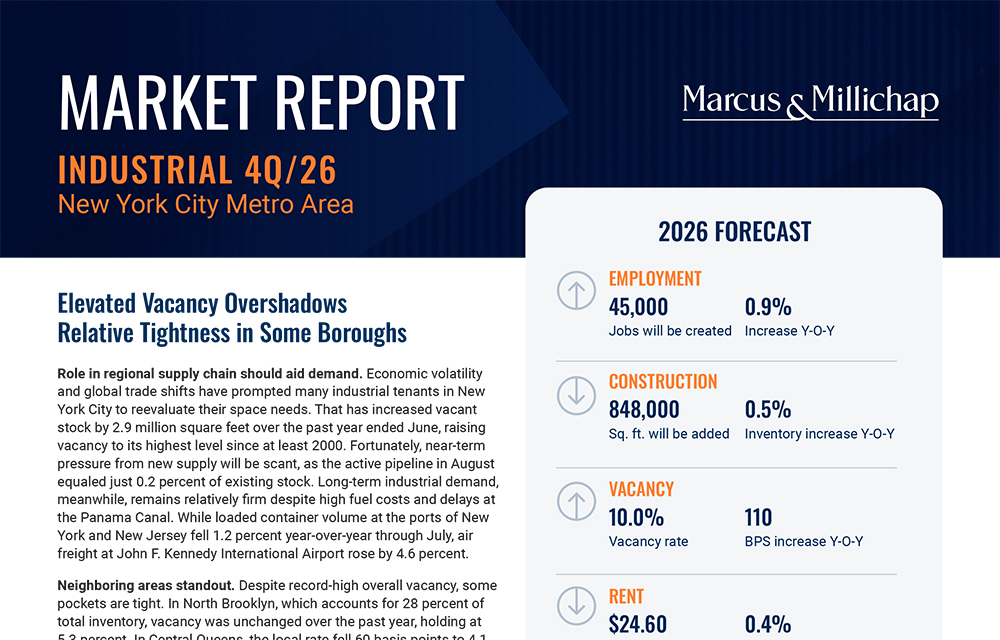
Marcus & Millichap releases fourth-quarter 2026 NYC industrial market report
Manhattan, NY Marcus & Millichap has published its fourth-quarter 2026 New York City Industrial Market Report. “New York City’s industrial market is showing a clear






Columns and Thought Leadership

New York’s streets are full again, and the retail numbers prove it - by Noam Aziz
Walk down any New York block this year and you can feel it. The sidewalks are crowded, the storefronts are lit, and the energy that defines this city is back at full volume.

The art of investing in real estate - by Thomas Donovan
Real estate investing is as much an art as it is a skill. No one can time the market, or the factors that drive it, perfectly. Location, zoning, size, transportation, and neighborhood density give you a baseline for

Hunt CRE question and answer: Choosing a real estate agent - by David Hunt
First, we will only work with one agent exclusively. The primary reason is that we want that agent to legally represent our client’s interests. In New York State, a real estate agent has a fiduciary

Hunt commercial real estate question and answer: Fortune 500 wisdom - by David Hunt
Yes, there are lessons to be learned from the largest companies in America when comes to managing your real estate. But the decision to buy or lease real estate may not be one of
.gif)