



News:
Brokerage
Posted: October 16, 2012
Get to know Gerald Swartz, partner at HKS Capital
Describe how you chose your profession and how you have succeeded in this industry?
I was in the manufacturing business and there was a credit crunch in the late 60s. I was 30 years old, had a wife and two children, was in contract to purchase a house and had to put my business into bankruptcy. I lost my contract on the house and I had given up my apartment renewal. I needed to support my family and do something to earn a living in a hurry. I had a friend that was an executive and son-in-law of Nat Goldman at Sonnenblick Goldman. He hired me as an originator on straight commission. I had to learn the commercial real estate industry quickly-and I did.
What are your proudest accomplishments so far this year and what are you looking forward to in 2013, in a personal or business sense?
My proudest accomplishment is growing HKS from a three person firm to a 16 person firm in only 18 months, increasing our production five fold and look forward to doubling staff as well as production next year.
How is the market doing, from your perspective?
When we started the company we were fortunate to experience a simultaneous renewal of the New York commercial real estate market. Since then we have originated a considerable amount of business from our Kansas City office as well. The market is reacting very favorably to historically low rates as well as lenders anxious to put dollars into real estate.
Describe something exciting that just happened at your company.
At my age, just getting to work in the morning!
If you could use one word to describe your work environment, what would it be?
Frenetic.
Describe a typical day at HKS?
A typical day at HKS moves at a fast pace. Brokers are diligently working with clients regarding their various debt and equity needs and consulting them on potential asset opportunities. Regardless if it's refinancing existing mortgages, planning for value add propositions or acquisition plays, or designing a viable and actionable plan for a development mobilization, we operate under a streamlined, team-oriented environment that coordinate seasoned analysts who assist brokers in the underwriting process and financial request submissions. Our comprehensive method for underwriting and third party relations for pre-qualifying valuations and feasibility ensure efficiency and accuracy for our submissions to the lending institutions. We pride our business on a long work day, but the reward is fruitful.
What are the ups and downs in your business?
As a rate and dollar driven industry, obviously all aspects of the business are sensitive to those two things. For example, as rates go up, cap rates follow and loan amount reduces affecting refinancing, acquisition, and construction costs. Availability of capital pushes the same buttons. When capital is scarce more equity is required on the part of borrowers, narrowing the potential for consummating a transaction. There have been any number of dips in the market from fallout of REITS, S&L's, tax law changes in 1986, market crash thereafter, long term capital in early 1990s, 9/11, etc., etc., etc., and of course the recent subprime lending crash. But I've toughed it out for over 40 years and am still a "deal junkie."
Gerald Swartz is a partner at HKS Capital Partners, New York, N.Y.
Tags:
Brokerage
MORE FROM Brokerage
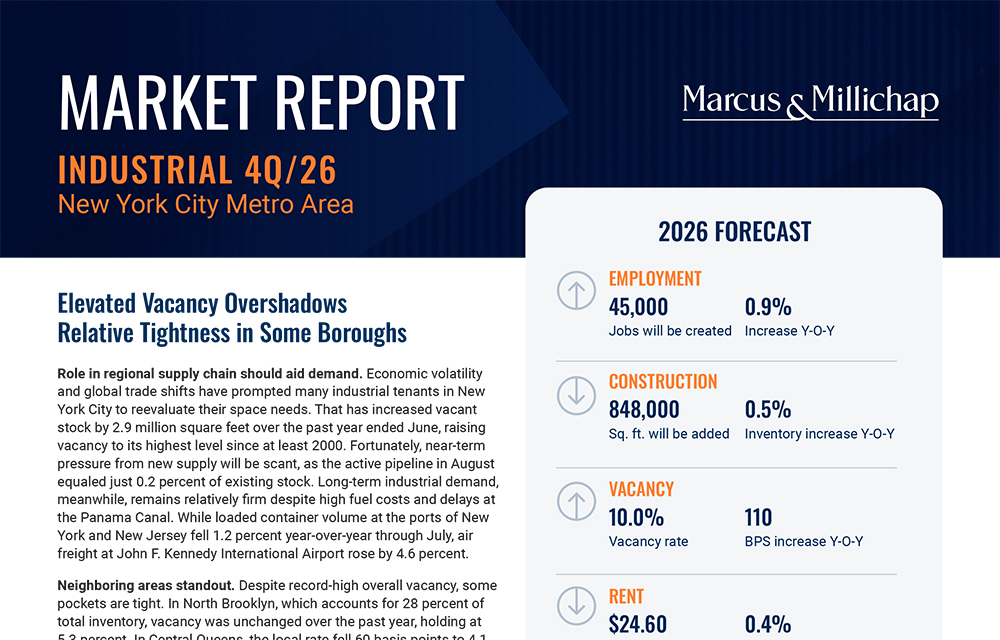
Marcus & Millichap releases fourth-quarter 2026 NYC industrial market report
Manhattan, NY Marcus & Millichap has published its fourth-quarter 2026 New York City Industrial Market Report. “New York City’s industrial market is showing a clear






Quick Hits

Columns and Thought Leadership

Hunt CRE question and answer: Choosing a real estate agent - by David Hunt
First, we will only work with one agent exclusively. The primary reason is that we want that agent to legally represent our client’s interests. In New York State, a real estate agent has a fiduciary

The art of investing in real estate - by Thomas Donovan
Real estate investing is as much an art as it is a skill. No one can time the market, or the factors that drive it, perfectly. Location, zoning, size, transportation, and neighborhood density give you a baseline for

Hunt commercial real estate question and answer: Fortune 500 wisdom - by David Hunt
Yes, there are lessons to be learned from the largest companies in America when comes to managing your real estate. But the decision to buy or lease real estate may not be one of

New York’s streets are full again, and the retail numbers prove it - by Noam Aziz
Walk down any New York block this year and you can feel it. The sidewalks are crowded, the storefronts are lit, and the energy that defines this city is back at full volume.
.gif)