



News:
Brokerage
Posted: May 11, 2015
Question of the Month: How does one dispose of a multifamily investment prop. & 1031 Exchange into a NNN leased prop.?
So you have owed multifamily investment properties for years and have been involved as an active investor handling all the day-to-day management. You are at a point in your life, where you are no longer interested in being an active investor. But, you like the financial benefits that real estate can offer as an investment. And would be interested in disposing of your multifamily investment property for a passive real estate investment.
You have learned that you would have a very sizable tax liability if you were to sell your multifamily investment property, which may be as much as one third of your selling price. Those taxes would include capital gains tax, re-capture of depreciation, potential Medicare surtax, as well as New York State.
There must be a better way! There is the "Best Kept Secret In Real Estate" known as a 1031 Real Estate Exchange. This concept has been around since the early 1900's when the first exchange laws were enacted. It is the opportunity to pay no tax when disposing of income-producing property, investment-held property even a secondary residence.
The way it works is as follows; you must be disposing of what's called a relinquished property, and before legal title is conveyed to the buyer, you must bring into your deal a professional qualified intermediary who's purpose and requirement is to structure these kinds of transactions. Once the qualified intermediary provides all the necessary 1031 exchange documents and the rights of the relinquished property have been assigned to the qualified intermediary you are ready to close. Upon closing, the title goes direct to the buyer and the net proceeds go to the qualified intermediary which are then used to acquire a replacement property, which has to be identified within forty-five days from closing of the relinquished property and closed within one hundred and eighty days of the first closing.
As a rule, as long as you acquire a replacement property whose value is equal or greater then the property you disposed of, there will be no tax. You also have the ability to do a partial 1031 exchange if you fall short of the value of the replacement property or would like to walk away with so cash.
Now that you have a solution to the problem of not having to pay in many cases as much as a third of your selling price to Uncle Sam in the form of taxation. What about the concept of acquiring a passive real estate investment to both fulfill the 1031 exchange requirement as well as your game plan of coming out of an active investment (multifamily) and going into a passive investment (NNN leased investment property)?
So what is a NNN Leased Investment Property? Triple Net Investing, (NNN) stands for "Net-Net-Net" and represents the three most common real estate expenses, property tax, insurance and maintenance. NNN investing involves buying a free-standing building that is leased long-term to a credit-worthy tenant. These types of tenants can include Walgreens, Dollar General, CVS, Auto Zone, McDonald's, Advance Auto Parts and KFC to name a few. NNN properties typically have corporate guaranteed leases by the tenants for a minimum term of fifteen to twenty years with additional options to renew said leases for an additional fifteen to fifty years.
There are clearly advantages in owning a NNN leased investment property. These properties can fulfill objectives that may not be met by a typical real estate investment in which you need to be an active investor in. With our life style today in the 21st century many investors are looking for a passive form of real estate investment. There is no better one then a NNN Leased Investment Property. So if you are looking for guaranteed monthly income with no property management responsibilities, a NNN leased investment property may be what you are looking for.
Russell Gullo, CCIM, CEA, is a certified exchange advisor, president of R. J. Gullo & Co., Inc., West Seneca, N.Y.
Tags:
Brokerage
MORE FROM Brokerage
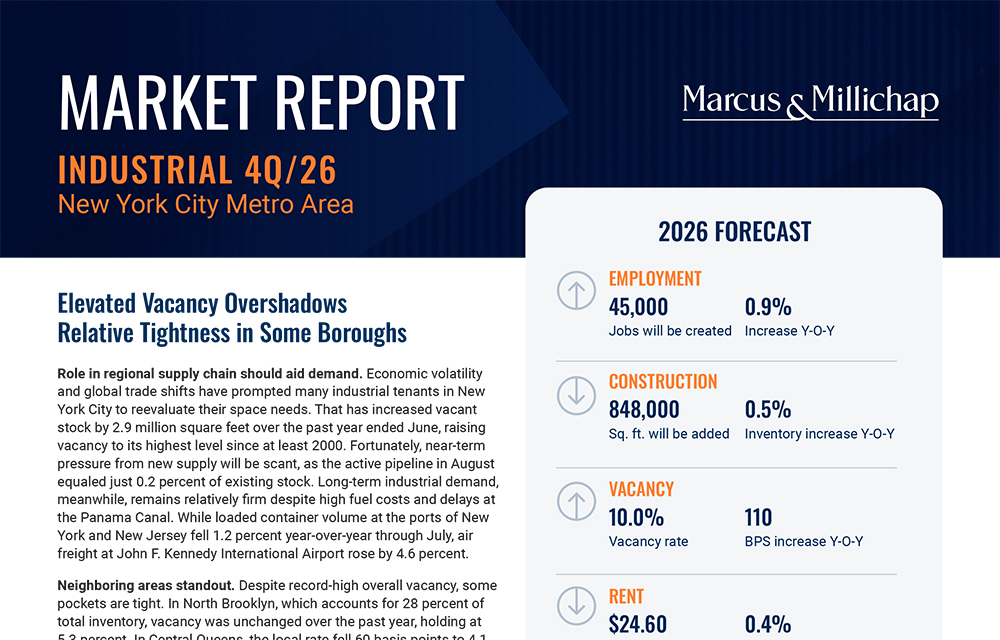
Marcus & Millichap releases fourth-quarter 2026 NYC industrial market report
Manhattan, NY Marcus & Millichap has published its fourth-quarter 2026 New York City Industrial Market Report. “New York City’s industrial market is showing a clear



Quick Hits
 (2).gif)

Columns and Thought Leadership

The art of investing in real estate - by Thomas Donovan
Real estate investing is as much an art as it is a skill. No one can time the market, or the factors that drive it, perfectly. Location, zoning, size, transportation, and neighborhood density give you a baseline for

Hunt CRE question and answer: Choosing a real estate agent - by David Hunt
First, we will only work with one agent exclusively. The primary reason is that we want that agent to legally represent our client’s interests. In New York State, a real estate agent has a fiduciary

New York’s streets are full again, and the retail numbers prove it - by Noam Aziz
Walk down any New York block this year and you can feel it. The sidewalks are crowded, the storefronts are lit, and the energy that defines this city is back at full volume.

Hunt commercial real estate question and answer: Fortune 500 wisdom - by David Hunt
Yes, there are lessons to be learned from the largest companies in America when comes to managing your real estate. But the decision to buy or lease real estate may not be one of
.gif)