


 (2).gif)
News:
Spotlight Content
Posted: May 30, 2023
Parking garage condition assessments New York state and New York City requirements - by Chris Krepcio

In April, a parking garage collapsed in lower Manhattan, killing one person and injuring five others. While the cause is still under investigation, structural issues are believed to be to blame for the tragic collapse. Recent changes were put into effect to prevent future negligence and destruction of parking garages across New York State and New York City. Below is a brief summary of each rule.
 New York State Parking Garage Condition Assessments
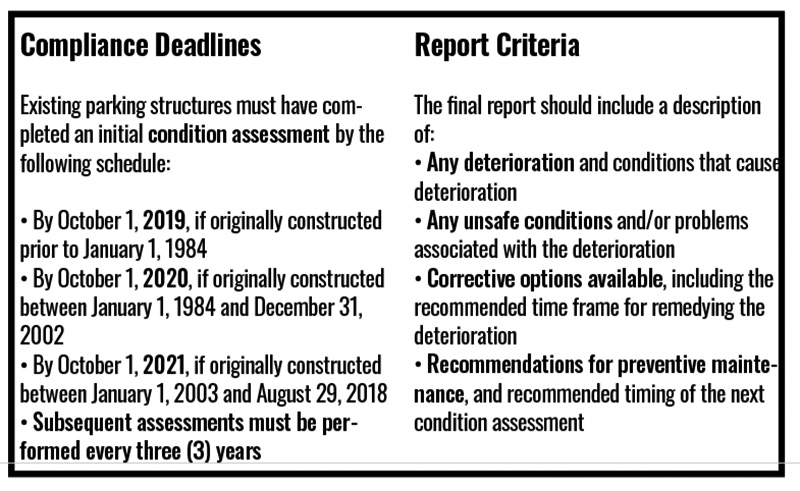
The Department of State adopted a rule that amends Parts 1202, 1203, and 1204 of Title 19 of the New York Codes, Rules and Regulations, which requires owners of parking garages to have periodic condition assessments performed by a qualified Professional Engineer (PE). The assessment should include an on-site inspection and evaluation of a parking garage to determine evidence of deterioration of any structural element or building component, evidence of the existence of any unsafe condition, and evidence indicating that a parking garage is an unsafe structure. Once the engineer completes the condition assessment, a report will be prepared, signed, sealed and then submitted to the local jurisdiction.
 New York City Local Law 126 Garage Inspections
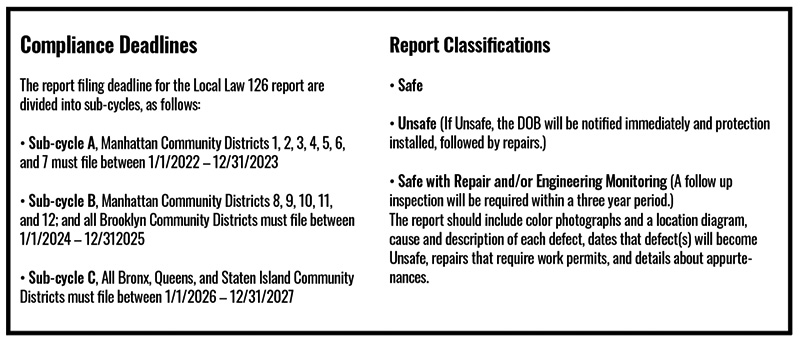
Local Law 126 of 2021 requires owners of parking structures to hire a NYS licensed and registered Professional Engineer (PE) to inspect the structure at least once every six years and file a report with the DOB documenting the results of the inspection (in accordance with NYC Construction Codes §28-323, and RCNY §103-13). Any space for parking/storing motor vehicles, other than an unenclosed outdoor lot, 1- or 2-car garage, or auto service station or showroom, must undergo an assessment by a certified QPSI.
Chris Krepcio, PE, Certified NYC QPSI, is principal at Merritt Engineering, Queens, N.Y.
Tags:
Spotlight Content
MORE FROM Spotlight Content

Participate in Developing New York Featuring Westchester County - November 24, 2026
Choose how you’d like to participate in this edition of NYREJ’s Developing New York series featuring Westchester County.




.png)

Quick Hits


Columns and Thought Leadership

2026 Developing Long Island: ERG Commercial Real Estate launches its new Retail Leasing division
North Hempstead, NY ERG Retail Leasing is the dedicated leasing division of ERG Commercial Real Estate, an established full-service commercial real estate brokerage for over 35 years.

2026 Developing Queens: Long Island Board of Realtors advances commercial growth and advocacy in Queens
The Long Island Board of Realtors (LIBOR) Commercial Network continues to play a key role in advancing opportunities and strengthening the commercial real estate landscape across Queens. Through targeted programming and global outreach

CRE Guide Featured Company: Merritt Environmental Consulting Corp.
Merritt Environmental Consulting Corp. (MECC) was established in June of 2009 after being part of a larger engineering firm for almost 20 years. The focus of the company is to assist lending institutions, attorneys, real estate investors, and property owners with environmental concerns. Today, MECC has offices in New York, Florida, and Vermont and has grown into a regional consulting firm serving clients along the East Coast.

From vacancy to vitality: How adaptive reuse is reshaping Long Island’s CRE landscape - by Andrea Tsoukalas Curto
Adaptive reuse has become one of the most important conversations in commercial real estate today. Long Island has a large inventory of aging retail, office and industrial