News: Brokerage

Pace celebrates grand opening of Alumni Hall
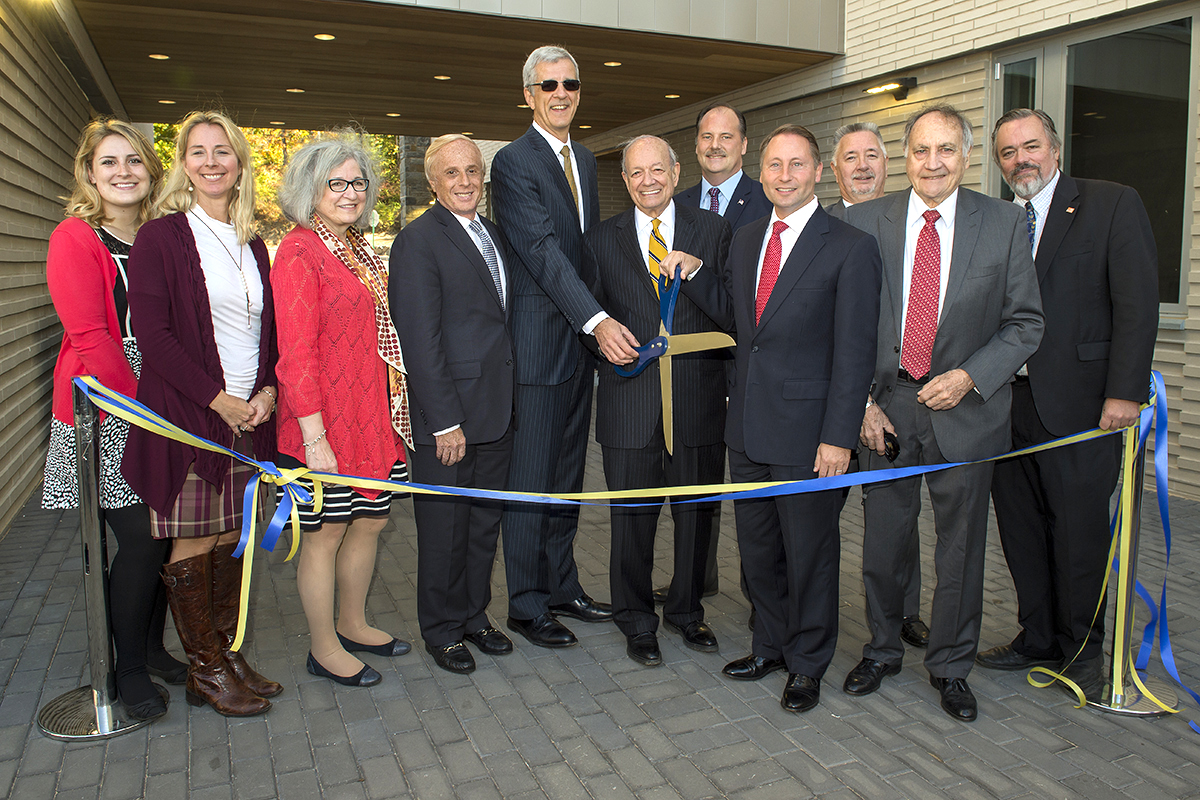
Shown (from left) are: President of Pace Resident Hall Association Kathryn Dunn; AVP and Dean for Students Lisa Bardill Moscaritolo; Dyson College Dean Nira Herrmann; Pace Trustee Mark Besca; Sr. VP and COO William McGrath; president Stephen Friedman; town of Mt. Pleasant Councilman Denis McCarthy, county executive Robert Astorino; town of Mt. Pleasant town supervisor Carl Fulgenzi; Pace Alumnus Dr. Ivor  Whitson and village of Pleasantville mayor Peter Scherer Shown (from left) are: President of Pace Resident Hall Association Kathryn Dunn; AVP and Dean for Students Lisa Bardill Moscaritolo; Dyson College Dean Nira Herrmann; Pace Trustee Mark Besca; Sr. VP and COO William McGrath; president Stephen Friedman; town of Mt. Pleasant Councilman Denis McCarthy, county executive Robert Astorino; town of Mt. Pleasant town supervisor Carl Fulgenzi; Pace Alumnus Dr. Ivor Whitson and village of Pleasantville mayor Peter Scherer
Pleasantville, NY Pace University celebrated an important milestone in the more than 50-year history of its Pleasantville campus as Pace University president Stephen Friedman joined with county and local leaders for the grand opening on October 15 of the new Alumni Hall residential building and new Environmental Center Complex. A formal ribbon-cutting ceremony for the two new facilities was attended by more than 100 Pace students, faculty and staff members as well as government and business leaders. “Alumni Hall and the new Environmental Center Complex are transformative additions to our reimagined campus,” said Friedman. “Thousands of young men and women will live and work in these buildings and discover the true meaning of Pace’s motto of Opportunitas.” “We congratulate Pace University on this historic milestone,” said Westchester County executive Robert Astorino. “This newly modernized campus further enhances Westchester’s reputation as a leader in higher education. We are particularly pleased that the County’s Local Development Corp. provided Pace with access to $98 million in low-cost, tax-exempt bond financing for this project at no cost to the taxpayers.” “The Pace University Pleasantville Master Plan has been a positive development for the Mount Pleasant community,” said Mount Pleasant town supervisor Carl Fulgenzi. “The University has worked hand-in-hand with the town throughout the approval and construction process, and we are ecstatic to see Alumni Hall and the Environmental Center Complex come to fruition.” Completion of these two major projects -- along with new athletic fields and field house -- represents the near completion of the first phase of a $100 million master plan to revitalize and transform the 200-acre Pleasantville campus to improve the student experience at Pace.
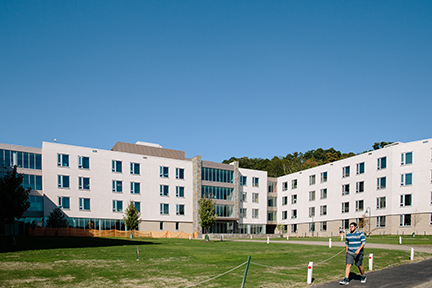
Alumni Hall residential building and new Environmental Center Complex - Pleasantville, NY Alumni Hall residential building and new Environmental Center Complex - Pleasantville, NY
The 125,000 s/f Alumni Hall is the first of the new residence halls planned for the Pleasantville campus that creates a more modern, sustainable, and dynamic living and learning community. Centrally located in the heart of the campus and overlooking a spacious campus green, the four-story residence hall houses primarily first-year students with space for returning students in suites and semi-suites. Amenities in Alumni Hall include two classrooms, a dining option, lounges, study rooms, and several First Year Interest Groups (FIGs), which are themed communities in the residence halls that bring together students with common interests. A second residence hall adjacent to Alumni Hall is under construction and will be completed by next fall. Completion of the new residence halls will enable Pace to consolidate functions that are now split between campuses in Pleasantville and Briarcliff Manor. The new Environmental Center Complex includes a classroom building and a replica of the former farmhouse building which serves as a key facility for faculty and students. There is also a raptor museum featuring various birds of prey; animal barns; and an open outdoor classroom and event space. The complex includes space for students to attend seminars and for informal gatherings with their peers and faculty members. The complex serves as a resource for the newly launched Department of Environmental Studies and Science (ESS), housed in the replica farmhouse building. The replica farmhouse is also the new home for the Pace Academy for Applied Environmental Studies and headquarters for the Environmental Consortium of Colleges and Universities. Pace is known for its commitment to the environment. Pace’s Environmental Studies program was one of the first of its kind in the U.S. and Pace Law School has consistently ranked high in the nation in environmental law. In April, Pace celebrated the reopening of the renovated and expanded Jeanette and Morris Kessel Student Center. Also newly completed are the Peter X. Finnerty baseball field and the new Pace Stadium. The new 14,000-square-foot Ianniello Field House is scheduled to be completed next month. The facility is named after Joseph Ianniello, the CBS Corporation’s Chief Operating Officer and a member of the Pace University Board of Trustees who made a $2 million commitment for the construction of the new facility.
READ ON THE GO
DIGITAL EDITIONS
Subscribe
Columns and Thought Leadership
A fresh start - by Shallini Mehra and Amit Doshi

A fresh start - by Shallini Mehra and Amit Doshi

For the past several years, the New York City multifamily housing market has been defined by disruption. The combined impact of the HSTPA rent laws and a sharply higher interest rate environment has fundamentally reduced
Tri-state capital  migrates nationally amid  regulation pressure - by Reese Weaver

Tri-state capital migrates nationally amid regulation pressure - by Reese Weaver

New York tri-state multifamily investors are increasingly reallocating capital to less-regulated markets across the U.S. as rent control and legislative risk erode returns at home. With over 60% of New York City’s rental housing stock classified as rent-stabilized, the traditional value-add model — buying under-performing buildings,

The anticipated effect of Basel III and ISO 20022 implementation on commercial real estate - by Michael Zysman

The anticipated effect of Basel III and ISO 20022 implementation on commercial real estate - by Michael Zysman

July 1, 2025 is the deadline for US banks to begin to adopt Basel III banking standards and July 14, 2025 is the deadline for U.S. banks to adopt ISO 20022 messaging standards. Both will have a significant effect on the banking and commercial real estate (CRE) finance sectors.
The death of the generic offering memorandum: What buyers expect in 2025 - by Kimberly Zar Bloorian

The death of the generic offering memorandum: What buyers expect in 2025 - by Kimberly Zar Bloorian

There was a time when an offering memorandum (OM) was pretty bare bones, some photos, a few bullet points on income, and a rent roll thrown in at the back. That used to get the job done. Not anymore. In 2025, buyers are sharper, faster, and more selective. They’re looking