



News:
Brokerage
Posted: November 21, 2017
Offshore capital taking over traditional real estate financing - by Joe Berko
The Israeli Bond market is booming. To date, 27 US real estate entities have gone to the Israeli public debt markets, bringing back approximately $6 billion to the shores of the U.S. Initially seen as a financing fad limited to the those operating in the metro-NYC market, US issuers from Texas, California, Florida, Chicago, New York and Boston are now tapping into Israel’s Capital Markets. With more familiarity on the Israeli side, along with the virtues, affordability, and speed of the financing reaching sponsors’ desks, the market is becoming a preferred long-term alternative financing option in place of partners, mezzanine and preferred equity. No validation to it’s long term use is stronger than the fact that of the 27 issuers, 14 of them have gone back to the market for at least a second series of bond raise.
A Unique, Flexible and Cheap Financing Option
The bonds are unsecured, non-recourse, corporate-level debt providing customizable payment schedules without the need for any inter-creditory agreements, asset-level mortgages, personal guarantees, liens or UCC filings, mitigating the headache typically associated with alternative financing options. With the ability to underwrite a Sponsor’s fractional ownership without affecting their non-participating partners or asset level capital stack, the bonds compliment a variety of real estate ownership structures, including REITs, private equity, and syndicated funds. At fixed interest rates typically between 4% and 6%, this financial instrument offers sponsors great flexibility in utilizing the proceeds–everything from paying off expensive debt to buying out partners to ground-up development.
Why Israel?
The underpinnings of this phenomenon can be attributed to a confluence of factors, namely, historically low Israeli interest rates, limited investment options and a mandatory Israeli state pension program. The Israeli Central Bank has maintained their rates between 0.1% and 0.25% over the last 3.5 years, creating a very favorable lending environment for foreign and domestic issuers. To that point, comparatively rated Israeli domiciled bonds yield approximately 2.0% less than foreign issuances, creating an investment delta that is highly attractive to both institutional and retail investors alike (refer to chart 1). Perhaps the most important of the three factors mentioned is the mandated state pension program, which is bringing $2.5 billion dollars into the market monthly (refer to chart 2). In a country, smaller than New Jersey, starved for investment grade options, the Israeli Corporate Bond market is a win-win for U.S. issuers and Israeli investors.
Joe Berko is president, Daniel Rizza is in capital markets, and Laura Nieves is vice president projects at Berko & Associates, New York, N.Y.
Tags:
Brokerage
MORE FROM Brokerage
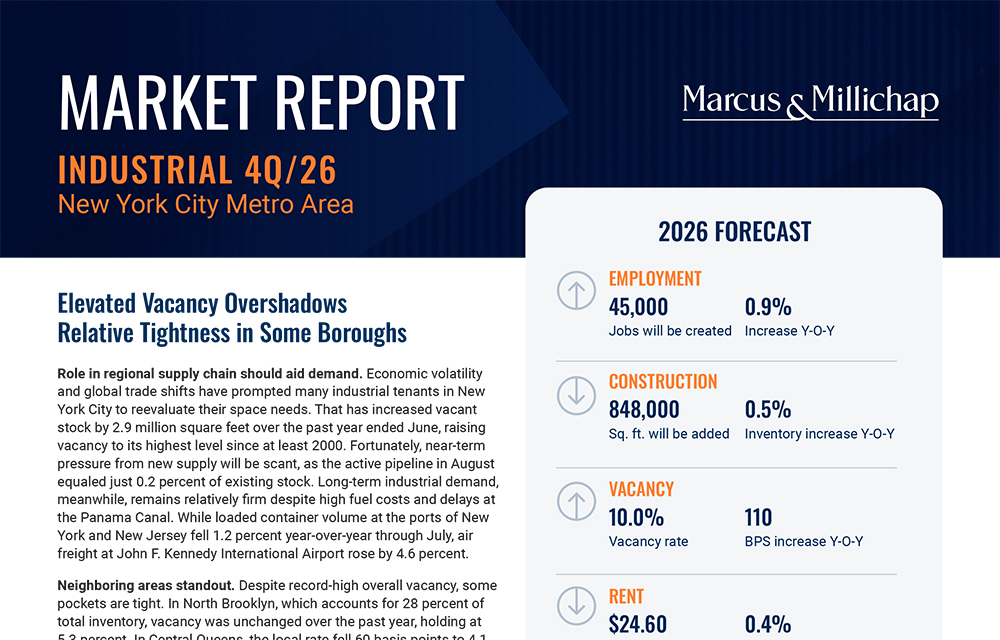
Marcus & Millichap releases fourth-quarter 2026 NYC industrial market report
Manhattan, NY Marcus & Millichap has published its fourth-quarter 2026 New York City Industrial Market Report. “New York City’s industrial market is showing a clear





 (2).gif)

Columns and Thought Leadership

The art of investing in real estate - by Thomas Donovan
Real estate investing is as much an art as it is a skill. No one can time the market, or the factors that drive it, perfectly. Location, zoning, size, transportation, and neighborhood density give you a baseline for

Hunt CRE question and answer: Choosing a real estate agent - by David Hunt
First, we will only work with one agent exclusively. The primary reason is that we want that agent to legally represent our client’s interests. In New York State, a real estate agent has a fiduciary

New York’s streets are full again, and the retail numbers prove it - by Noam Aziz
Walk down any New York block this year and you can feel it. The sidewalks are crowded, the storefronts are lit, and the energy that defines this city is back at full volume.

Hunt commercial real estate question and answer: Fortune 500 wisdom - by David Hunt
Yes, there are lessons to be learned from the largest companies in America when comes to managing your real estate. But the decision to buy or lease real estate may not be one of
.gif)