



News:
Brokerage
Posted: April 16, 2024
New York City Real Estate Recovery - by Robert Khodadadian

As a Manhattan-based commercial real estate broker at Skyline Properties, I've been closely involved in observing the surprising turnaround in New York City's real estate market following the COVID-19 pandemic. When initial projections suggested a recovery by 2025, the city defied expectations, rebounding ahead of schedule, fueled by robust job growth and a resurgence in population.
In my role, I've witnessed firsthand the resilience of New York City's real estate landscape. Despite a 5.4% population decline from April 2020 to July 2022, the city swiftly regained its footing, reclaiming all lost private-sector jobs by October 2023, with the unemployment rate dropping to 5.3% in September 2023. While challenges like office space vacancies persist, there's a palpable sense of improvement, especially in vibrant areas like Midtown and Lower Manhattan, which have bounced back to 74% of their 2019 levels.
Manhattan, in particular, has seen a notable influx of new residents, with over 17,000 newcomers welcomed by 2022. I've noticed this transformation in neighborhoods like the Civic Center and Lower East Side Manhattan, as well as popular spots in Brooklyn such as Brooklyn Heights and Williamsburg. However, challenges remain in certain inner neighborhoods of Brooklyn, where population declines persist.
As the city's job market gains momentum, we're seeing increased foot traffic in retail, dining, and hospitality sectors, particularly in bustling districts like Midtown and Lower Manhattan. Yet, despite the promising signs of a return-to-office movement, office space utilization remains below pre-pandemic levels, posing a significant challenge to real estate recovery efforts.
Amidst these challenges, Manhattan's office market has shown resilience, with a noticeable shift towards quality spaces. Buildings like One Vanderbilt, with its low vacancy rates and premium amenities, highlight the demand for high-quality office environments in the city.
Substantial investments in subway safety and infrastructure upgrades have restored confidence in public transportation, contributing to the city's overall recovery. Additionally, New York City's tourism industry is experiencing a resurgence, with plans to add 11,000 hotel rooms in the coming years.
In the housing market, we've experienced a remarkable boom, with record-low vacancy rates and soaring rent prices. However, challenges persist, including rising construction costs and changes in tax incentives for developers.
Looking ahead, I believe that New York's real estate recovery in 2024 will require innovative approaches and strategic planning. As someone deeply invested in the city's real estate landscape, I'm committed to navigating these complexities alongside my clients, ensuring that we seize opportunities for growth and development in this evolving market.
Robert Khodadadian is a investment sales broker at Skyline Properties, New York, NY.
Tags:
Brokerage
MORE FROM Brokerage
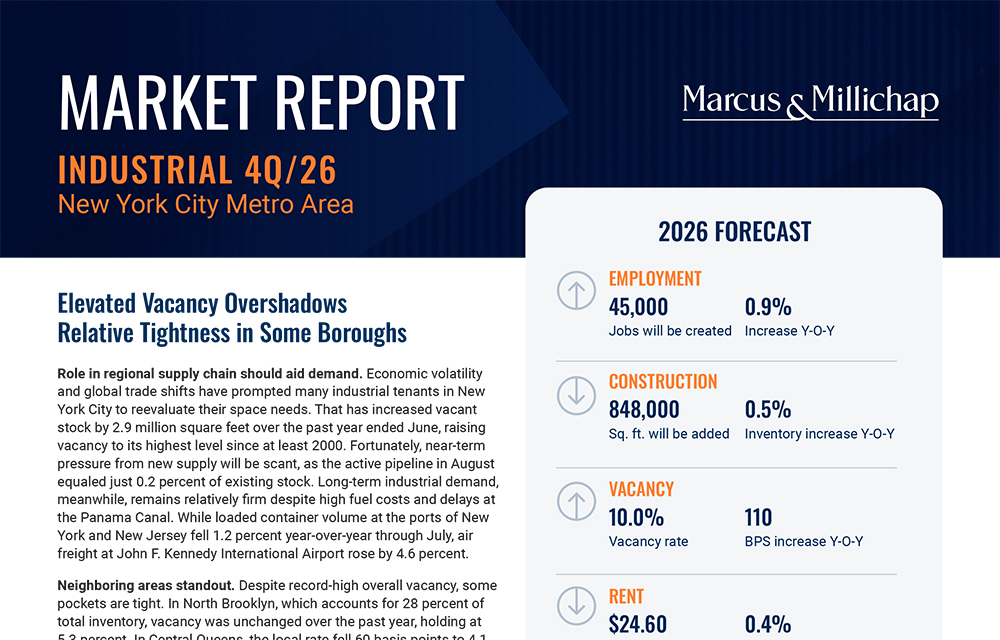
Marcus & Millichap releases fourth-quarter 2026 NYC industrial market report
Manhattan, NY Marcus & Millichap has published its fourth-quarter 2026 New York City Industrial Market Report. “New York City’s industrial market is showing a clear




Columns and Thought Leadership

Hunt CRE question and answer: Choosing a real estate agent - by David Hunt
First, we will only work with one agent exclusively. The primary reason is that we want that agent to legally represent our client’s interests. In New York State, a real estate agent has a fiduciary

New York’s streets are full again, and the retail numbers prove it - by Noam Aziz
Walk down any New York block this year and you can feel it. The sidewalks are crowded, the storefronts are lit, and the energy that defines this city is back at full volume.

Hunt commercial real estate question and answer: Fortune 500 wisdom - by David Hunt
Yes, there are lessons to be learned from the largest companies in America when comes to managing your real estate. But the decision to buy or lease real estate may not be one of

The art of investing in real estate - by Thomas Donovan
Real estate investing is as much an art as it is a skill. No one can time the market, or the factors that drive it, perfectly. Location, zoning, size, transportation, and neighborhood density give you a baseline for
.gif)