



News:
Brokerage
Posted: January 12, 2009
N.Y. is well positioned to take advantage of high-tech industries
In light of the current economy, this may be a good time for the state and communities around N.Y. to evaluate policies that help those businesses that rely more on intellectual property than real property. N.Y. is well positioned to take advantage of competitive strengths that benefit strategic, high-tech industries. While these businesses have real estate needs, other factors such as proximity to a research university, an educated and available work force and quality of life, tend to be more important factors. Businesses in sectors such as nanotech, clean energy, and life sciences are inventing and investing in NYS. In the Capital District, more than $5 billion has been invested in the last eight years by organizations such as IBM, Phillips, Tokyo Electron, Sematech, and SUNY Albany College of Nanoscale Engineering and Science.
But, perhaps the strategic industry that may provide the greatest potential for NYS is life science. There are several key factors that drive the location and expansion process, labor costs, availability of a skilled work force, business-friendly environment, distribution accessibility, and, of course, incentives. In N.Y., we have all this and more to expand our growing bioscience industry. For starters, there's our exceptional research infrastructure, with more than 30 academic centers and $38 million in research funding, it supports hundreds of existing bioscience companies and is a key factor in attracting and retaining research staff. N.Y. offers a large, highly skilled talent pool, graduating more than 4,300 MDs and 136,000 PhDs annually; we've produced 130 Nobel Prize winners and 330 Howard Hughes Investigators. Couple talent with a world-class medical network and the stage is set for fruitful collaboration, discovery, and commercialization. Today, N.Y. ranks second in the U.S. in three areas:
* Total university and R&D expenditures: $3.09 billion.
* Life sciences R&D expenditures: $2.15 billion.
* Biological scientists in the work force: 38,200.
N.Y. ranks third in the country in:
* National Institute of Health funding: $1.96 billion.
* Higher education degrees in biological sciences: 6,760.
From the urban centers downstate to rural areas and small cities upstate, every bioscience cluster is rich in academic resources, R&D, and a skilled work force. There are more than 800 medical device and equipment companies, employing 20,000 workers at every level.
About 1,200 firms are engaged in research and testing and a growing number of companies are working in the agricultural feedstock & chemical subsector. The drugs and pharmaceuticals sector accounts for the largest work force, primarily downstate, with more than 20,000 workers and over 150 companies. These businesses provide an average compensation of $65,000. Here, you'll find U.S. headquarters for household names such as Pfizer and Bristol Myers Squibb, and entrepreneurial leaders such as OSI Pharmaceuticals and Intercept Pharmaceuticals.
The pharmaceutical and biotechnology industries pour $846 million in tax revenue into NYS, and invested more than $530 million in factory expansions in 2005 alone. This amounts to the second largest capital expenditure industry in the state.
Making N.Y. attractive to biotechnology and pharmaceuticals will help build on the $8.4 billion the industries now contribute to the state's economic output. Biotech offers the potential of rapid growth following discovery and commercialization. N.Y. is an international leader in this sector and can improve its position further through wise investments that grow human capital and facilitate research and development.
Brian McMahon is president of the NYS Economic Development Council, Albany, N.Y.
Tags:
Brokerage
MORE FROM Brokerage
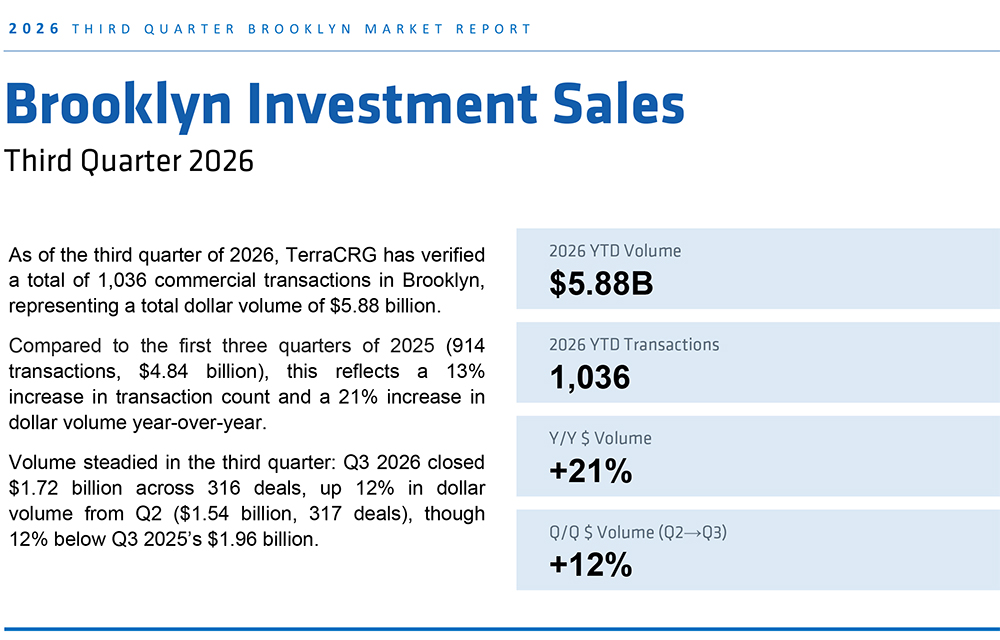
TerraCRG releases 3Q 2026 Brooklyn Market Report: Investment sales reach $5.88 billion tear-to-date, up 21%
Brooklyn, NY TerraCRG released its 3Q 2026 Brooklyn Market Report. Through the first three quarters of 2026, TerraCRG verified 1,036 commercial investment sales in Brooklyn





 (2).gif)

Columns and Thought Leadership

Hunt CRE question and answer: Choosing a real estate agent - by David Hunt
First, we will only work with one agent exclusively. The primary reason is that we want that agent to legally represent our client’s interests. In New York State, a real estate agent has a fiduciary

New York’s streets are full again, and the retail numbers prove it - by Noam Aziz
Walk down any New York block this year and you can feel it. The sidewalks are crowded, the storefronts are lit, and the energy that defines this city is back at full volume.

The art of investing in real estate - by Thomas Donovan
Real estate investing is as much an art as it is a skill. No one can time the market, or the factors that drive it, perfectly. Location, zoning, size, transportation, and neighborhood density give you a baseline for

Hunt commercial real estate question and answer: Fortune 500 wisdom - by David Hunt
Yes, there are lessons to be learned from the largest companies in America when comes to managing your real estate. But the decision to buy or lease real estate may not be one of
.gif)