



News:
Brokerage
Posted: May 26, 2015
Mullaney of Pembrook Capital closes $20 million first mortgage loan for acquisition of 468 Columbus Avenue
Pembrook Capital Management LLC, a commercial real estate investment manager that provides financing throughout the capital structure including first mortgages, mezzanine, bridge loans, note financings, and preferred equity for most property types, has closed a $20 million first mortgage loan for the purchase of 468 Columbus Ave., a property on the Upper West Side. Paul Mullaney, managing director, head of underwriting for Pembrook closed the loan.
The property is currently a three-story, 15,000 s/f vacant retail asset, with the potential for constructing residential apartments. The borrower plans to lease the current three floors to a retail tenant and then redevelop the property for residential use by adding five additional floors of apartments. Upon completion, the new property is expected to be eight stories with 31,000 s/f of total rentable area.
"Our reputation as an experienced lender helped us source and close this opportunity," said Pembrook's Terence Baydala, managing director, originations. "We continue to identify what we believe to be quality deals with experienced sponsors. In addition to what is a prime location in Manhattan a block away from Central Park and the Museum of Natural History, the borrower's business plan to add an extensive residential component to the property should create long-term value and we look forward to seeing the final construction."
Pembrook works with real estate developers and investors to deliver financing for new construction, acquisition, and repositioning, focusing on primary and secondary markets with high barriers to entry. Since inception, Pembrook has originated or participated in 75 investments totaling over $850 million.
Tags:
Brokerage
MORE FROM Brokerage
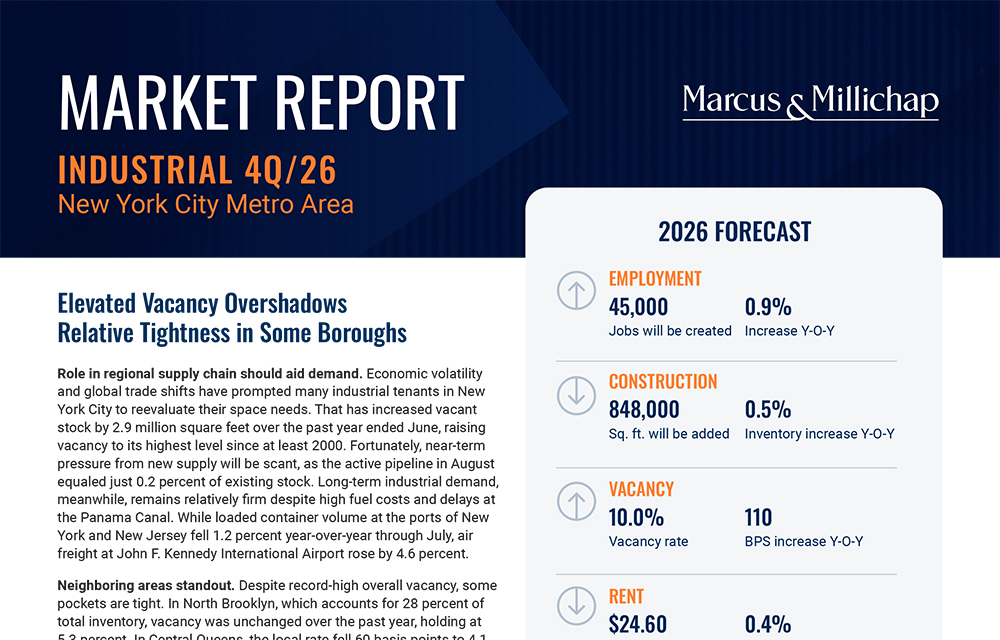
Marcus & Millichap releases fourth-quarter 2026 NYC industrial market report
Manhattan, NY Marcus & Millichap has published its fourth-quarter 2026 New York City Industrial Market Report. “New York City’s industrial market is showing a clear






 (2).gif)

Columns and Thought Leadership

The art of investing in real estate - by Thomas Donovan
Real estate investing is as much an art as it is a skill. No one can time the market, or the factors that drive it, perfectly. Location, zoning, size, transportation, and neighborhood density give you a baseline for

New York’s streets are full again, and the retail numbers prove it - by Noam Aziz
Walk down any New York block this year and you can feel it. The sidewalks are crowded, the storefronts are lit, and the energy that defines this city is back at full volume.

Hunt CRE question and answer: Choosing a real estate agent - by David Hunt
First, we will only work with one agent exclusively. The primary reason is that we want that agent to legally represent our client’s interests. In New York State, a real estate agent has a fiduciary

Hunt commercial real estate question and answer: Fortune 500 wisdom - by David Hunt
Yes, there are lessons to be learned from the largest companies in America when comes to managing your real estate. But the decision to buy or lease real estate may not be one of
.gif)