



News:
Brokerage
Posted: May 26, 2015
Law: Owner and lessee of real property must be served with a mechanic's lien
The lessee of real property who hires a contractor to perform construction work in its leased space has an obligation to pay the contractor for that work. When the lessee does not pay the contractor, the contractor may file a mechanic's lien against the real property to secure payment for its work.
The contractor may then serve the fee simple owner with the mechanic's lien, but it may fail to serve the lessee with a copy of the lien. The contractor's failure to serve both the fee simple owner and the lessee with the lien, however, renders the lien defective and subject to cancellation by the court.
In order to avoid cancellation of a lien, under the facts stated above, a mechanic's lien must be served on both the fee simple owner and the lessee of real property. Pursuant to Lien Law §4(1), a lien extends "to the owner's right, title or interest in the real property and improvements, existing at the time of filing the notice of lien..."
Lien Law §2(3) defines an owner to include both the owner in fee simple of real property and the lessees of that real property. As such, a leaseholder is considered an owner within the definition of Lien Law §2(3). Moreover, a leasehold is a lienable interest, and the tenant is an "owner" of its leasehold under Lien Law §2(3).
Under Lien Law §11, the owner of real property must be served with a notice of mechanic's lien, otherwise the lien must be canceled and discharged of record. Not only does Lien Law §11 require a party to serve a notice of lien upon the owner, but proof that the lien was served on the owner must be filed with the county clerk where the real property is located.
A court has no discretion if a party fails to comply with Lien Law §11, and must discharge the lien, when a party fails to either serve the notice of lien on the owner or fails to timely file proof of service for the lien with the county clerk. Thus, it is imperative that a contractor who is contracted directly by a tenant to perform work, in filing its mechanic's lien, serve both the fee simple owner and the tenant with the lien to its avoid cancellation.
Parshhueram Misir, Esq. is an attorney at Forchelli, Curto, Deegan, Schwartz, Mineo & Terrana LLP, New York, N.Y.
Tags:
Brokerage
MORE FROM Brokerage
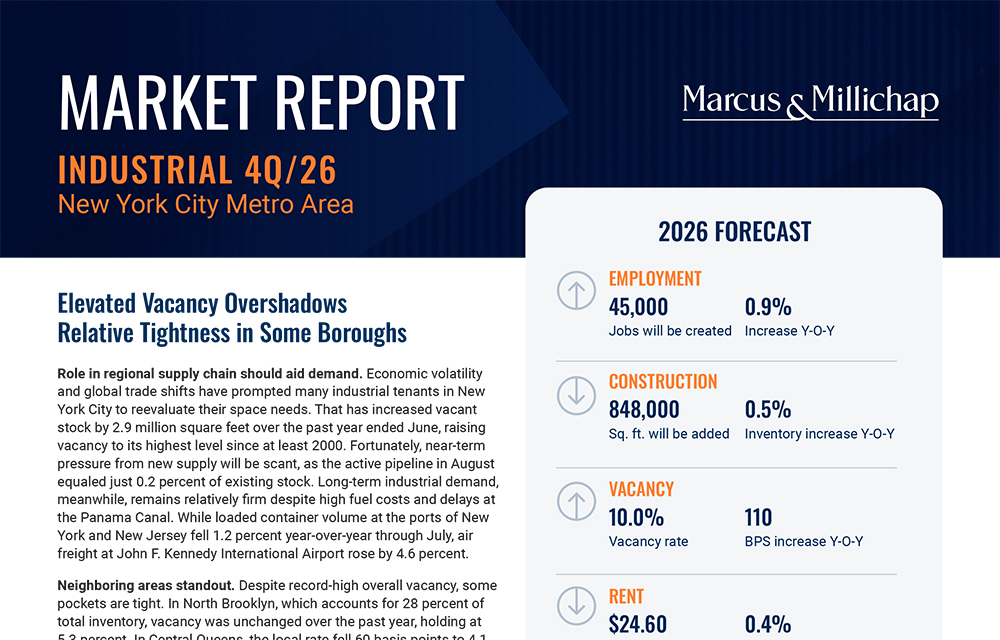
Marcus & Millichap releases fourth-quarter 2026 NYC industrial market report
Manhattan, NY Marcus & Millichap has published its fourth-quarter 2026 New York City Industrial Market Report. “New York City’s industrial market is showing a clear






Quick Hits

Columns and Thought Leadership

New York’s streets are full again, and the retail numbers prove it - by Noam Aziz
Walk down any New York block this year and you can feel it. The sidewalks are crowded, the storefronts are lit, and the energy that defines this city is back at full volume.

Hunt commercial real estate question and answer: Fortune 500 wisdom - by David Hunt
Yes, there are lessons to be learned from the largest companies in America when comes to managing your real estate. But the decision to buy or lease real estate may not be one of

Hunt CRE question and answer: Choosing a real estate agent - by David Hunt
First, we will only work with one agent exclusively. The primary reason is that we want that agent to legally represent our client’s interests. In New York State, a real estate agent has a fiduciary

The art of investing in real estate - by Thomas Donovan
Real estate investing is as much an art as it is a skill. No one can time the market, or the factors that drive it, perfectly. Location, zoning, size, transportation, and neighborhood density give you a baseline for
.gif)