



News:
Brokerage
Posted: July 28, 2026
IREON Insights: Long Island industrial market tightens further as northeast distribution demand grows - by Robert Kuppersmith

Long Island’s industrial real estate market continues to show resilience even as broader national fundamentals soften, according to recent data. The industrial vacancy rate for Long Island declined 20 basis points year-over-year to 5.2%, with Nassau County falling under 5.0% for the first time since Q4 2024. That tightening comes even as some competing submarkets loosen — the outer boroughs’ industrial vacancy rate rose for a third straight quarter, hitting 6.8%, its highest level in recent history.
The divergence underscores what many brokers are seeing on the ground: Long Island’s combination of limited developable land, strong last-mile logistics positioning, and proximity to New York City continues to insulate it from the supply pressures affecting other parts of the region.
A Market of Mixed Signals
Not every data source tells an identical story, which itself reflects how tight and fast-moving the market has become. Newmark’s first-quarter figures show a different trajectory, with Long Island industrial vacancy rising 30 basis points from year-end 2025 to 6.3% — the highest level since 2011 — even as average asking rents climbed to an all-time high of $17.25 per square foot. CBRE similarly found the market softening in the first quarter, with net absorption reversing from a modest gain in the fourth quarter of 2025 to a loss, pushing vacancy higher. Colliers put the availability rate at 6.5%, up slightly quarter-over-quarter, though the firm characterized the broader market as showing notable resilience and stabilizing fundamentals despite economic headwinds.
Taken together, the picture is one of a market recalibrating rather than retreating: vacancy metrics vary by methodology and submarket definition, but rents are holding firm or rising almost everywhere, and larger, well-located blocks of space remain scarce.
Demand Still Concentrated in Distribution and Food-Related Users
One trend that’s consistent across reports is where the demand is coming from. Food, beverage, and consumer distribution companies have been among the most active users of large-format industrial space on Long Island, competing for a shrinking pool of modern, well-configured buildings near major highway corridors.
That dynamic played out recently at 999 Bethpage Rd. in Bethpage, where I arranged a 117,000 s/f lease on behalf of snack and bakery companies MidniteSnax and Dana’s Bakery, with Steel Equities as landlord. The deal is a useful snapshot of the broader trend: growing food and beverage brands are increasingly willing to commit to larger blocks of warehouse and distribution space to build out Northeast logistics networks, even as available inventory tightens.
Long Island continues to experience strong demand for well-located industrial space. Transactions like this reflect the importance of securing high-quality facilities that can support long-term operational growth in a market where that kind of space is increasingly hard to find.
Rents at Record Highs, Big-Box Activity Rebounding
The rent story mirrors what’s happening nationally. Big-box leasing for spaces of at least 500,000 s/f surged 80.7% year-over-year nationally in the first quarter, signaling renewed confidence in long-term space commitments after a more cautious prior year. On Long Island specifically, Class A leasing activity rose 65.5% from a year earlier, even though it accounted for its smallest share of total leasing since 2021.
What It Means Going Forward
For occupiers, the message is straightforward: quality industrial space on Long Island is not getting easier to find, and companies with growth plans are increasingly securing space ahead of need rather than waiting for the market to loosen. For landlords, sustained demand from food, beverage, and consumer distribution tenants — sectors with steady, recession-resistant growth trajectories — continues to support both occupancy and rent growth, even in a national industrial environment that has cooled in other regions.
As one of the tightest infill industrial markets in the country, Long Island is likely to remain a seller’s — or in this case, a landlord’s — market for the foreseeable future, particularly for buildings in the 100,000 s/f plus range that can accommodate modern distribution operations.
Robert Kuppersmith is the executive managing director, brokerage at Cushman & Wakefield, Melville, N.Y. and a member of IREON since 2023.
MORE FROM Brokerage
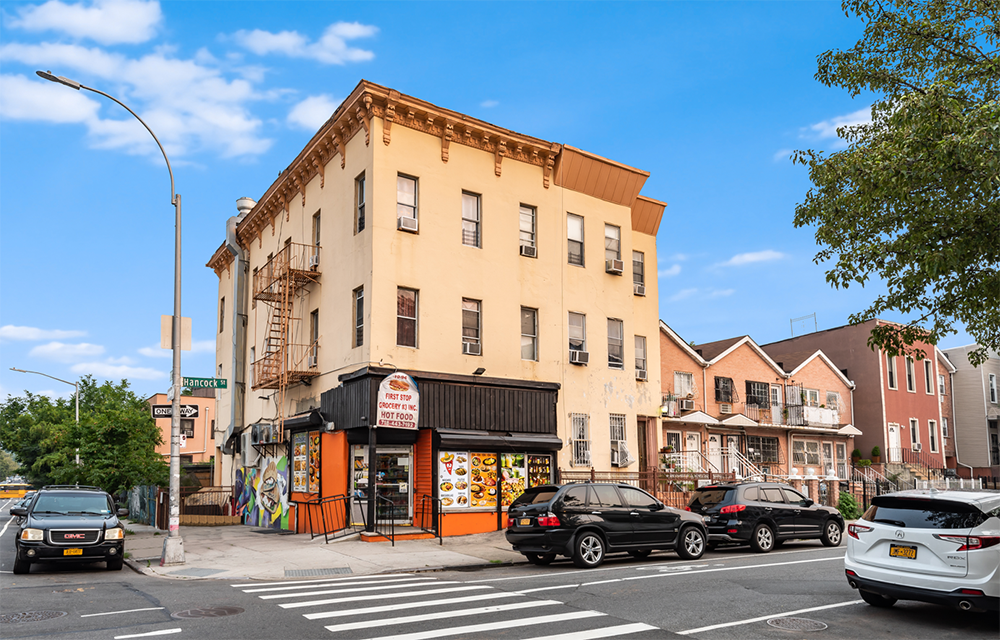
Investment Property Realty Group closes $1.75 million sale of 1094 Hancock Street in Brooklyn
Brooklyn, NY Investment Property Realty Group (IPRG), a New York-based commercial investment firm, has closed the sale of 1094 Hancock St., a mixed-use building in the Bushwick section, for $1.75 million.



Quick Hits
 (2).gif)

Columns and Thought Leadership

A guide to finding the right NYC property management company - by Sanjay Gandhi
Being a small to midsize landlord in NYC is an increasingly demanding endeavor. From navigating complex regulations, increased compliance demands to dealing with tenant issues and remediating violations. It is wise to enlist the assistance of a partner, a professional

Hunt commercial real estate question and answer: Fortune 500 wisdom - by David Hunt
Yes, there are lessons to be learned from the largest companies in America when comes to managing your real estate. But the decision to buy or lease real estate may not be one of

New York’s streets are full again, and the retail numbers prove it - by Noam Aziz
Walk down any New York block this year and you can feel it. The sidewalks are crowded, the storefronts are lit, and the energy that defines this city is back at full volume.

Hunt CRE question and answer: Choosing a real estate agent - by David Hunt
First, we will only work with one agent exclusively. The primary reason is that we want that agent to legally represent our client’s interests. In New York State, a real estate agent has a fiduciary
.gif)