



News:
Brokerage
Posted: October 15, 2026
New REBNY analysis finds NYC Class B office visitation stabilizing after years of post-pandemic recovery
Manhattan, NY New York’s Class B office market is showing more resilience than the conventional narrative around this segment of the office market might suggest.
A new report from the Real Estate Board of New York (REBNY) examined visitation trends across 200 Class B office properties in Manhattan, Brooklyn and Queens. The analysis found that average visitation stood at 72% of pre-pandemic levels in August 2026, settling into a relatively consistent range over the past two years.
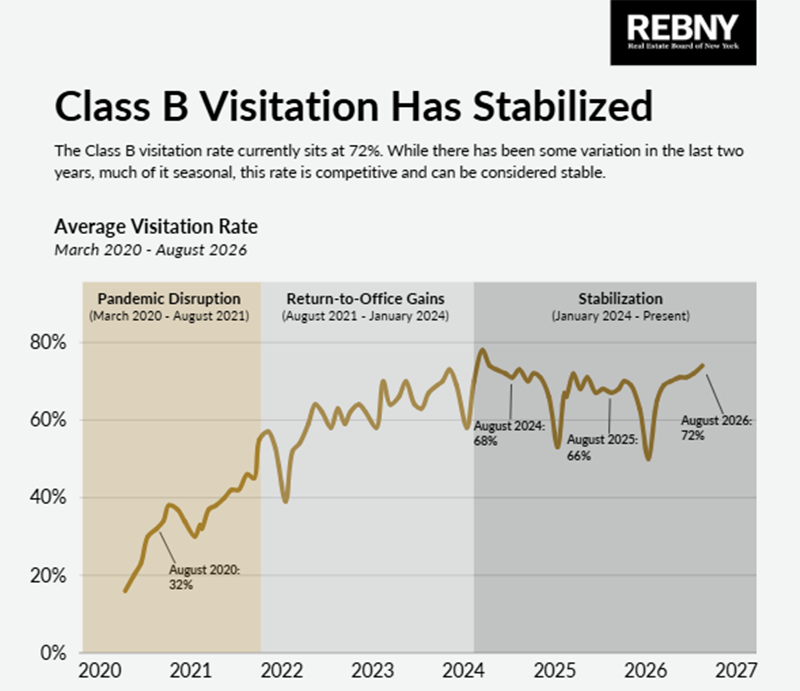
The results offer a closer look at a large and varied part of the city’s office market. New York City has more than 1,500 Class B office buildings totaling more than 235 million s/f across the five boroughs. These properties serve a wide mix of small and mid-sized businesses, nonprofits, creative firms, professional services companies, and fast-growing technology start-ups.
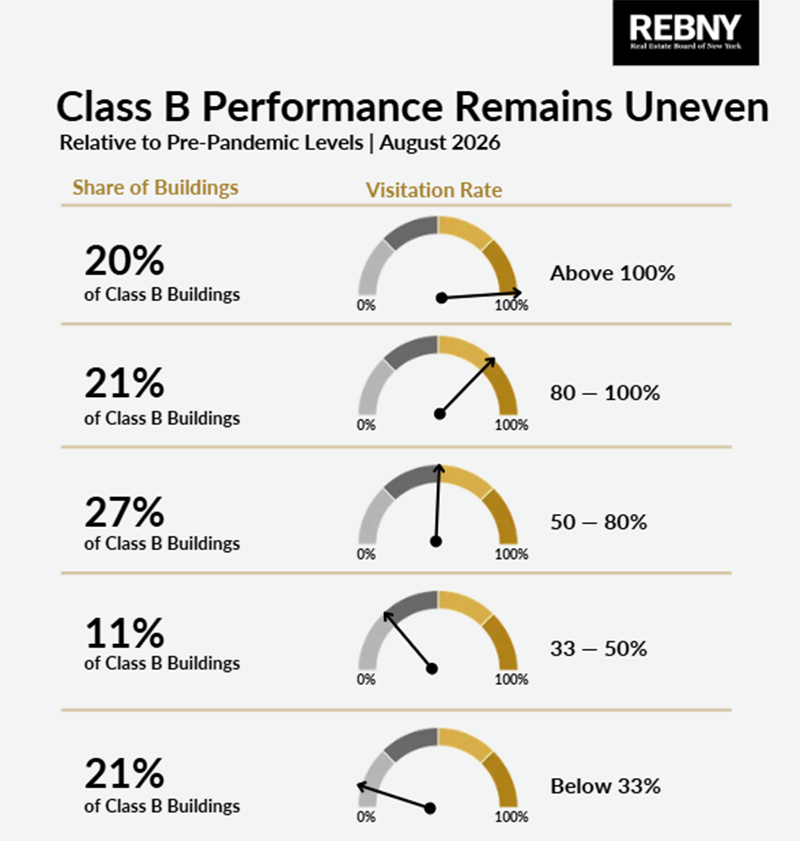
The data shows that many of those buildings remain active parts of the market. 41% of the properties analyzed reached at least 80% of their pre-pandemic visitation rate, including 20% that exceeded pre-pandemic activity. Midtown posted the strongest results among the markets studied, with Class B visitation reaching 89% of pre-pandemic levels in August.
Lower Manhattan and Brooklyn/Queens hovered around 70% of pre-pandemic visitation in August. Midtown South remained below the other Manhattan submarkets, though recent data showed some improvement.
Among the properties that are performing better, certain patterns emerged. Buildings with experienced ownership, strong transit access, and more diversified tenant rosters generally saw stronger visitation. Buildings affected by major tenant losses or coworking operators reducing their footprints have had a harder time recovering activity.
“Class B office space is not one uniform market,” said Basha Gerhards, executive vice president of public policy at REBNY. “Many properties have recovered much of their pre-pandemic activity and continue to compete successfully for tenants, while a smaller subset faces deeper, longer-term challenges. Policy needs to reflect that nuance and focus on flexibility. Some properties need the tools to reinvest, modernize and attract new tenants, while others need a realistic path to conversion where office use is no longer the best fit.”
The stabilization of Class B visitation comes as several broader office trends have provided some support. Class A availability has tightened, more companies have increased in-office expectations, and millions of square feet of office inventory have already been removed from the market through conversions.
Even so, recovery has its limits. Tighter conditions at the top of the office market have not yet produced a major shift of tenants into Class B space, and hybrid and remote work continue to keep overall office attendance below pre-pandemic levels.
For owners, the next phase of the market will depend heavily on the condition, location, and tenant prospects of individual buildings. A well-located Class B property with stable ownership and a diversified tenant base may have a strong case for continued investment. A building with prolonged vacancy, outdated layouts, or a large tenant loss may face a more difficult path as office space.
That building-by-building reality is becoming more important as owners weigh capital improvements, leasing prospects and new regulatory requirements. Local Law 97, for example, adds new costs and investment considerations for many properties, which could factor into decisions about whether to modernize, reposition or pursue another use.
Incentives are one part of that equation. The Relocation and Employment Assistance Program (REAP) and Relocation Assistance Credit for Employees (RACE) provide incentives tied to business relocation and expansion, which can support tenant recruitment and reinvestment at office properties that remain viable.
Conversion incentives offer another option for buildings facing more persistent challenges. Regulatory and tax incentives for office-to-residential conversions have helped create a pathway for properties that may no longer be able to compete as office space over the long term.
The question for many owners now is where their building sits in the market. A property with steady tenant demand and the ability to modernize may still have a clear office future. A building with prolonged vacancy or a major tenant loss may face a different calculation.
That difference will matter as owners, tenants, and policymakers continue to assess how this major segment of the office market fits into New York’s broader real estate recovery.
The full Class B Office Building Visitation Report is available on REBNY’s website at: https://www.rebny.com/reports/2026-class-b-office-building-visitation-report
MORE FROM Brokerage

Chef Driven Hospitality and AI technology company Fuel Cycle complete leasing deals at GFP Real Estate’s 630 Ninth Ave.
New York, NY GFP Real Estate announced that it has completed two office leasing transactions totaling 6,715 s/f at 630 Ninth Ave., the historic Film Center Building in Manhattan’s Hell’s Kitchen neighborhood. The transactions include a lease extension with Napkin Office, Inc., the administrative office of restaurant operator Chef Driven Hospitality, and a new lease with Fuel Cycle, Inc.




Quick Hits
 (2).gif)

Columns and Thought Leadership

New York’s streets are full again, and the retail numbers prove it - by Noam Aziz
Walk down any New York block this year and you can feel it. The sidewalks are crowded, the storefronts are lit, and the energy that defines this city is back at full volume.

Hunt CRE question and answer: Choosing a real estate agent - by David Hunt
First, we will only work with one agent exclusively. The primary reason is that we want that agent to legally represent our client’s interests. In New York State, a real estate agent has a fiduciary

Hunt commercial real estate question and answer: Fortune 500 wisdom - by David Hunt
Yes, there are lessons to be learned from the largest companies in America when comes to managing your real estate. But the decision to buy or lease real estate may not be one of

A guide to finding the right NYC property management company - by Sanjay Gandhi
Being a small to midsize landlord in NYC is an increasingly demanding endeavor. From navigating complex regulations, increased compliance demands to dealing with tenant issues and remediating violations. It is wise to enlist the assistance of a partner, a professional
.gif)