



News:
Spotlight Content
Posted: July 30, 2013
Engineering: Innovative approaches to data center modernization; Meeting current needs and future goals
Recently, JFK&M Consulting Group worked with a key financial client on modernizing and expanding their critical data center. The client's new data center would need to be capable of meeting their current needs as well as their future goals through 2032. JFK&M evaluated the existing data center and determined the best configuration and location for a larger more flexible data center. A key requirement was that their existing data center must remain operational while the new data center was being built in the same location.
Most new data centers require a raised floor between 24" to 36" high to allow conditioned air to be distributed to the data equipment. Because the new data center was being located within an existing office building, the only height that could be achieved under the raised floor was 18". Therefore, in order to meet the cooling requirements of the data processing equipment, we needed to model the heat rejection in the space.
A complex Computational Fluid Dynamics (CFD) program was utilized to determine the temperatures at various locations and heights in the data center. By using the CFD to model the space, we were able to use a smaller raised floor height and still get the required air distribution to the space. In addition, we used the CFD analysis to model the actual location of each piece of computer equipment in each cabinet to maximize the cooling within each rack & dramatically improve efficiency.
Based on the CFD model and a need for greater maintenance flexibility, it was determined that a gallery would be designed between the data center and the exterior windows. This gallery not only provided space to house the numerous Computer Room Air Handling (CRAH) units, it also shielded the space from direct sun load. It allowed us to add humidification to the data center by providing a vapor barrier as well as allowed the CRAH units to be serviced and maintained without having to enter the data center.
One of the client's goals was to design a cost effective and energy efficient means of providing chilled water for cooling the data center equipment with the capability of 2N reliability. The existing data center used a series of small compressors to chill the water, scattered all over the building. These small compressors were inefficient and required many small transfer switches to allow for emergency operation. Although our original concept was to use two extremely high efficiency Magnetic Levitation Chillers to provide the required chilled water, we realized that the Magnetic Levitation Chillers would require a licensed operating engineer 24-hours a day 7 days a week. Due the high costs associated with a 24-hour operating engineer, we selected smaller high efficiency modular chillers to supply chilled water to the CRAH units.
Water-side free cooling was incorporated into the chiller plant using a plate and frame heat exchanger to cool the chilled water with condenser water at low outdoor wet bulb temperatures. This allows space cooling within the building without operating any chillers during much of the winter and colder temperatures during the spring and fall.
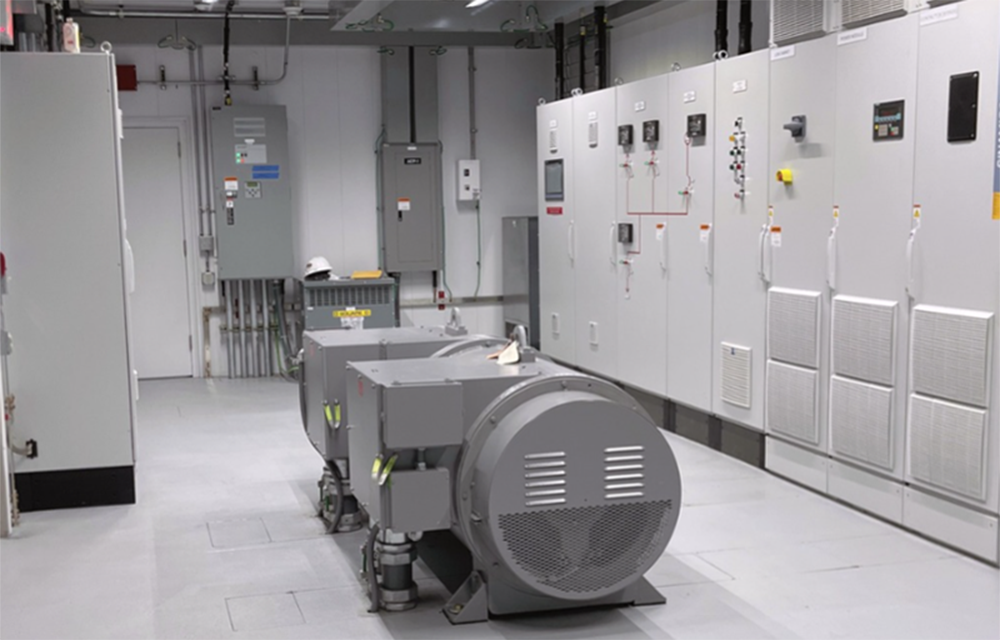
Another issue was how to provide sufficient emergency generator backup and switchgear in an existing overcrowded space. We had to find a way to configure the new larger capacity generators to fit in the same space that was occupied by the old generators.
To accomplish this, we temporarily relocated the emergency service from the three old generators to the two existing building generators. During the design, we traced out all of the existing conduit runs that were no longer required and reused as many as possible to reconnect to and supply new loads. We generally did not use the existing wiring; we reused the conduits and installed larger cabling to reduce voltage drop and make the feeders more efficient.
Once the re-feeding of loads was completed, we removed the old generators and installed new dunnage to accept the new larger capacity generators. New synchronizing and paralleling switchgear was provided as well as electrical distribution equipment and a permanent load bank. This equipment was all designed to be located as close to the generators as possible.
We resolved location problems by providing pre-fabricated, weatherproof outdoor housings to contain the switchgear equipment and the generators. These pre-fabricated housings minimized space requirements as well as reduced lifting time to set the equipment in place.
With these innovative solutions, the data center met the client's needs; was completed ahead of schedule and well under the original construction budget.
Pat Hildebrandt is a director at JFK&M Consulting Group, LLC, New York, N.Y.
Tags:
Spotlight Content
MORE FROM Spotlight Content

NYREJ's 2026 Developing Long Island Spotlight is here!
This spotlight showcases projects completed and currently under construction across Long Island as well as highlights improvements made to the region through Industrial and Economic Development Agencies and BIDs.


.png)

Quick Hits


Columns and Thought Leadership

CRE Guide Featured Company: Merritt Environmental Consulting Corp.
Merritt Environmental Consulting Corp. (MECC) was established in June of 2009 after being part of a larger engineering firm for almost 20 years. The focus of the company is to assist lending institutions, attorneys, real estate investors, and property owners with environmental concerns. Today, MECC has offices in New York, Florida, and Vermont and has grown into a regional consulting firm serving clients along the East Coast.

Properly serving a lien law Section 59 Demand - by Bret McCabe
Many attorneys operating within the construction space are familiar with the provisions of New York Lien Law, which allow for the discharge of a Mechanic’s Lien in the event the lienor does not commence an action to enforce following the service of a “Section 59 Demand”.

From vacancy to vitality: How adaptive reuse is reshaping Long Island’s CRE landscape - by Andrea Tsoukalas Curto
Adaptive reuse has become one of the most important conversations in commercial real estate today. Long Island has a large inventory of aging retail, office and industrial

2026 Developing Queens: Long Island Board of Realtors advances commercial growth and advocacy in Queens
The Long Island Board of Realtors (LIBOR) Commercial Network continues to play a key role in advancing opportunities and strengthening the commercial real estate landscape across Queens. Through targeted programming and global outreach