


News:
Owners Developers & Managers
Posted: May 10, 2022
Digital twins are revolutionizing big real estate data, but what do companies do with it? - by Ian Siegel

Originally developed by NASA, digital twins are being embraced across the commercial real estate industry as the must-have tool for big data and efficiency from construction through the asset management life cycle. The industry’s biggest players are increasingly among the leaders in the deployment of digital twins, but for the uninitiated, a digital twin is a powerful technology that converts physical structures into living, learning, and evolving virtual replicas. Digital twins are the most intuitive way to store, organize and access the incredible amount of data generated by the various, complex technology systems that make buildings “smart” for owners, facility managers, occupiers, and other built environment professionals. And yes, to answer your question, you can interact with your building’s digital twin through a really futuristic-looking 3D or 2D layout.
The goal with digital twins is to give built environment professionals real-time insights to strategize and optimize various aspects of a building’s operations. The technology is ultimately supposed to open up new horizons for sustainability, tenant experience, efficiency and risk management, as owners and operators will have complete transparency and a single source of truth on big data from across a facility’s complex systems. Owners can solve problems before they happen and identify previously impossible integrated strategies. For example, if there’s a corner of the 29th floor that tends to be a bit warmer than the thermostat’s set point, the digital twin is designed to let you know whether the source of the problem is with the air conditioning unit that serves the space, the fan that provides cooled air to the entire floor or the nearby south-facing window that isn’t sufficiently shaded or insulated.
But how do you get from the collection of this massive amount of data to something you can actually use? This part is not simple, and not all digital twin technology can help you develop an efficient, cost effective solution for your property and suited to the way its occupants work.
Clean Data and Customization
The original digital twin models were essentially virtual dashboards of building systems and management data. In other words, the technology-enabled digital twin was originally a replication platform. Today, however, they do much more, or at least they should.
One of the major hurdles is establishing clean, easily navigable data. The best digital twins solutions don’t simply compile data and visualize it; they give context to the data by mapping the complex web of relationships between the building’s equipment, systems, spaces, and people. Many of the technology systems installed in today’s buildings are notoriously difficult to pair with other solutions, and this is an issue, because the real insights are to be found in the development of a holistic digital approach that allows the digital twin actually to work in tandem with other Proptech solutions to develop analytics and insights that drive informed, agile decision-making.
You can think of it almost like having a smart phone. The phone performs its basic functions for any user, but apps personalize it to the needs of the individual user. Digital twins aren’t that much different. Your data should be easily integrated to your customized suite of data services, whether it’s climate control, fault detection, cost management, safety, leasing activity, meeting room management, visitor security, access controls, water reduction or any number of details geared for your team members that make your building hum, whether it’s a commercial office, apartment tower or something less traditional, like a football stadium, airport or data center. Without that, the data can be difficult to maneuver and act on, even with a virtual replica.
It is true that digital twins are the next step in the evolution of sustainability, safety, risk management, efficiency and user experience in the built environment, but getting that granular mass of data is only half the battle. Putting that data to work is what will ultimately optimize your building for performance, and that is the goal.
Ian Siegel is the digital project director at Willow, New York, N.Y.
MORE FROM Owners Developers & Managers
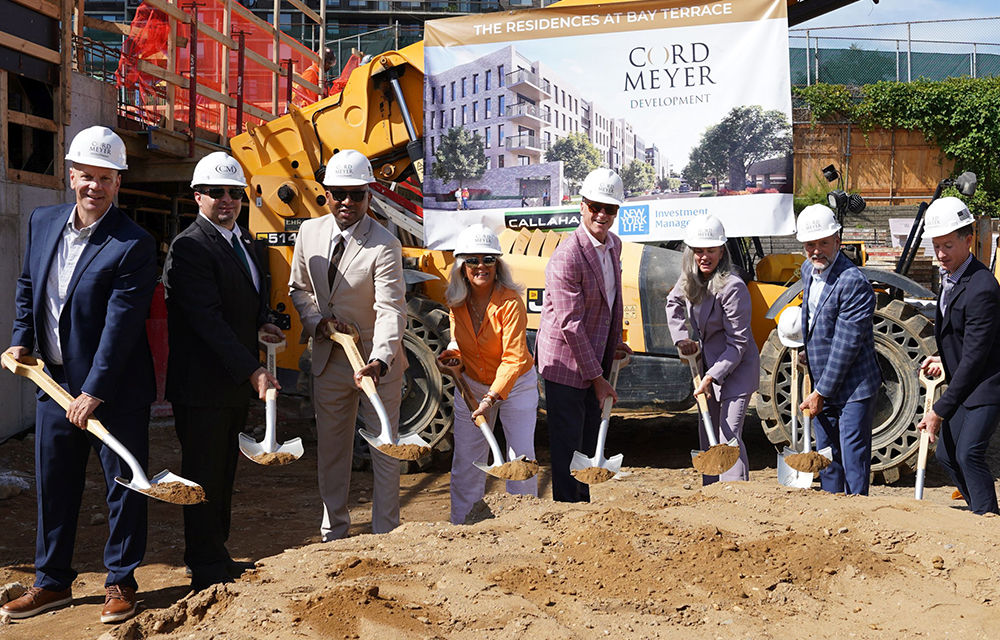
Cord Meyer Development breaks ground on new residential community at the Bay Terrace Shopping Center
Queens, NY On September 10, Cord Meyer Development celebrated the groundbreaking of its new residential community at the Bay Terrace Shopping Center, marking a major investment in new housing and the continued evolution of one of




Quick Hits
 (2).gif)

Columns and Thought Leadership

Hunt Commercial Real Estate Q&A: Location, location, location? - by David Hunt
In working with our clients, we break down our search objectives into two categories. The first category involves the specific needs of your business such as warehouse height, amount of office space and number of loading

NYC's Community Opportunity to Purchase Act is back - and multifamily owners should pay attention - by Ron Cohen
New York City’s Community Opportunity to Purchase Act (COPA) is back, and this latest version could have a much better chance of becoming law. The proposal would give qualified nonprofit organizations

IREON Insights: Research and development tax credit: Very important deadline for amendments is July 6 - by Richard Levychin
If you are a company that either claimed or qualify for the research and development tax credit you need to be aware of the following update resulting from the One Big Beautiful Bill Act (OBBBA).

Don’t leave severance damages behind - by Sebastian Jablonski
When the government takes a portion of a landowner’s property, most assume just compensation stops at the value of the land taken. However, in partial takings, that is only half of the equation.
September Promotion
