



News:
Spotlight Content
Posted: November 12, 2024
Developing Rochester: Andrews Terrace: Revitalizing an Icon
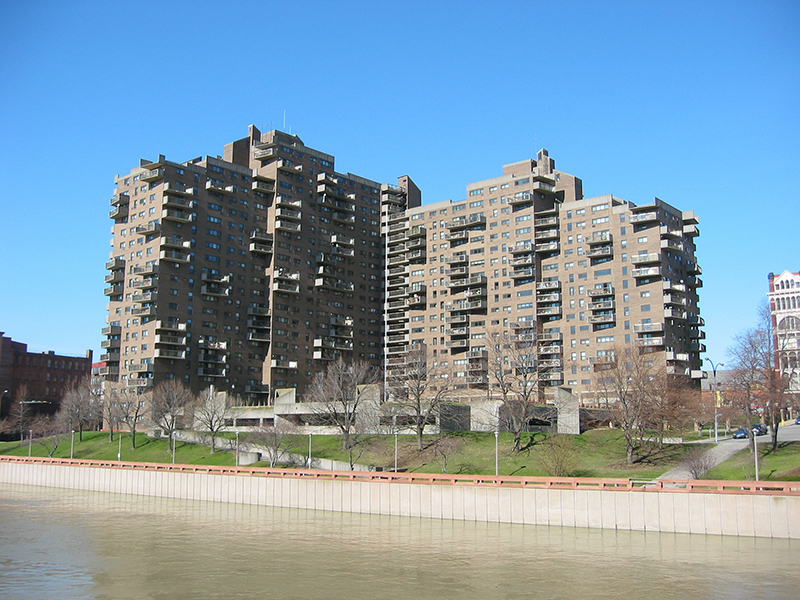
Rochester, NY Conifer Realty, LLC and Community Preservation Partners (CPP) have joined forces to rehabilitate and preserve Andrews Terrace. This waterfront community, originally built in 1975, is undergoing extensive renovations to preserve and enhance 526 affordable housing units for seniors (62+) and disabled residents.
Celebrating its 50th anniversary in 2025, Conifer takes a collaborative approach to working with existing building owners to revitalize vital community residential assets. This is the second joint venture between Conifer and CPP in Rochester, reinforcing their commitment to quality affordable housing.
Andrews Terrace consists of two connected residential towers, each standing between 19 and 22 stories high, offering studio, one-, and two-bedroom apartments. Spanning over 557,000 s/f, the property is a key piece of Rochester’s architectural and community history, with a unique “brutalist” design. The buildings have faced significant maintenance challenges in recent years, prompting this $111 million renovation project, with a total investment reaching approximately $335 million.
According to Ari Shachter, vice president of acquisitions for Conifer, “Financial backing for this ambitious effort comes from a range of partners, including New York HCR, the New York State Historic Preservation Office, the National Parks Service, the County of Monroe Industrial Development Agency, the City of Rochester, the Department of Housing and Urban Development, KeyBank, Goldman Sachs and JP Morgan. Without them, this great rehab could not have occurred.”
The restoration of Andrews Terrace aligns with Rochester’s ROC the Riverway Program, a comprehensive initiative aimed at transforming the Genesee River waterfront. The project will focus on enhancing residents’ quality of life while preserving the building’s distinctive architectural elements.
All apartments will receive significant upgrades, including new countertops, cabinets, appliances, and kitchen fixtures, along with similar improvements in bathrooms. Five percent of the apartments will be updated to meet ADA standards, improving accessibility for all residents.
Common areas will also see considerable upgrades, including drywall repairs, new flooring, and HVAC updates in spaces like the lobby, community room, management office, and maintenance shop. Additional new amenities include a fitness room, game room, reading nook, and two community rooms with serve-in kitchens. Outdoor improvements will include a community garden, grandparents’ playground, bocce ball courts, and grilling areas, fostering a sense of community among residents.
The building’s signature cantilevered balconies and connecting outdoor breezeways will be restored and refinished, bringing these architectural features back to their original condition. Windows and select doors will be replaced, and electrical/plumbing systems will be upgraded to enhance energy efficiency and reliability.
Preserving affordability is central to the project. Under an existing Housing Assistance Payment contract, 496 apartments are reserved for residents earning 50% or less of the Area Median Income (AMI), with 30 apartments reserved for those earning 60% or less of AMI. The project also includes a renewed 20-year Project-Based Section-8 contract, ensuring that Andrews Terrace will continue to provide affordable housing options for years to come.
“We are thrilled to collaborate with Community Preservation Partners on the revitalization of this cherished affordable housing community here in our hometown” said Jason Carroll, senior vice president of acquisitions & development at Conifer. “This collaboration exemplifies our commitment to providing quality affordable housing and fostering sustainable neighborhoods that enhance the Rochester community.”
Renovations are expected to take 32 months, with careful planning to minimize disruption to residents. Conifer Realty and CPP are dedicated to ensuring that Andrews Terrace continues to serve the community, offering high-quality, comfortable, and accessible homes for its residents.
Project Team:
Developer Conifer Realty, LLC, Community Preservation Partners
Construction Manager Conifer-LeChase Construction, LLC
Architect Inglese Architecture + Engineering
Structural Engineer Rand Engineering & Architecture
Fire Protection Colonial Fire Protection Systems, Inc.
Financing NY HCR, NY Historic Preservation Office, National Parks Service, County of Monroe Industrial Development Agency, City of Rochester, Department of Housing and Urban Development, KeyBank, Goldman Sachs and JP Morgan
Tags:
Spotlight Content
Western NY
MORE FROM Spotlight Content

Participate in Developing New York Featuring Westchester County - November 24, 2026
Choose how you’d like to participate in this edition of NYREJ’s Developing New York series featuring Westchester County.




.png)

Quick Hits
 (2).gif)

Columns and Thought Leadership

2026 Developing Long Island: ERG Commercial Real Estate launches its new Retail Leasing division
North Hempstead, NY ERG Retail Leasing is the dedicated leasing division of ERG Commercial Real Estate, an established full-service commercial real estate brokerage for over 35 years.

From vacancy to vitality: How adaptive reuse is reshaping Long Island’s CRE landscape - by Andrea Tsoukalas Curto
Adaptive reuse has become one of the most important conversations in commercial real estate today. Long Island has a large inventory of aging retail, office and industrial

CRE Guide Featured Company: Merritt Environmental Consulting Corp.
Merritt Environmental Consulting Corp. (MECC) was established in June of 2009 after being part of a larger engineering firm for almost 20 years. The focus of the company is to assist lending institutions, attorneys, real estate investors, and property owners with environmental concerns. Today, MECC has offices in New York, Florida, and Vermont and has grown into a regional consulting firm serving clients along the East Coast.

2026 Developing Queens: Long Island Board of Realtors advances commercial growth and advocacy in Queens
The Long Island Board of Realtors (LIBOR) Commercial Network continues to play a key role in advancing opportunities and strengthening the commercial real estate landscape across Queens. Through targeted programming and global outreach