



News:
Brokerage
Posted: October 28, 2013
"Crowdfunding" is broadening the base of real estate investors
Corporate stocks and bonds have been made available to smaller individual investors for years, but commercial real estate has perhaps been slower to embrace these investors as a financing source. Real estate investment trusts (REITs) enable some broader individual participation in commercial real estate, but most REITs function as holders of "pools" of assets, and smaller investors still have trouble participating in individual syndications. Project sponsors have traditionally sought financing from larger investment groups - in part, to avoid dealing with numerous individual investor reports.
Recently, though, communications technology and its facilitation of "crowdfunding" has enabled smaller investors to participate more broadly in specific real estate investments. Through an online platform like that provided by Realty Mogul, people can now review real estate investment projects at their convenience - sitting with their computer at home after the kids have been put to bed.
Introductions to these opportunities used to require specially arranged meetings with attorneys, bankers or financial advisers - that is, if the person had such connections at all. Just as such opportunities had previously been more difficult to access, they were also often still limited to institutions or persons of very substantial wealth. A project syndicator seeking $2 million in equity wouldn't typically bother with contributions of $10,000 or $20,000; instead, he would search for contributions of ten times those amounts, in order to simplify his task of managing investor distributions during the project's life.
Technology, however, has enabled large numbers of unrelated investors to pool their contributions and make a significant investment through a single legal entity - keeping things easy for syndicators while broadening the source of potential investors. This new "crowdfunding" approach, together with the SEC's relaxation of the "general solicitation" rules concerning advertising, has enabled smaller investors to more conveniently access "deal flow" directly, so that increased numbers of "retail" investors can now invest in larger real estate projects.
Crowdfunding platforms also help investors improve on the infrequent reporting that they often suffered with in private real estate investments. The Internet now makes it easy to access centralized information, and sites like Realty Mogul allow investors to do status checks and review project updates on a 24/7 basis. This in turn permits the investment to be more transparent, enhancing investor trust and thus creating a virtuous circle whereby the investor base is increasingly broadened.
Investors are often eager to receive recurring, passive cash flow - and real estate investing has proven to be one of the most effective ways of generating it. In the past, though, an average investor had little prospect of participating in commercial real estate investments other than through a REIT holding a pool of numerous properties. Now, crowdfunding sites like Realty Mogul allow persons without pre-existing industry connections to join in specific real estate projects, and with lesser individual investment requirements than were previously possible. What a difference technology makes!
Jilliene Helman is CEO of Realty Mogul, Co., Beverly Hills, Calif.
Tags:
Brokerage
MORE FROM Brokerage
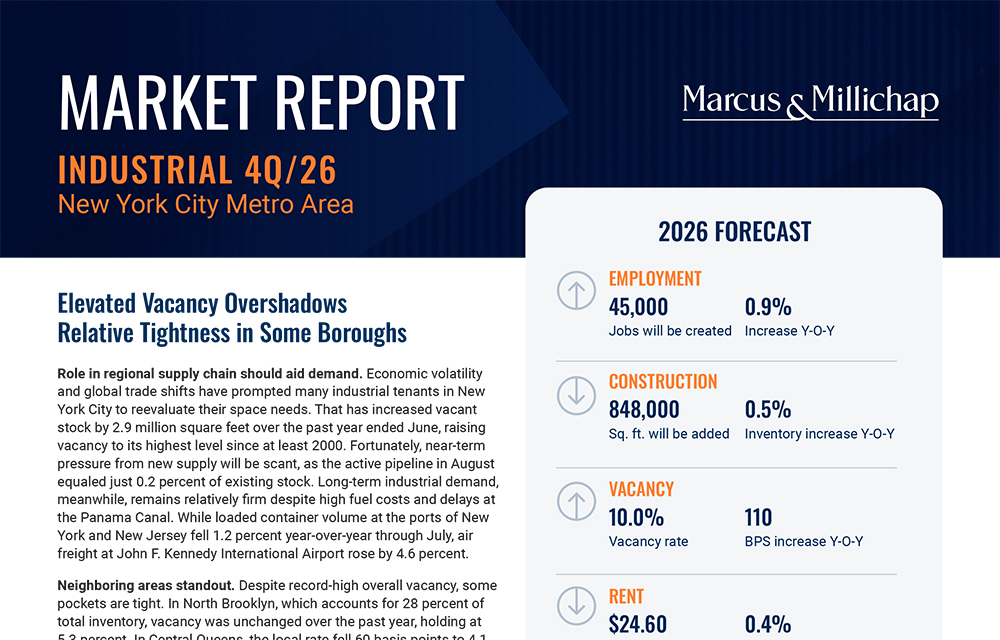
Marcus & Millichap releases fourth-quarter 2026 NYC industrial market report
Manhattan, NY Marcus & Millichap has published its fourth-quarter 2026 New York City Industrial Market Report. “New York City’s industrial market is showing a clear






Quick Hits
 (2).gif)

Columns and Thought Leadership

The art of investing in real estate - by Thomas Donovan
Real estate investing is as much an art as it is a skill. No one can time the market, or the factors that drive it, perfectly. Location, zoning, size, transportation, and neighborhood density give you a baseline for

Hunt CRE question and answer: Choosing a real estate agent - by David Hunt
First, we will only work with one agent exclusively. The primary reason is that we want that agent to legally represent our client’s interests. In New York State, a real estate agent has a fiduciary

New York’s streets are full again, and the retail numbers prove it - by Noam Aziz
Walk down any New York block this year and you can feel it. The sidewalks are crowded, the storefronts are lit, and the energy that defines this city is back at full volume.

Hunt commercial real estate question and answer: Fortune 500 wisdom - by David Hunt
Yes, there are lessons to be learned from the largest companies in America when comes to managing your real estate. But the decision to buy or lease real estate may not be one of
.gif)