



News:
Brokerage
Posted: May 11, 2015
Commercial Real Estate: Why the Brooklyn market will remain strong
From boom to bust to recovery, the New York City real estate market has remained strong, and the Brooklyn market has proved especially healthy.
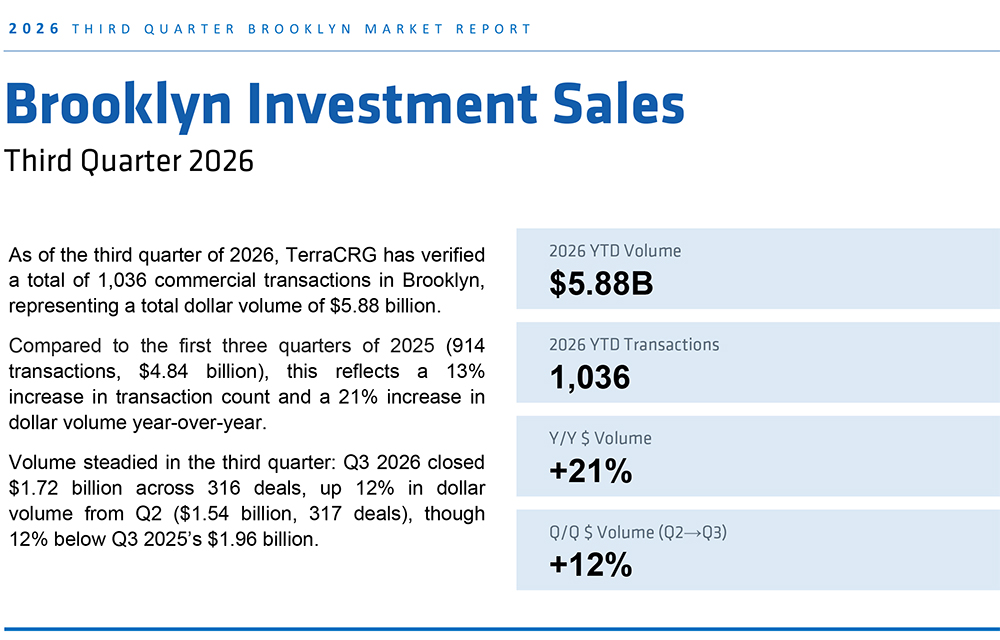
While several Brooklyn neighborhoods, including Williamsburg, Fort Greene, Bedford-Stuyvesant and Bushwick, have demonstrated notable changes over the past several years, the story of Crown Heights is particularly illustrative of the capital investment flowing into the market.
According to a study conducted by GFI Realty, which analyzed a select number of properties in Brooklyn, neighborhoods like Crown Heights are soaring. In 2007, as the market reached its peak, the average price per unit in Crown Heights was $112,000. After The Great Recession, the market recovered steadily, with price per units reaching an average of $175,000 by 2014, exceeding the average price per unit during the "height" of the market in 2007.
Why do we believe that the Brooklyn market will remain strong? As property values in New York City continue to rise, many domestic and foreign investors are setting their sights on Brooklyn, and purchasing apartment buildings near transportation routes that provide convenient access to Manhattan.
And as investors continue to seek out these opportunities, the average price per unit in neighborhoods like Crown Heights and Flatbush will continue to flourish.
Consider this: During one of the most tumultuous economic time periods, Crown Heights has demonstrated a tremendous amount of growth and appreciation, making it an ideal area to represent the meteoric rise of certain neighborhoods in Brooklyn.
As we look to the future, we expect that Brooklyn will continue to play a major role in driving the New York real estate market.
Visit http://bit.ly/1HAZpv6 to view the full Brooklyn 2007-2014 CAP & GRM Trend Report
Michael Weiser is the president of GFI Realty Services, Inc., an affiliate of GFI Capital Resources Group, Inc., New York, N.Y.
Tags:
Brokerage
MORE FROM Brokerage

200E20TH sells out in Gramercy, penthouse A closes out sales at the CetraRuddy-designed condominium residences
Manhattan, NY 200E20TH, the CetraRuddy-designed architectural masterwork that brought a curved, contemporary sensibility to Gramercy’s Beaux-Arts streetscape, has



Quick Hits
 (2).gif)

Columns and Thought Leadership

New York’s streets are full again, and the retail numbers prove it - by Noam Aziz
Walk down any New York block this year and you can feel it. The sidewalks are crowded, the storefronts are lit, and the energy that defines this city is back at full volume.

Hunt CRE question and answer: Choosing a real estate agent - by David Hunt
First, we will only work with one agent exclusively. The primary reason is that we want that agent to legally represent our client’s interests. In New York State, a real estate agent has a fiduciary

Hunt commercial real estate question and answer: Fortune 500 wisdom - by David Hunt
Yes, there are lessons to be learned from the largest companies in America when comes to managing your real estate. But the decision to buy or lease real estate may not be one of

The art of investing in real estate - by Thomas Donovan
Real estate investing is as much an art as it is a skill. No one can time the market, or the factors that drive it, perfectly. Location, zoning, size, transportation, and neighborhood density give you a baseline for
.gif)