



News:
Brokerage
Posted: April 17, 2018
Clifford and Barrett of Cushman & Wakefield arrange $12.8 million Gowanus sale

Cushman & Wakefield
Brooklyn, NY Cushman & Wakefield has arranged the sale of 80 4th St., a 180’ x 107.67’ lot improved by a 17,942 s/f, single-story, brick warehouse located in the Gowanus neighborhood. The final closing price was $12.8 million, equating to $713.40 per s/f and $300,000 above the original asking price.
Cushman & Wakefield senior director Winfield Clifford and senior associate William Barrett represented the seller, famed sculptor Tom Otterness. The property was purchased by The Brooklyn Home Company.
“The Gowanus neighborhood continues to attract strong interest from developers in anticipation of the neighborhood’s rezoning and the sale of 80 4th St. is no exception,” said Clifford.
80 4th St. is located in an M3-1 zoning district allowing for 35,954 s/f of commercial development. The property provides a wet sprinkler system, two curb cuts and two rolling gates, with one offering a loading bay.
There are 24 skylights providing significant light across the building. The building is currently owner occupied and will be delivered vacant.
80 4th Street is located just a block away from the Carroll Street and Smith/9th Street subway stations and a short walk from the Union Street subway station. The property is also surrounded by numerous Citi Bike stations and is serviced by multiple bus routes.Situated between two well-established residential neighborhoods, Carroll Gardens and Park Slope, Gowanus has become the connecting fabric of the area offering a variety of retail and hospitality destinations including Whole Foods, Royal Palms Shuffleboard, Dinosaur BBQ, Freek’s Mill and the Bell House.
Tags:
Brokerage
MORE FROM Brokerage
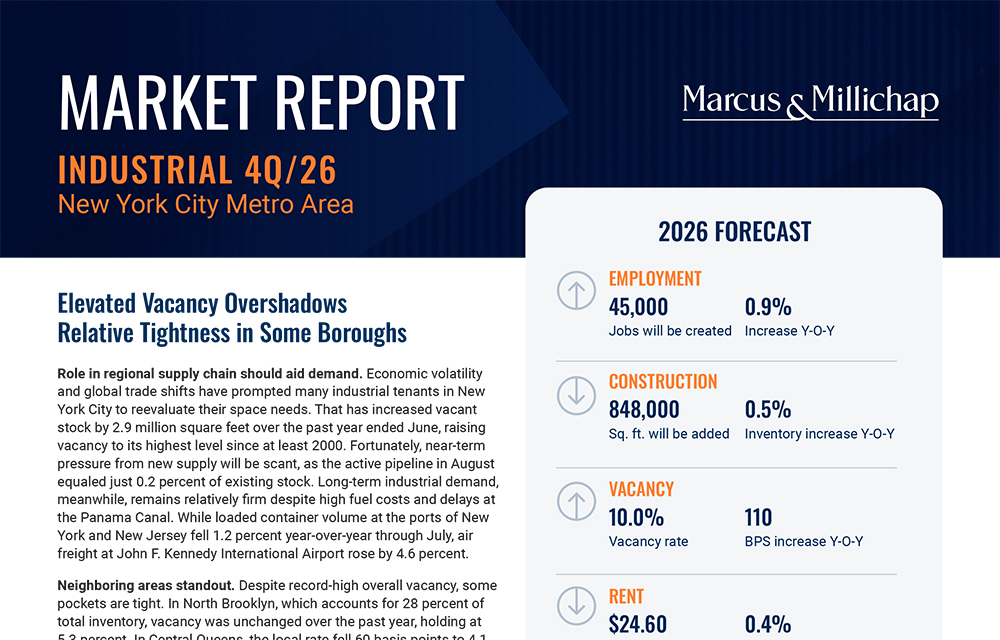
Marcus & Millichap releases fourth-quarter 2026 NYC industrial market report
Manhattan, NY Marcus & Millichap has published its fourth-quarter 2026 New York City Industrial Market Report. “New York City’s industrial market is showing a clear






Quick Hits

Columns and Thought Leadership

Hunt commercial real estate question and answer: Fortune 500 wisdom - by David Hunt
Yes, there are lessons to be learned from the largest companies in America when comes to managing your real estate. But the decision to buy or lease real estate may not be one of

The art of investing in real estate - by Thomas Donovan
Real estate investing is as much an art as it is a skill. No one can time the market, or the factors that drive it, perfectly. Location, zoning, size, transportation, and neighborhood density give you a baseline for

New York’s streets are full again, and the retail numbers prove it - by Noam Aziz
Walk down any New York block this year and you can feel it. The sidewalks are crowded, the storefronts are lit, and the energy that defines this city is back at full volume.

Hunt CRE question and answer: Choosing a real estate agent - by David Hunt
First, we will only work with one agent exclusively. The primary reason is that we want that agent to legally represent our client’s interests. In New York State, a real estate agent has a fiduciary
.gif)