



News:
Brokerage
Posted: December 6, 2016
Can hoteliers break Airbnb’s global stride? by Andrew Posil
 Andrew Posil, Cushman & Wakefield
As the sharing economy encroaches on traditional lodging around the globe, Airbnb undergoes enhanced scrutiny. The criticism largely stems from the platform’s inflationary effect on residential pricing, its lack of standardized security and life safety, and the challenges presented in collecting lodging taxes. This article offers a comparison of the regulatory response in four different gateway cities, two domestically–New York and San Francisco; and two overseas–Paris and Moscow.
Domestically, Airbnb units make up 3% of total lodging supply and resulted in a direct loss of roughly $450 million in revenue to hoteliers in 2015 (HVS). As a result, hoteliers have voiced tough challenges that primarily focus on the differences between the rules regulating hotels and short term rentals.
According to Daniel Lesser, president and CEO of LWHA, “Airbnb has an unfair advantage because the platform isn’t subject to the same regulatory or market standards as hotels–unfortunately, hoteliers and private residents who don’t play the Airbnb game, suffer.”
New York City hoteliers recently won a major victory in combatting Airbnb. The law signed in late October imposes fines of up to $7,500 per incident on hosts that advertise illegal short-term listings where the guest stays for less than 30 days. While the law targets hosts, and not Airbnb, it will undoubtedly reduce Airbnb’s New York City inventory. Despite the new law, New York City regulations do permit residents to sublet their property for less than 30 days, provided they are still residing at that address. However, 55% of the nearly 39,000 active listings in New York City were found to be entire homes. With the prospect of increased enforcement and hefty fines looming, that market is likely to shrink.
San Francisco is the birthplace of Airbnb and has turned into one of its hottest markets. In fact, San Francisco’s Airbnb listings increased by nearly 14% in 2016 (InsideAirbnb.com). Lawmakers addressed the issue in several ways. San Francisco’s housing code limits rentals where the host is not present to a maximum of 90 days per year while violators are subject to a daily fine of up to $1,000. While San Francisco and New York have distinct approaches to the problem, they are representative of some of the strategies various U.S. cities have implemented to combat Airbnb.
Despite Airbnb’s strong U.S. presence, Airbnb CEO Brian Chesky recently stated that the platform’s core market is Europe, accounting for more than 55% of revenues.
Paris is a good case study to examine how some European cities are adapting to Airbnb. With over 29 million visitors in 2015, demand for lodging in Paris remains high. As a result, Paris is Airbnb’s most popular city with approximately 52,000 individual listings welcoming over 223,000 guests (InsideAirbnb.com). In response, a Parisian law enacted in 2011 requires hosts who wish to rent their home for over 120 days to obtain a “change of use” registering their homes as commercial properties. Hosts of unauthorized units are subject to fines up to 25,000 euros.
Looking across Europe, Airbnb has gained a serious foothold in Moscow. Residents, and the local government, have been receptive to Airbnb. In part, due to challenging economic conditions, a record number of Moscow residents opened their homes to strangers. Airbnb guests increased by 260% in 2015 (Bloomberg). Despite the growth in the market, all indications are that the Russian government will continue to take a laissez faire approach to regulation.
As Airbnb expands across the globe, traditional hoteliers increase efforts to encourage regulators to “level the playing field.” The effectiveness of efforts to curb the practice will no doubt play a significant role in the future of the lodging industry.
Andrew Posil is a director, hospitality investment sales at Cushman & Wakefield, New York, N.Y. Anna Ivashchuk, a member of Posil’s sales team contributed to this article.
Tags:
Brokerage
MORE FROM Brokerage
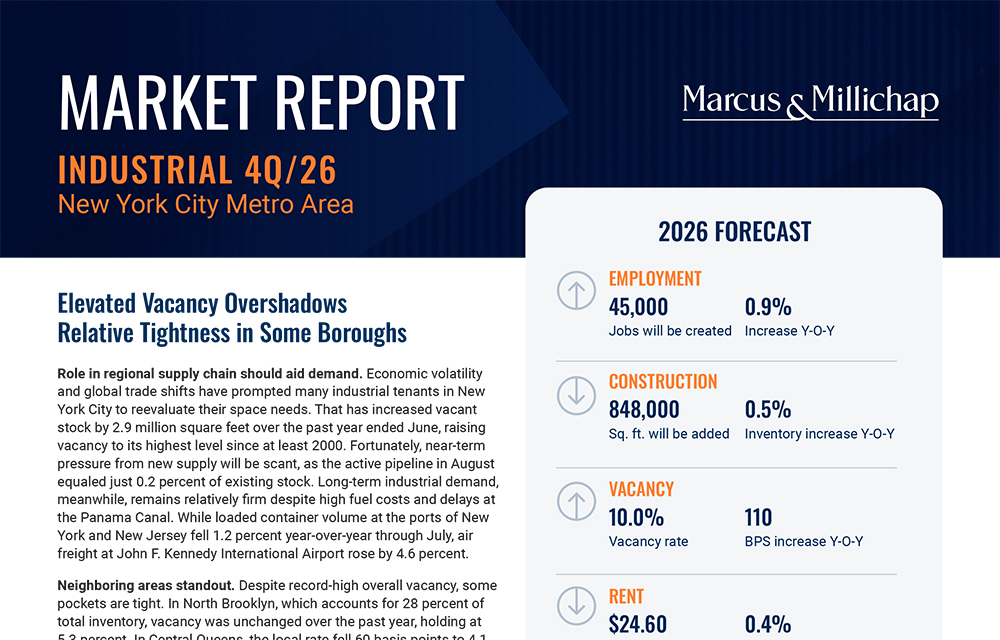
Marcus & Millichap releases fourth-quarter 2026 NYC industrial market report
Manhattan, NY Marcus & Millichap has published its fourth-quarter 2026 New York City Industrial Market Report. “New York City’s industrial market is showing a clear






Quick Hits
 (2).gif)

Columns and Thought Leadership

New York’s streets are full again, and the retail numbers prove it - by Noam Aziz
Walk down any New York block this year and you can feel it. The sidewalks are crowded, the storefronts are lit, and the energy that defines this city is back at full volume.

Hunt CRE question and answer: Choosing a real estate agent - by David Hunt
First, we will only work with one agent exclusively. The primary reason is that we want that agent to legally represent our client’s interests. In New York State, a real estate agent has a fiduciary

The art of investing in real estate - by Thomas Donovan
Real estate investing is as much an art as it is a skill. No one can time the market, or the factors that drive it, perfectly. Location, zoning, size, transportation, and neighborhood density give you a baseline for

Hunt commercial real estate question and answer: Fortune 500 wisdom - by David Hunt
Yes, there are lessons to be learned from the largest companies in America when comes to managing your real estate. But the decision to buy or lease real estate may not be one of
.gif)