



News:
Brokerage
Posted: June 5, 2018
Business Council of Westchester unveils Data Exchange
Rye Brook, NY Westchester County, The Business Council of Westchester (BCW) has unveiled the BCW Data Exchange. The free, user-friendly, online portal will for the first time provide businesses, non-profits and the public with key data about Westchester all in one place. Demographics, data on workforce, housing, education, local governments, transportation, infrastructure, real estate trends, consumer spending, municipal services and other vital data will be available and updated on a regular basis.
“Data is knowledge and knowledge is power. We believe the BCW Data Exchange is a critical resource that will allow Westchester County to win in a very competitive economic climate locally, nationally and globally,’’ said Marsha Gordon, president and CEO of the Business Council of Westchester.
The BCW Data Exchange will have the most up-to-date information on a wide variety of topics and issues impacting business in the county. The research was conducted by Hudson Valley Pattern for Progress, a not-for-profit policy, planning, advocacy and research organization. Customized reports will be available for those looking for a deeper dive into the data.
“We are on the cusp of serious development and growth, and the BCW Data Exchange will help spur the creative thinking and innovation we need to take that growth to the next level. It will also provide the critical insights that our business organizations, educational institutions, non-profits and government leaders need to make the best, most informed decisions,” said Gordon.
The idea of a comprehensive online data resource to help promote economic development in Westchester is the result of more than two years of strategic planning by the BCW Board of Directors. Contributing partners in the endeavor included Hudson Gateway Association of Realtors and The Journal News. Sponsors include Marks Paneth Accountants and Advisors, JLL and Simone Development Cos.
Board member Heidi Davidson, who chaired the committee, said that the new service would fill a real need in the business community. “We live in a world where having and understanding data is everything,’’ said Davidson, co-founder of Galvanize Worldwide. “The comprehensive data available through the BCW Data Exchange will fuel Westchester’s economic development efforts,” she said.
In addition to the data, the portal will offer a rotating blog with the perspectives of influencers in the community. Upcoming blogs will feature Westchester County executive George Latimer and the county’s city mayors who will discuss major revitalization projects currently underway in Westchester’s urban centers among other topics.
Anthony Justic, chairman of the Business Council of Westchester, said that the BCW Data Exchange is part of the BCW’s larger role in economic development for Westchester County. The BCW has also been working with the county’s leaders on initiatives to support Westchester’s urban centers in their development efforts.
“This is exactly the type of work that a leading business organization should be doing and we thank Heidi Davidson for her leadership on this initiative,’’ said Justic. “The BCW Data Exchange will be a tremendous resource for everyone in the community.’’
The county’s largest and most influential business membership organization, The Business Council of Westchester is committed to helping businesses market, learn, advocate and grow. In addition, The Business Council of Westchester is actively involved in reviewing federal, state and county legislation and regulations in order to assess the potential impact on the business community and to influence the outcomes through advocacy when the business community’s interests may be affected. It also acts as an information resource for the business community and government leaders at all levels.
Hudson Valley Pattern for Progress is a not-for-profit policy and planning organization that promotes regional, balanced and sustainable solutions to enhance the growth and vitality of the Hudson Valley. Founded in 1965 by business, academic and civic leaders, and based in Newburgh, N.Y., Pattern works within the nine-county area that includes Columbia, Dutchess, Greene, Orange, Putnam, Rockland, Sullivan, Ulster and Westchester.
Tags:
Brokerage
MORE FROM Brokerage
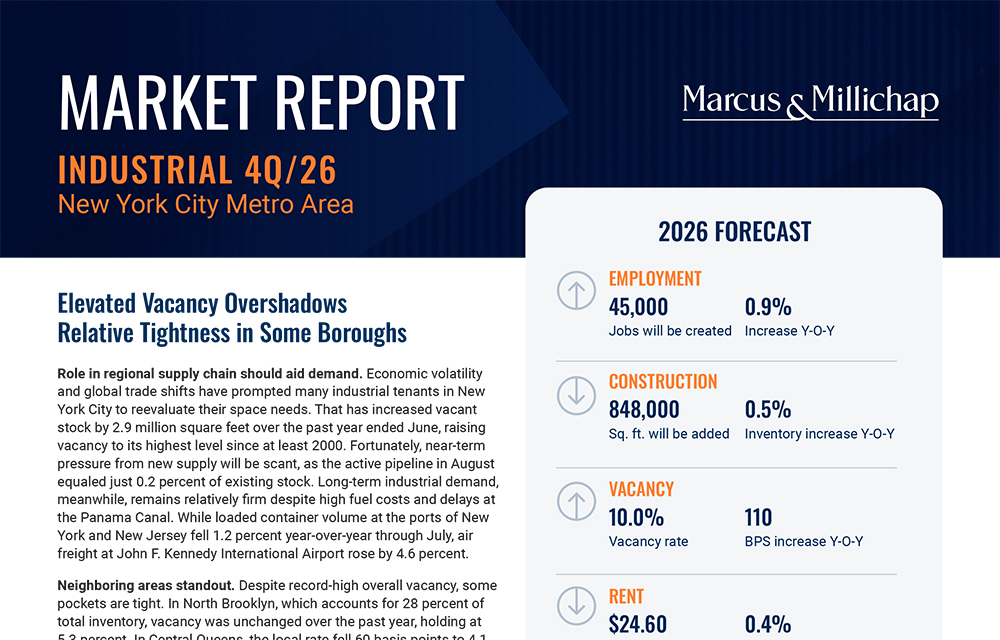
Marcus & Millichap releases fourth-quarter 2026 NYC industrial market report
Manhattan, NY Marcus & Millichap has published its fourth-quarter 2026 New York City Industrial Market Report. “New York City’s industrial market is showing a clear





Quick Hits
 (2).gif)

Columns and Thought Leadership

Hunt CRE question and answer: Choosing a real estate agent - by David Hunt
First, we will only work with one agent exclusively. The primary reason is that we want that agent to legally represent our client’s interests. In New York State, a real estate agent has a fiduciary

Hunt commercial real estate question and answer: Fortune 500 wisdom - by David Hunt
Yes, there are lessons to be learned from the largest companies in America when comes to managing your real estate. But the decision to buy or lease real estate may not be one of

New York’s streets are full again, and the retail numbers prove it - by Noam Aziz
Walk down any New York block this year and you can feel it. The sidewalks are crowded, the storefronts are lit, and the energy that defines this city is back at full volume.

The art of investing in real estate - by Thomas Donovan
Real estate investing is as much an art as it is a skill. No one can time the market, or the factors that drive it, perfectly. Location, zoning, size, transportation, and neighborhood density give you a baseline for
.gif)