



News:
Brokerage
Posted: March 23, 2015
Brooklyn continues to outshine its borough counterparts in commercial and residential dev.
It is no secret that in 2014 the sales market hit an all-time high, surpassing the previous market peak from seven years ago. With a recorded transaction dollar amount of over $15 billion spread across the active boroughs of Manhattan, Bronx, Queens and Brooklyn, New York experienced an incredibly prosperous year. It seems like it was only yesterday that pessimistic forecasters were decrying the onslaught of development slated for construction. They assumed that the supply hitting the market would outpace the demand, subsequently leading to a decrease in rent growth. However, the record-setting performance of 2014 proved the naysayers wrong. With the completion of over 15,000 units in Manhattan and Brooklyn, the demand tailwind was incredibly strong and the market quickly absorbed these units.
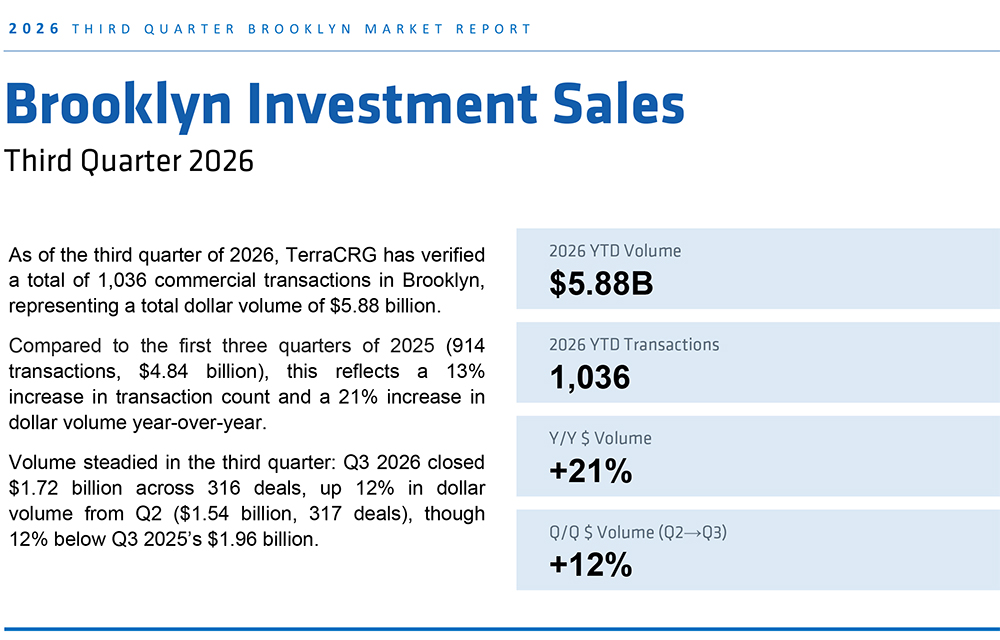
In the vanguard of this epic sales surge was Brooklyn, which alone produced a sales volume of over $6 billion, translating to an increase of over 65% in its sales from 2013. A mere year ago it seemed that rents were going to level off at 3% in Brooklyn, and investors assumed that net operating income growth would be at a minimum, when in fact it was the opposite, as Brooklyn saw rents rise a staggering 10%. There are several factors that influenced this increase. First, the unemployment rate in New York dropped to 5.8% in 2014, down 1.2% from 2013. As job growth continues to improve, there's always the added need for additional housing. Transplants flocked to the city to take advantage of the influx of employment, and people who were unable to afford housing before because of precarious or completely absent job opportunities are now reaping the benefits of income stability and putting down roots. Second, while the multifamily sector showed great gains, single family home ownership did not perform in kind. Millennials' often hefty student loans preclude them from meeting some of the credit standards to obtain a home mortgage; instead they seek rentals. Thus, the multifamily sector benefits as its occupancy rates are bolstered by this surge of young professionals in need of housing. Finally, offering more spacious apartments and a vibrant multicultural life - as well as cheaper rents - Brooklyn has become even more appealing to millennials.
The purchase of 1525 Bedford Ave. by Adam America reflects the continued demand for housing in the newly gentrified areas - a veritable haven for millennials seeking a trendy, stylish lifestyle. The development site on the corner of Eastern Pwy., two blocks east of Prospect Park in Crown Heights was purchased for $32.5 million, rounding the price to $196 per buildable s/f. Plans are to construct a 170-unit rental building totaling 165,000 s/f, which will include basement space, as well as ground-floor retail. Taking advantage of the zoning bonus that will bring the residential space to approximately 144,000 s/f, 20% of the project will be affordable housing, according to Adam America.
Another residential development is 953 Atlantic Ave. located in Clinton Hill. The former home of White Castle restaurant is slated to become an eight-story rental that will boast 67,000 s/f and house 98 apartments, averaging 700 s/f per unit. In the current red-hot market, all comers are looking to take advantage. The nonprofit organization Brooklyn Community Services decided to cash in on the borough's sizzling market as well, working out a deal with developers to convert their offices into a mixed-use property. Their 285 Schermerhorn St. property will be converted from a seven-story building into a 14-story tower that will include 100 residential units, as well as a 17,000 s/f office condo. The office condo component will be owned by Brooklyn Community Services, while the residential component will belong to Second Development Services.
The Gowanus section of Brooklyn still shows great gains as investors continue to look for new opportunity in the area. With a total sales volume of over $155 million in 2014 alone, investors are confidently hedging on the neighborhood's future growth. Developers are creatively designing attractive structures leading to an increase of average prices for development sites of over $225 per buildable s/f. With a joint venture project helmed by real estate stalwarts SL Green, LIVWRK and Kushner Companies in the works, Gowanus is on deck to undergo a dramatic transformation in the coming years. Their 175 Third St. project is a 140,000 s/f lot purchased for $80 million, tallying $266 per buildable s/f. The site will allow a mixed-use development of up to 300,000 s/f.
As we close out the first quarter of 2015, New York's five boroughs are still adjusting to the great gains that were achieved in 2014. As it has in the past few years, Brooklyn continues to outshine its borough counterparts as both residential and commercial developments reinvigorate its neighborhoods. Watchful onlookers should not be surprised as the entire city continues to surpass all expectations, and the skyline makes room for new steel.
Dennis Gelin is a sales associate at Azad Property Group, New York, N.Y.
Tags:
Brokerage
MORE FROM Brokerage

200E20TH sells out in Gramercy, penthouse A closes out sales at the CetraRuddy-designed condominium residences
Manhattan, NY 200E20TH, the CetraRuddy-designed architectural masterwork that brought a curved, contemporary sensibility to Gramercy’s Beaux-Arts streetscape, has



 (2).gif)

Columns and Thought Leadership

New York’s streets are full again, and the retail numbers prove it - by Noam Aziz
Walk down any New York block this year and you can feel it. The sidewalks are crowded, the storefronts are lit, and the energy that defines this city is back at full volume.

The art of investing in real estate - by Thomas Donovan
Real estate investing is as much an art as it is a skill. No one can time the market, or the factors that drive it, perfectly. Location, zoning, size, transportation, and neighborhood density give you a baseline for

Hunt commercial real estate question and answer: Fortune 500 wisdom - by David Hunt
Yes, there are lessons to be learned from the largest companies in America when comes to managing your real estate. But the decision to buy or lease real estate may not be one of

Hunt CRE question and answer: Choosing a real estate agent - by David Hunt
First, we will only work with one agent exclusively. The primary reason is that we want that agent to legally represent our client’s interests. In New York State, a real estate agent has a fiduciary
.gif)