


 (2).gif)
News:
Spotlight Content
Posted: June 21, 2016
AKRF’s greatest asset: Different disciplines working side by side to deliver successful outcomes for complex projects
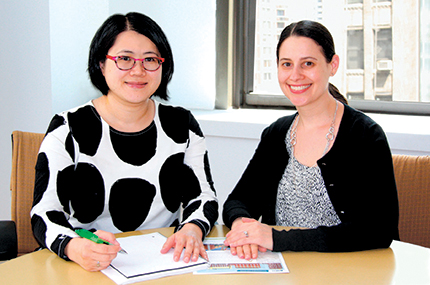 Lisa Lau, AICP, a senior vice president in AKRF’s planning group and Deborah Shapiro, QEP, a senior technical director in AKRF’s site assessment and remediation group collaborate
for another project.
New York, NY For their two decades worth of work with affordable housing projects in the city, the biggest reward for both AKRF planner Lisa Lau, AICP, and AKRF environmental scientist Deborah Shapiro, QEP, is seeing a neighborhood revitalized.
Affordable housing has been a major focus of the de Blasio administration, with programs that have included reforming codes and regulations to unlock development opportunities as well as creating affordable housing on underutilized public sites. An environmental, planning, and engineering firm with 35 years of experience in the cty, AKRF has played a major role in helping developers meet the administration’s goals, and Lau and Shapiro have helped lead the way for the firm’s efforts—from different directions.
Lau, a senior vice president in AKRF’s planning group, has led environmental assessments for some of the most ambitious projects in the city. She has specialized in environmental review under CEQR, SEQRA, or NEPA for affordable housing projects.
Shapiro, a senior technical director in AKRF’s site assessment and remediation group, has managed the investigation and remediation of sites throughout the New York metropolitan area. Shapiro often advances affordable housing projects on underutilized brownfield sites—land previously used for industrial purposes—through the requirements of state or city Brownfield Cleanup Programs, while helping developers discover these programs’ financial benefits.
In working with each other, Lau and Shapiro have exemplified AKRF’s greatest asset—environmental professionals from different disciplines working side by side to deliver successful outcomes for complex projects. For affordable housing projects in particular, AKRF draws from its deep resources of experts in geotechnical engineering, civil engineering, air quality, cultural resources, acoustics, and financial feasibility and market studies.
Lau and Shapiro, along their colleagues at AKRF, have collaborated extensively with developers and public agencies to move the development and preservation of these affordable housing projects forward. Teaming up for projects such as Lexington Gardens, 407-415 Lenox Ave., and 225 West 140th St., Lau, Shapiro, and the rest of the firm have been able to witness the transformation of neighborhoods in Harlem, South Bronx, and elsewhere.
Tags:
Spotlight Content
MORE FROM Spotlight Content
Participate in Developing New York Featuring Westchester County - November 24, 2026
Choose how you’d like to participate in this edition of NYREJ’s Developing New York series featuring Westchester County.



.png)

 (2).gif)

Columns and Thought Leadership

2026 Developing Queens: Long Island Board of Realtors advances commercial growth and advocacy in Queens
The Long Island Board of Realtors (LIBOR) Commercial Network continues to play a key role in advancing opportunities and strengthening the commercial real estate landscape across Queens. Through targeted programming and global outreach

2026 Developing Long Island: ERG Commercial Real Estate launches its new Retail Leasing division
North Hempstead, NY ERG Retail Leasing is the dedicated leasing division of ERG Commercial Real Estate, an established full-service commercial real estate brokerage for over 35 years.

From vacancy to vitality: How adaptive reuse is reshaping Long Island’s CRE landscape - by Andrea Tsoukalas Curto
Adaptive reuse has become one of the most important conversations in commercial real estate today. Long Island has a large inventory of aging retail, office and industrial

CRE Guide Featured Company: Merritt Environmental Consulting Corp.
Merritt Environmental Consulting Corp. (MECC) was established in June of 2009 after being part of a larger engineering firm for almost 20 years. The focus of the company is to assist lending institutions, attorneys, real estate investors, and property owners with environmental concerns. Today, MECC has offices in New York, Florida, and Vermont and has grown into a regional consulting firm serving clients along the East Coast.