


News:
Owners Developers & Managers
Posted: December 14, 2021
Aircuity: Life sciences clients reduce energy and carbon by optimizing ventilation
New York, NY Aircuity, a leader in creating healthy and sustainable buildings, released new data showing that its clients in the life sciences industry are achieving record-setting levels of energy savings and environmental quality in their critical laboratory spaces and across their portfolios. According to our analysis, more than 50 life sciences organizations are using Aircuity’s platform to save 158,353,872 pounds of carbon dioxide (CO2) annually, while simultaneously saving more than one billion (1B) in MBTUs. This does not include the vast success in higher education, healthcare and medical research that is reported separately.
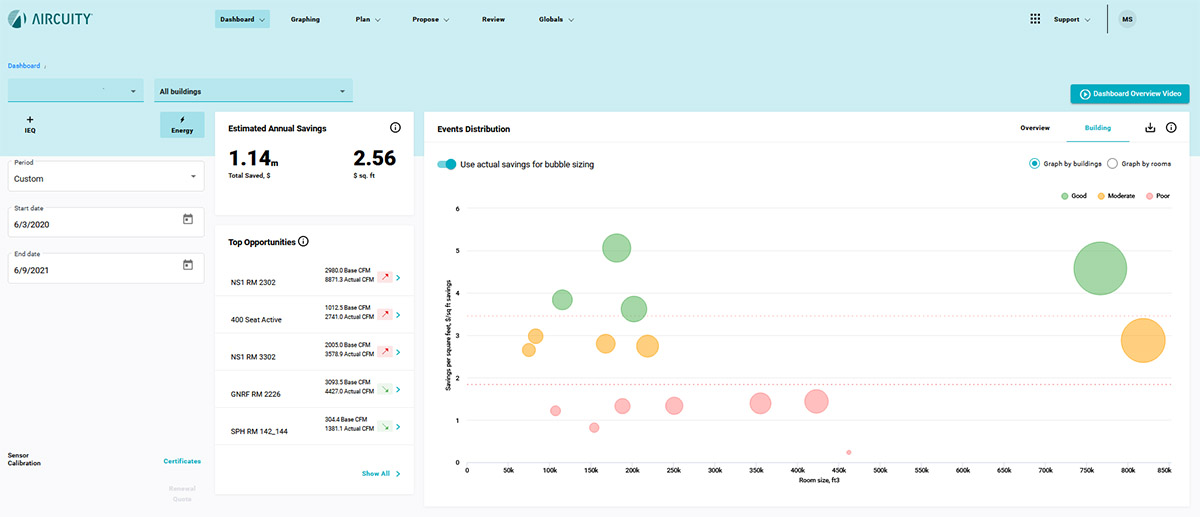
“The global life sciences industry has grown rapidly over the past decade, with its dramatic upward trajectory only strengthened by COVID-19 and the critically important drive to Net Zero,” said Dan Diehl, CEO of Aircuity. “Aircuity’s platform delivers deep energy savings and better indoor air quality while reducing operating expenses and creating safer labs.”
Heating/ventilation/air conditioning (HVAC) systems typically represent 30% of total energy use in commercial buildings, whereas in laboratories–like the ones inherent in most life sciences companies–this rate increases to 60-70%. As many cutting-edge life sciences companies are now further focusing on decarbonizing and deep energy efficiency as part of a larger corporate ESG commitments, turning to lab efficiency is often the biggest opportunity to reach these aggressive but critical important targets.
As the leader in demand control ventilation, Aircuity has more than 20 years of experience with the top-tier companies in life sciences worldwide, including Eli Lilly, Illumina and Takeda. Aircuity’s platform addresses both their demand for deep energy and carbon savings with improved working and research environments – safer, healthier and more productive.
“Life science companies now realize that labs are typically the most carbon intensive areas in their portfolios and are focusing on leveraging proven concepts for a future of Net Zero Labs,” Diehl said. “Implementing Aircuity reduces HVAC energy use by 40-60% and helps to significantly decrease clean energy and HVAC supply systems providing a first cost diversity savings which can provide an infinite ROI. Other co benefits include reduced deferred maintenance, improved sequence modifications and better life cycle costs; all while creating healthier IAQ for occupants.”
According to a report from BIO, the biotech industry’s green initiatives could mitigate the equivalent of 3 billion tons of carbon dioxide every year by 2030, or about half of the country’s annual CO2 emissions. Improving indoor air quality in offices could add as much as $20 billion annually to the U.S. economy, according to estimates from the Lawrence Berkeley National Laboratory.
MORE FROM Owners Developers & Managers

JVP Development names new sales team at 250 West 96th St.
Manhattan, NY JVP Development has appointed Team Arceon, led by Corcoran Top 25 broker Kristen Suh, as the exclusive sales and marketing team for 250 West 96th St., the 131-residence luxury condominium on the Upper West Side designed by renowned Danish designer Thomas Juul-Hansen. The official announcement comes on the heels of 250 West 96th St.




Quick Hits
 (2).gif)

Columns and Thought Leadership

Don’t leave severance damages behind - by Sebastian Jablonski
When the government takes a portion of a landowner’s property, most assume just compensation stops at the value of the land taken. However, in partial takings, that is only half of the equation.

New York City’s historic rent freeze now rests with the courts - by Ron Cohen
New York City’s first-ever two-year rent freeze is now in the hands of a state Supreme Court judge, and the decision could reset income for owners of roughly one million rent-stabilized apartments housing some 2.4 million residents.
NYC's Community Opportunity to Purchase Act is back - and multifamily owners should pay attention - by Ron Cohen
New York City’s Community Opportunity to Purchase Act (COPA) is back, and this latest version could have a much better chance of becoming law. The proposal would give qualified nonprofit organizations

Hunt Commercial Real Estate Q&A: Location, location, location? - by David Hunt
In working with our clients, we break down our search objectives into two categories. The first category involves the specific needs of your business such as warehouse height, amount of office space and number of loading