



News:
Brokerage
Posted: February 18, 2011
Developers are working to meet the strong demands for downtown Albany living
Albany's downtown apartment market is starting to sizzle. Over fifty new residential units have been added in the last few years. And according to the building owners, all of those units are fully rented and there is strong demand for more.
In addition to those fifty units, the number of projects in the pipeline is growing. Recent announcements of new projects include a 15 unit conversion of a formerly vacant nightclub at 4-6 Sheridan Avenue, as well as a 24 unit luxury condominium project in an abandoned car dealership building at 17 Chapel Street.
All of these announcements take on a greater significance when you consider that just five years ago there were no apartments or condos available in Albany's downtown business district. With nearly 40,000 people working in downtown Albany, that figure did not go unnoticed by local officials.
In 2006, the Albany Downtown Business Improvement District partnered with the Capitalize Albany Corporation to hire Zimmerman Volk Associates, Inc., a nationally recognized research firm, to conduct a residential survey to gauge the interest for downtown living.
The results of that first survey confirmed what many already believed: there was a strong demand for apartments and condominiums in downtown Albany. And the demand has grown steadily since that first survey.
The most recent update to the Zimmerman Volk Associates survey in 2011 showed that Albany could support 134 new units over the next three years and then 287 more units in years four through seven. This news and the success of recent projects have developers buzzing.
All of these projects have been helped along by forward-thinking policies like the 485-a program. Administered by the City of Albany, it is a tax abatement program which applies to structures in the City that are converted from commercial to mixed-use. The tax assessment of the existing building (pre-development) is held in place for the first eight years following conversion, and beginning in year nine, 25 percent of the increase phases in each year until full assessment in the 13th year.
In addition to the tax abatement program, economic development agencies have created loan programs to help these projects along. Last summer the Capitalize Albany Corporation unveiled a $2 million loan program intended to provide the tools necessary to target high impact, large-scale transformational projects in Albany. It offers below market, fixed rate loans up to 40 percent of a total project cost. The loans may be used for construction, fixed asset financing as well as rehab costs related to tenant "fit ups" for new business locations or residential conversion projects. The program is aimed at projects that invest in underutilized or vacant properties and create economic opportunities in the City of Albany.
The results of the survey proved that there is a strong demand for downtown living options in Albany, and developers are working to meet the demand with the help of tax incentives and lending options. 2011 promises to be a strong year for residential development in downtown Albany.
Joshua Poupore is communications officer for Capitalize Albany Corp., Albany, N.Y.
Tags:
Brokerage
MORE FROM Brokerage
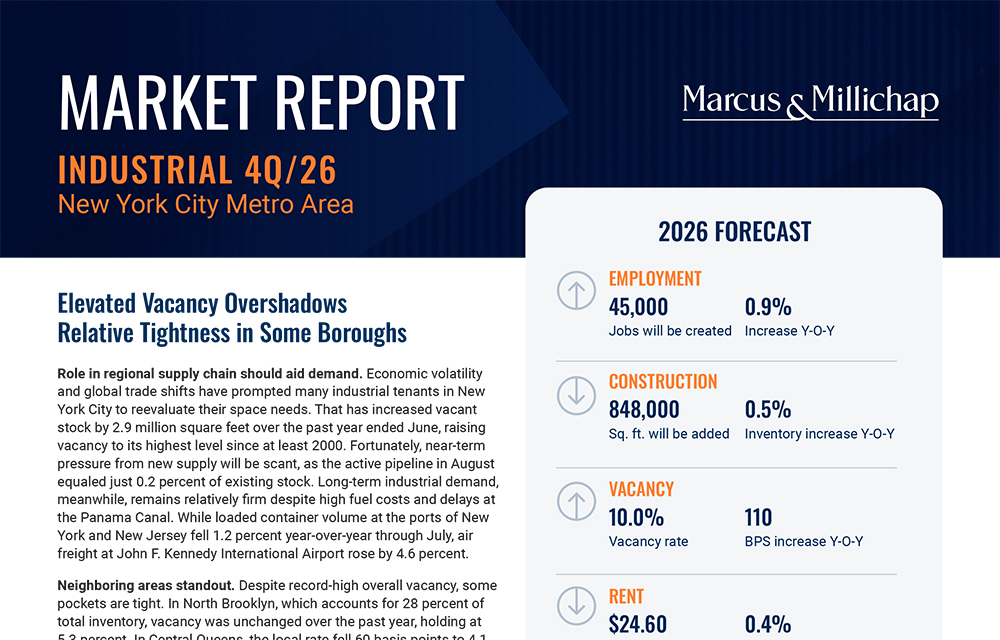
Marcus & Millichap releases fourth-quarter 2026 NYC industrial market report
Manhattan, NY Marcus & Millichap has published its fourth-quarter 2026 New York City Industrial Market Report. “New York City’s industrial market is showing a clear



Quick Hits
 (2).gif)

Columns and Thought Leadership

The art of investing in real estate - by Thomas Donovan
Real estate investing is as much an art as it is a skill. No one can time the market, or the factors that drive it, perfectly. Location, zoning, size, transportation, and neighborhood density give you a baseline for

Hunt commercial real estate question and answer: Fortune 500 wisdom - by David Hunt
Yes, there are lessons to be learned from the largest companies in America when comes to managing your real estate. But the decision to buy or lease real estate may not be one of

Hunt CRE question and answer: Choosing a real estate agent - by David Hunt
First, we will only work with one agent exclusively. The primary reason is that we want that agent to legally represent our client’s interests. In New York State, a real estate agent has a fiduciary

New York’s streets are full again, and the retail numbers prove it - by Noam Aziz
Walk down any New York block this year and you can feel it. The sidewalks are crowded, the storefronts are lit, and the energy that defines this city is back at full volume.
.gif)