



News:
Brokerage
Posted: October 16, 2012
WNC & Associates participates in mfg. plant financing-$71 million
WNC & Associates, Inc. (WNC) has collaborated with three other community development entities to provide The Westervelt Co. $55.5 million in New Markets Tax Credit (NMTC) financing for the $71 million construction of an alternative energy wood pellet manufacturing facility.
WNC provided $6 million of the $55.5 million in NMTC allocations in its collaboration with Wells Fargo Bank, N.A., Rural Development Partners and Coastal Enterprises. WNC has also entered into a community benefits agreement, whereby The Westervelt Co. will contribute $110,000 to be reinvested into the community for much needed services, such as employment training programs and programs.
"The local area's poverty rate is approximately 27%, while according to the U.S. Bureau of Labor Statistics its unemployment rate has grown to 11.8%, significantly greater than the national average of 8.1%," said Will Cooper Jr., president, CEO and director of WNC.
"This facility will bring much needed economic stimulus to the area, creating approximately 800 temporary construction jobs and nearly 275 permanent jobs either directly or indirectly tied to the wood pellet manufacturing facility," said Cooper.
The Westervelt Company, founded in 1884 by Herbert Westervelt, is a privately held natural resources firm that owns and manages more than 500,000 acres of timberland and employs in excess of 525 people. The company will use the facility, located at 6777 Highway 17, to manufacture wood pellets used as alternative energy resources worldwide. The facility is expected to generate more than $37 million in annual revenue from the sale of the wood pellets. The local community will benefit through local taxes that can be utilized for other worthy city projects to help employ the local citizens.
Westervelt will purchase wood for its new facility from the local Southern Yellow Pine timber market, covering a 50-mile radius. The manufacturing of wood pellets is expected to significantly increase demand for timber and trucking companies in Pickens County, as well as utilize local barging operations for transportation of goods.
The wood pellets created at the facility are considered a renewable source of energy with a nearly neutral carbon balance, substantially reducing the carbon dioxide emissions when compared to open burning, landfill disposal and others. Additionally, due to the pellets' low moisture content when compared to coal, the alternative energy source aids its consumers in reducing their carbon footprint by offering better and more uniform heating properties per unit volume.
The financing completes a capital campaign that began in 2011 and included support from a number of local corporations and foundations.
Already underway, construction of the manufacturing facility is projected to be completed summer of 2013. The Westervelt Company has worked on development plans for the manufacturing facility for the last five years and required additional capital to complete the project.
Absent the NMTCs, the project and resulting economic stimulus would not have been possible.
The New Markets Tax Credit program is a federal effort created as part of the Community Renewal Tax Act of 2000 to stimulate economic and community development in America's low-income communities.
Tags:
Brokerage
MORE FROM Brokerage
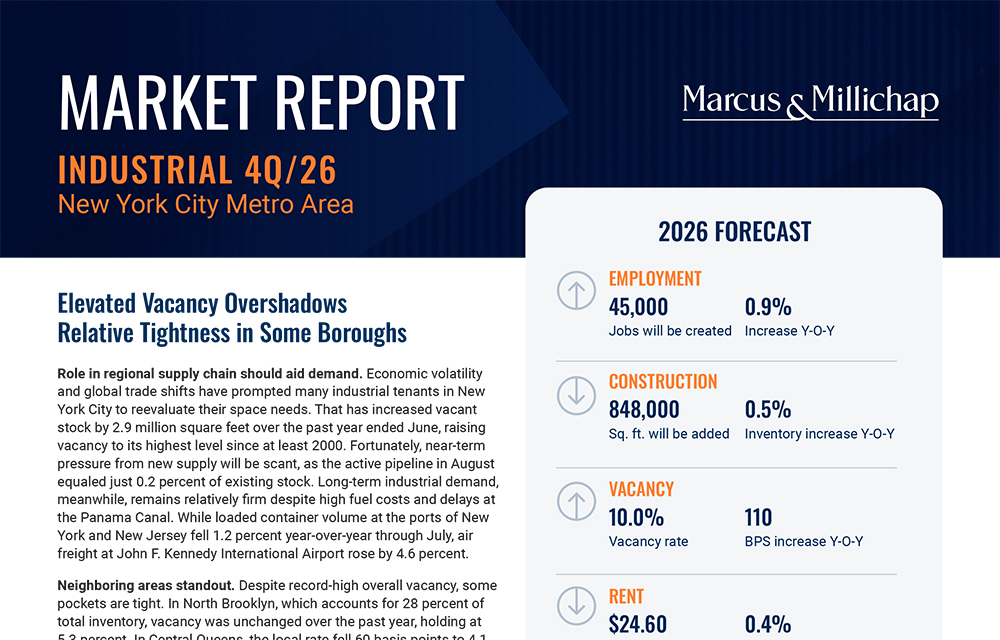
Marcus & Millichap releases fourth-quarter 2026 NYC industrial market report
Manhattan, NY Marcus & Millichap has published its fourth-quarter 2026 New York City Industrial Market Report. “New York City’s industrial market is showing a clear





 (2).gif)

Columns and Thought Leadership

Hunt CRE question and answer: Choosing a real estate agent - by David Hunt
First, we will only work with one agent exclusively. The primary reason is that we want that agent to legally represent our client’s interests. In New York State, a real estate agent has a fiduciary

Hunt commercial real estate question and answer: Fortune 500 wisdom - by David Hunt
Yes, there are lessons to be learned from the largest companies in America when comes to managing your real estate. But the decision to buy or lease real estate may not be one of

New York’s streets are full again, and the retail numbers prove it - by Noam Aziz
Walk down any New York block this year and you can feel it. The sidewalks are crowded, the storefronts are lit, and the energy that defines this city is back at full volume.

The art of investing in real estate - by Thomas Donovan
Real estate investing is as much an art as it is a skill. No one can time the market, or the factors that drive it, perfectly. Location, zoning, size, transportation, and neighborhood density give you a baseline for
.gif)