



News:
Brokerage
Posted: March 15, 2016
Why discuss joint venture partnerships in today’s housing market? - by Osei Rubie
 Osei Rubie, National Standard Abstract
I am inspired to write about joint venture partnerships as I witness the shifting landscape in affordable, supportive and market-rate housing. Leveraging my 10 years of industry expertise, I founded National Standard Abstract, a full service title insurance firm, in March 2015. In the first year of operation, we have closed $124 million in real estate transactions, primarily commercial and affordable deals in the five boroughs of New York City and in Nassau County. With another $345 million in the pipeline in 2016, joint venture partnerships continue to play a crucial role as a tool for sustaining successful development and preservation of affordable housing.
What role does a joint venture partnership play in housing development?
Joint venture partnerships continue to evolve, thereby expanding the landscape of affordable, supportive, and market rate housing. While the joint venture model has long been an option for housing developers, we’ve seen it used more widely in recent history. A joint venture partnership is established when two or more entities – typically a combination of nonprofit and for-profit housing developers – collaborate to pool resources and gain greater access to funding. How has this trend grown? A study by the Supportive Housing Network of New York attributes the change to shortages in city-owned land and changes to housing finance and social service agency term sheets that permit for profit entity involvement1. What is particularly interesting about the use of these partnerships is that as each player’s needs, objectives, and resources vary, the partnership structures will vary from one deal to another to meet those needs and objectives adequately and to protect the parties involved. The resulting partnerships have undertaken strong projects all throughout New York to meet the need for affordable housing and positively impact local communities. A joint venture agreement that assigns rights and responsibilities appropriately from the outset is key.
Perspectives of Current Players: Successful Joint Venture Partnerships in Action
L+M Development Partners Inc, a for-profit developer, says of its joint venture partnerships: “Partnerships are vital to the world of affordable housing and they allow us to better serve the communities in which we work. They are also a prime example of the whole being greater than the sum of its parts.” Essex Crossing, a Manhattan Development project, involves three for-profits: L+M Development, BFC Partners, and Taconic Investment Partners, collectively known as the Delancey Street Associates Partnership. It demonstrates the size and scope of some joint venture partnerships and economic benefits to the local community. It will include a new Essex Street Market, contractor opportunities for minority and women owned businesses, and 500 affordable rental units.
The South Bronx Overall Economic Development Corporation (SoBRO), a Bronx based nonprofit developer, holds supportive housing projects among various types in its portfolio. One such project is the Jasmine Court Apartments. Developed with for-profit partners and a social service provider, Jasmine Court is a five story development with 115 units of supportive housing for formerly homeless individuals. In addition to the immediate community benefit of housing for the formerly homeless, such projects create employment for members of the local community, as city/state housing agencies often stipulate. Nathaniel Montgomery, SoBRO’s senior vice president of Real Estate Development, highlights the impact of participation of diverse partners: “Each development project is different for a variety of reasons. Therefore, the benefits realized by the parties involved in the JV partnership are often predicated on the perceived value of the parties involved.” He also points out the importance of the joint venture agreement and the role of legal counsel in structuring the partnership, “The underpinning to a successful JV partnership is an experienced attorney…A well written JV agreement can reduce, and in some cases eliminate, any confusion as it pertains to the roles and obligations of each party to the agreement. I am of the opinion that behind every successful JV partnership there is an experienced attorney.”
Kenneth Morrison, principal of Lemor Development Group, a for-profit developer based in Harlem, offers an example of where a joint venture partnership preserves affordable housing. At the 15-year mark, developers reposition their housing portfolio. He explained that a nonprofit without a strong balance sheet and operating capital would benefit from a partnership with a for-profit entity with the capital and balance sheet required. Such a partnership represents a new investment opportunity for the for-profit developer and a new asset. The vetting process includes individual members of each entity, and can present challenges. Further, Mr. Morrison states that the exit strategy must be clearly outlined, regardless of the outcome, at the outset to make the partnership successful.
As the topic generates growing discussion industry-wide, National Standard Abstract and SoBro partner to bring a thought-provoking panel discussion among industry leaders. Join us April 7th at the Bronx Museum for “Joint Venture Partnerships in Affordable, Supportive and Market Rate Housing.”
Footnote:
1. Baldwin, S. (2015). Joint Venture Partnerships for Supportive Housing. Supportive Housing Network of New York. http://shnny.org/reports/joint-venture-partnerships-for-supportive-housing-development
Osei Rubie is the founder & president of National Standard Abstract LLC, Floral Park, N.Y.
Tags:
Brokerage
MORE FROM Brokerage
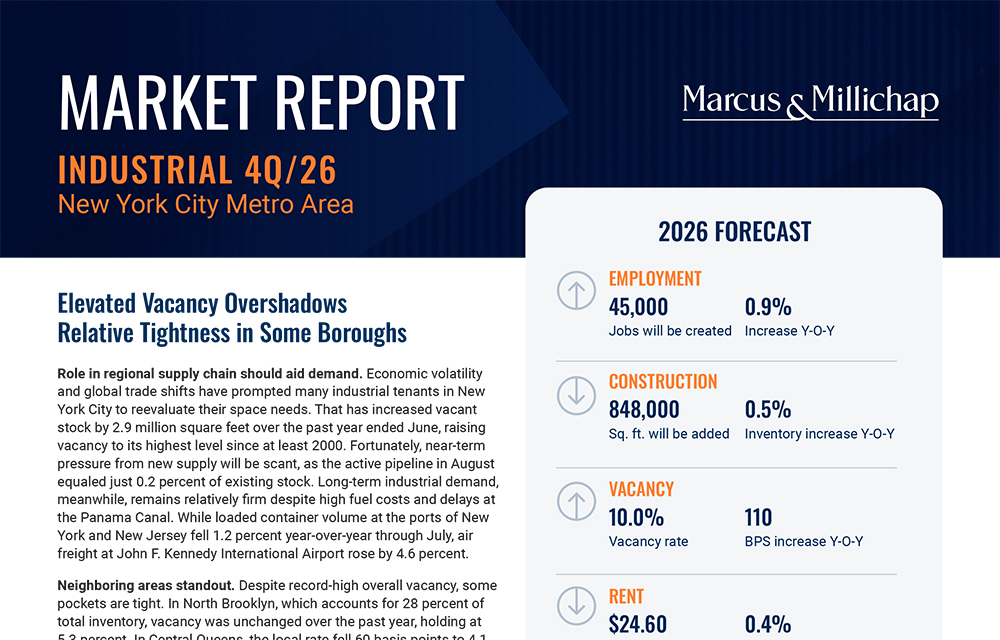
Marcus & Millichap releases fourth-quarter 2026 NYC industrial market report
Manhattan, NY Marcus & Millichap has published its fourth-quarter 2026 New York City Industrial Market Report. “New York City’s industrial market is showing a clear







Columns and Thought Leadership

New York’s streets are full again, and the retail numbers prove it - by Noam Aziz
Walk down any New York block this year and you can feel it. The sidewalks are crowded, the storefronts are lit, and the energy that defines this city is back at full volume.

The art of investing in real estate - by Thomas Donovan
Real estate investing is as much an art as it is a skill. No one can time the market, or the factors that drive it, perfectly. Location, zoning, size, transportation, and neighborhood density give you a baseline for

Hunt CRE question and answer: Choosing a real estate agent - by David Hunt
First, we will only work with one agent exclusively. The primary reason is that we want that agent to legally represent our client’s interests. In New York State, a real estate agent has a fiduciary

Hunt commercial real estate question and answer: Fortune 500 wisdom - by David Hunt
Yes, there are lessons to be learned from the largest companies in America when comes to managing your real estate. But the decision to buy or lease real estate may not be one of
.gif)