



News:
Brokerage
Posted: July 5, 2016
Westchester IDA’s Astorino meets with Jones Lang LaSalle brokers: Westchester is the "smart spot for business"
 Shown (from left) are: William Mooney III, director of Westchester County Office of Economic Development; Chris O’Callaghan, managing director, Jones Lang LaSalle; Westchester County executive Robert Astorino; Dan Santagata, vice president, Jones Lang LaSalle; Frank Bistrian, WeWork; Reid Longley, vice president, Jones Lang LaSalle; and Kurtis Gibbs, associate vice president, Jones Lang LaSalle.
Manhattan, NY Continuing it’s ongoing initiative to promote Westchester County as the “smart spot for business,” Westchester County executive Rob Astorino recently met with a group of nearly 30 commercial real estate brokers from Jones Lang LaSalle (JLL) at their New York City offices to discuss the many benefits that Westchester County offers to businesses.
Noting Westchester’s key strengths –talent, accessibility and quality of life–Astorino told the assembled group that they should be aware of these strengths when working with and for their client base when making decisions on where to locate or relocate their businesses.
Astorino said Westchester has the talented and skilled workforce employers are looking for, as well as the balanced lifestyle employees are looking for. Combined with commercial real-estate space that is twice the space at half the cost, Westchester is a great option for brokers who have clients threatening to leave New York City or New York State.
“We’re proud of the fact that Westchester is the most highly-educated county in America,” said Astorino at the meeting held June 9. “Between our skilled workforce, amazing quality of life and affordable office space, Westchester is the smart choice for business in the 21st Century.”
Joined by his economic development team, headed by Director of Economic Development, Bill Mooney, Astorino noted ways the county could assist businesses in staying or relocating to Westchester, including available financial incentives available through the county’s Industrial Development Agency (IDA).
Astorino also discussed the many “hot” and active sectors in Westchester including the dramatic expansion and investment in the biotech and healthcare sectors. He also noted the increased movement and investment in multi-use, mixed use, transit-oriented developments taking place in the counties, cities, towns and villages designed to attract those millennials being priced-out of Manhattan and Brooklyn.
The County Executive said that significant investments in these sectors by nationally known real estate development companies such as Lennar, RXR and LCOR was a sign of confidence in Westchester’s economy and clearly show the market is responding to Westchester’s strengths. He also urged the brokers to reach out to the county’s Office of Economic Development New York City office at 125 Park Ave.
The IDA is a public benefit corporation created in 1976 for promoting and encouraging economic development in the county, primarily through assisting in the creation and retention of jobs. The IDA is also empowered to issue taxable and tax-exempt bonds for organizations meeting federal and state guidelines. There is no financial risk to the county or to county taxpayers. The obligation for repaying the debt rests solely with the organizations. Created in 2013 under the state’s Not-For-Profit Corporation Law, the LDC provides non-profits access to low-cost, tax-exempt bonds for the financing of job-creating construction projects.
Tags:
Brokerage
MORE FROM Brokerage
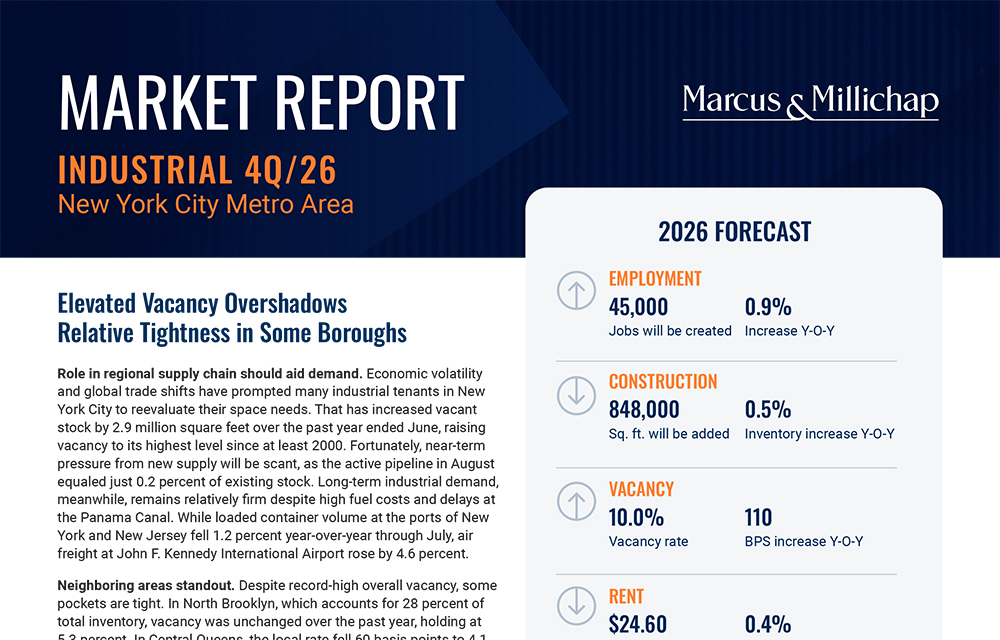
Marcus & Millichap releases fourth-quarter 2026 NYC industrial market report
Manhattan, NY Marcus & Millichap has published its fourth-quarter 2026 New York City Industrial Market Report. “New York City’s industrial market is showing a clear






Columns and Thought Leadership

Hunt commercial real estate question and answer: Fortune 500 wisdom - by David Hunt
Yes, there are lessons to be learned from the largest companies in America when comes to managing your real estate. But the decision to buy or lease real estate may not be one of

The art of investing in real estate - by Thomas Donovan
Real estate investing is as much an art as it is a skill. No one can time the market, or the factors that drive it, perfectly. Location, zoning, size, transportation, and neighborhood density give you a baseline for

Hunt CRE question and answer: Choosing a real estate agent - by David Hunt
First, we will only work with one agent exclusively. The primary reason is that we want that agent to legally represent our client’s interests. In New York State, a real estate agent has a fiduciary

New York’s streets are full again, and the retail numbers prove it - by Noam Aziz
Walk down any New York block this year and you can feel it. The sidewalks are crowded, the storefronts are lit, and the energy that defines this city is back at full volume.
.gif)