

News: Brokerage

Westchester IDA approves resolution of intent for financial incentives for White Plains development


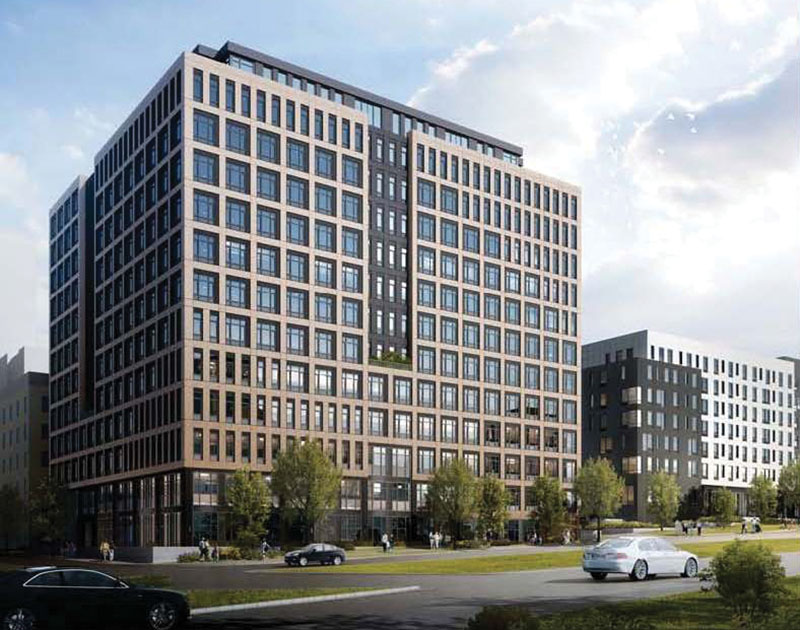
White Plains, NY The Westchester County Industrial Development Agency (IDA) approved on September 27 a resolution of intent to provide financial incentives for a $203 million mixed-use residential development located at 440 Hamilton Ave. 

The development involves the adaptive reuse of a 12-story office building formerly occupied by AT&T to allow for construction of 255 apartment units and 2,420 s/f of commercial retail space for a green grocer. The plan also calls for developing an adjacent surface parking lot on Barker Ave. with a tiered six- and seven-story apartment building with 213 units together with parking for the project’s residents and associated retail space. 6% of the units will be affordable at 60% of Westchester County Area Median Income (AMI). 

Estimated IDA benefits include $3.335 million in sales tax exemption and $1.685 million in mortgage recording tax exemption for a total tax abatement of $5.021 million. The development is expected to create 659 construction jobs and 31 permanent jobs over a period of 24-28 months. The developer is Rose Associates of New York City. 

440 Hamilton Ave. will incorporate green building technologies including LED lighting throughout, electric car charging stations, bicycle storage room, green cleaning practices, low-flow kitchen and bathroom features, Energy Star rated appliances and a building envelope that exceeds NYS Energy Code.  

“This project is an excellent example of the type of innovative adaptive reuse development that the IDA is interested in providing financial incentives. The IDA is focused on making the county more appealing to new young talent. Updating commercial properties such as 440 Hamilton Ave. with new housing that is easily accessible to Metro-North train service is an important part of that focus,” said Bridget Gibbons, deputy director of the Westchester County Office of Economic Development.  
MORE FROM Brokerage

NYSCAR June 2026 president’s message - by Mercedes Brien

As I write this letter, we are preparing to be at the Annual Conference being held at the Rivers Casino, Schenectady, New York. I look forward to reporting on the conference in my next letter. We have some great courses coming up via Zoom. Please be sure to keep watch on upcoming courses by visiting nyscar.org/resources and tools/professional development.
READ ON THE GO
DIGITAL EDITIONS
Subscribe
Columns and Thought Leadership
The anticipated effect of Basel III and ISO 20022 implementation on commercial real estate - by Michael Zysman

The anticipated effect of Basel III and ISO 20022 implementation on commercial real estate - by Michael Zysman

July 1, 2025 is the deadline for US banks to begin to adopt Basel III banking standards and July 14, 2025 is the deadline for U.S. banks to adopt ISO 20022 messaging standards. Both will have a significant effect on the banking and commercial real estate (CRE) finance sectors.
The death of the generic offering memorandum: What buyers expect in 2025 - by Kimberly Zar Bloorian

The death of the generic offering memorandum: What buyers expect in 2025 - by Kimberly Zar Bloorian

There was a time when an offering memorandum (OM) was pretty bare bones, some photos, a few bullet points on income, and a rent roll thrown in at the back. That used to get the job done. Not anymore. In 2025, buyers are sharper, faster, and more selective. They’re looking
A fresh start - by Shallini Mehra and Amit Doshi

A fresh start - by Shallini Mehra and Amit Doshi

For the past several years, the New York City multifamily housing market has been defined by disruption. The combined impact of the HSTPA rent laws and a sharply higher interest rate environment has fundamentally reduced
Tri-state capital  migrates nationally amid  regulation pressure - by Reese Weaver

Tri-state capital migrates nationally amid regulation pressure - by Reese Weaver

New York tri-state multifamily investors are increasingly reallocating capital to less-regulated markets across the U.S. as rent control and legislative risk erode returns at home. With over 60% of New York City’s rental housing stock classified as rent-stabilized, the traditional value-add model — buying under-performing buildings,